A combination of political change, economic insecurity, hostility towards foreigners and the growing refugee crisis in Europe, particularly from the Spanish Civil War resulted in the return of Édouard Daladier to lead a new French government on 10 April 1938.
A major measure of the government was the passing of a decree-law of 2 May 1938 on the policing of foreigners, designed to tighten the regulation, surveillance and expulsion of foreign nationals. This was followed by a decree of 14 May 1938 which set out the conditions governing foreigner’s entry and residence, particularly their identity cards and residence status.
Under the new laws Gurdjieff was officially expelled from France by an order dated 15 July 1938, the details of which are to be found in his 1938-1940 National Security File.
GURDJIEFF GEORGES 28.12.1877 ALEXANDROPOL, Intérieur. Fichier central de la Surete nationale: dossiers individuels de GOV à GZ (fin XIXe siècle-1940) (1938-1940) Reference Code 19940448/493, Archives Nationales (French National Archives, Paris)
This file ceased in 1940 when, after the occupation of Paris the Germans took the over 600,000 National Security Surveillance files (including Gurdjieff’s) back to Germany. In 1945 the files were discovered by the Red Army, sent to Moscow and stored in a secret facility known as the Osobyi (Special) Archive. Their existence was completely unknown to the West until the 1990’s. Following the fall of the USSR, lengthy negotiations and the payment by the French government of half a million dollars in “storage charges, microfilming fees, and administrative costs” led to the gradual return of these and other government files (Fonds de Moscou) in the 1990’s and 2003.
Gurdjieff had been issued a French identity card on 16 June 1938 that was valid until his expulsion.
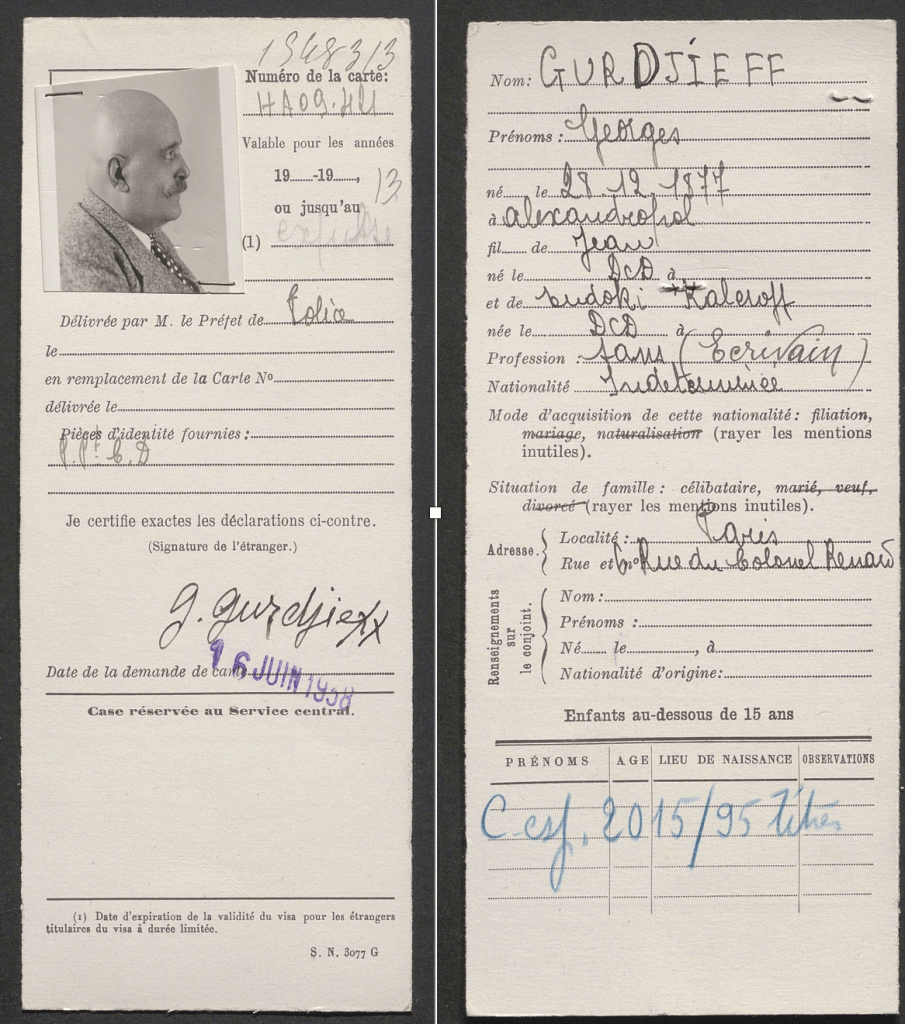
As he had no recognised nationality or valid passport and no state was prepared to accept him, France could not readily put the order into effect, because there was nowhere to send him. In these cases, the law introduced “assignation of residence” as a substitute for expulsion. He was required to reside only at 6 rue du Colonel Renard, Paris and report to the police regularly. He was also subject to continuing three-monthly, later increased to six-monthly deferments of the expulsion order, up until it was officially withdrawn in October 1946. Failure to comply with any of these conditions would have resulted in imprisonment.
On 14 February 1940, a letter and a two-page report on Gurdjieff, was sent by the Prefect of Police, Paris to the Minister of the Interior, which detailed Gurdjieff’s situation and the reason for his expulsion.
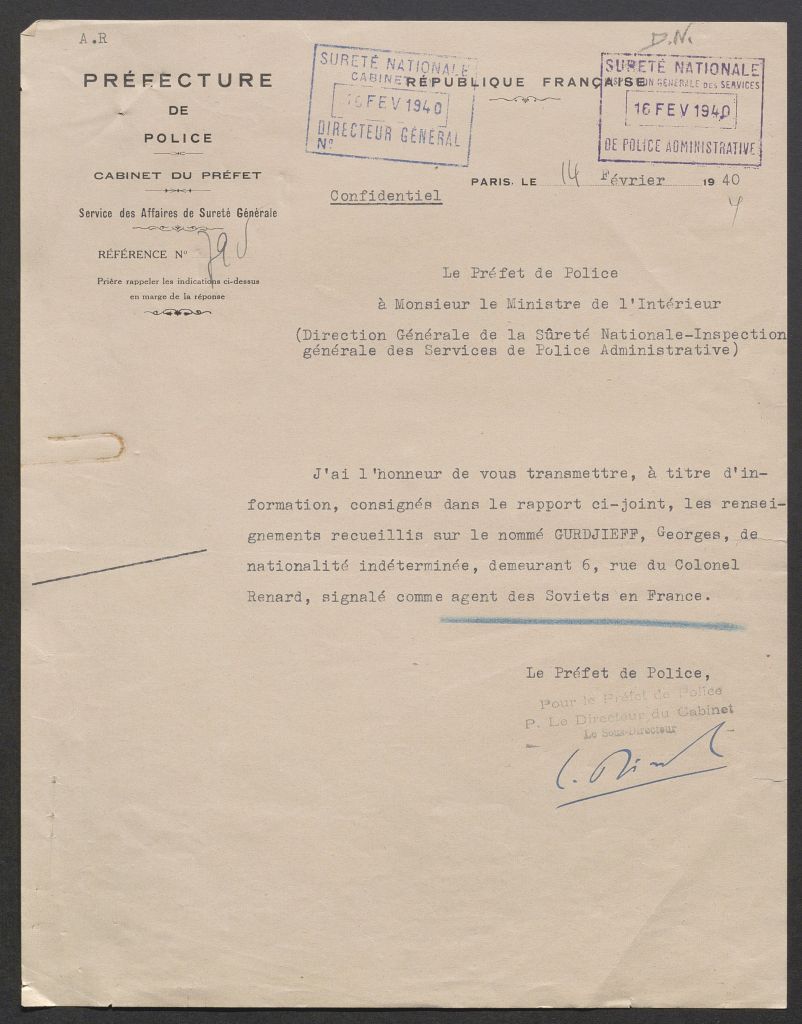
(English Translation)
PARIS, 14 February 1940
General Security Affairs Department
The Prefect of Police to the Minister of the Interior (General Directorate of National Security – General Inspectorate of Administrative Police Services)
I have the honour to forward to you, for your information, the details recorded in the attached report concerning GURDJIEFF Georges, of undetermined nationality, residing at 6, rue du Colonel Renard, reported as a Soviet agent in France.
The Prefect of Police
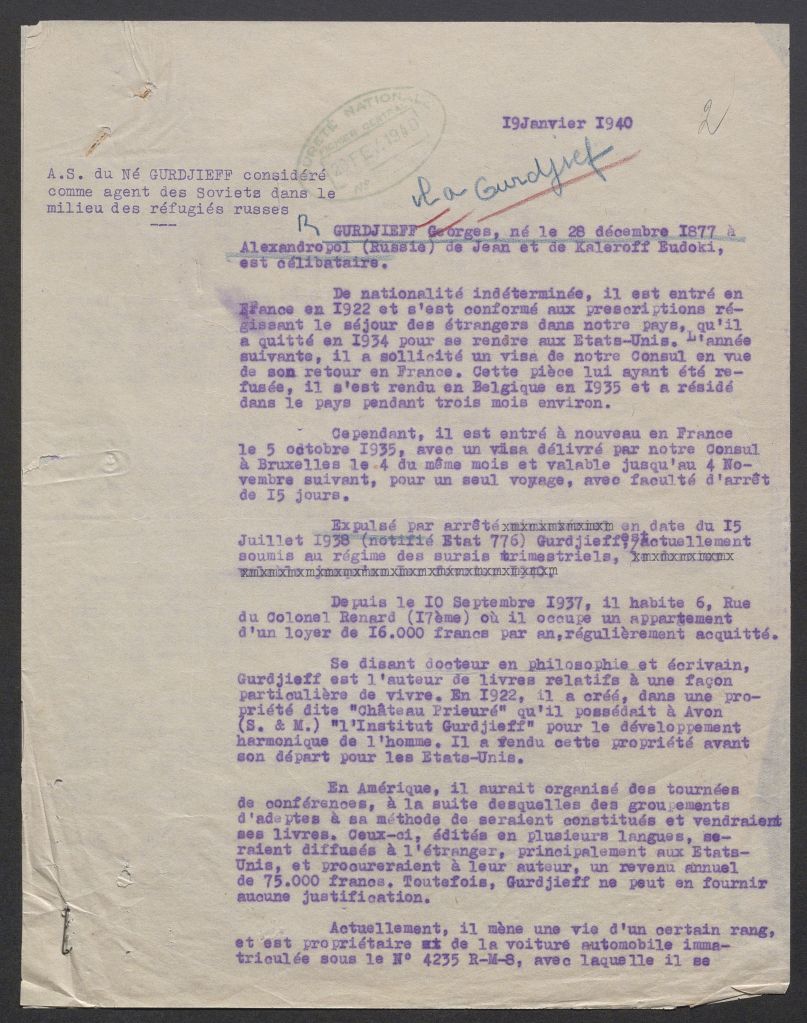
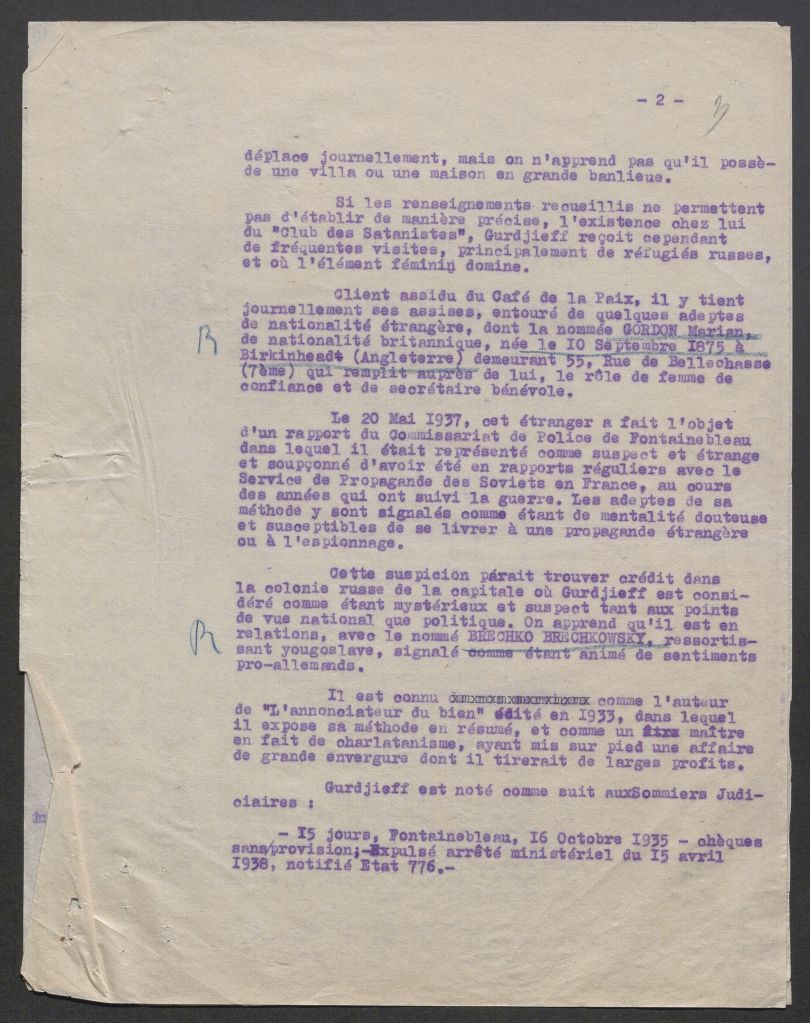
(English Translation)
January 19, 1940
Regarding GURDJIEFF considered an agent of the Soviets among russian refugees
GURDJIEFF Georges, born December 28, 1877, in Alexandropol (Russia) to Jean and Eudoki Kaleroff, is single.
Of undetermined nationality, he entered France in 1922 and complied with the regulations governing the stay of foreigners in our country, which he left in 1934 to go to the United States. The following year, he applied for a visa from our Consul for a return to France. This document having been refused, he went to Belgium in 1935 and resided in the country for approximately three months.
However, he re-entered France on October 5, 1935, with a visa issued by our Consul in Brussels on the 4th of the same month and valid until the following November 4, for a single trip, with the possibility of a 15-day stopover.
Expelled by order dated July 15, 1938 (notified State 776). Gurdjieff is currently subject to the quarterly deferment system.
Since September 10, 1937, he has been living at 6, Rue du Colonel Renard (17th arrondissement) where he occupies an apartment with a rent of 16,000 francs per year, which is regularly paid.
Claiming to be a doctor of philosophy and a writer, Gurdjieff is the author of books relating to a particular way of life. In 1922, he created the “Gurdjieff Institute” for the harmonious development of man on a property he owned called “Château Prieuré” in Avon (Seine-et-Marne). He relinquished this property before leaving for the United States.
In America, he allegedly organized lecture tours, following which groups of followers of his method formed and sold his books. These books, published in several languages, were supposedly distributed abroad, mainly in the United States, and provided their author with an annual income of 75,000 francs. However, Gurdjieff could not provide any evidence of this.
Currently, he leads a life of a certain standing, and owns the automobile registered under No. 4235 R-M-8, with which he travels daily, but we were unable to learn if he owns a villa or a house in the outer suburbs.
While the information gathered does not allow us to precisely establish the existence of the “Satanist Club” at his home, Gurdjieff nevertheless receives frequent visits, mainly from Russian refugees, and where the female element predominates.
A regular at the Café de la Paix, he holds his meetings there daily, surrounded by a few followers of foreign nationality, including GORDON Marian, a British national, born on September 10, 1875, in Birkenhead (England), residing at 55 Rue de Bellechasse (7th arrondissement), who fulfills the role of confidante and unpaid secretary to him.
On May 20, 1937, this foreigner was the subject of a report from the Fontainebleau Police Station in which he was described as suspicious and strange, and suspected of having been in regular contact with the Soviet Propaganda Service in France during the years following the war. The followers of his method were described as having a dubious mentality and being likely to engage in foreign propaganda or espionage.
This suspicion seems to find credence in the Russian community of the capital, where Gurdjieff is considered mysterious and suspicious from both a national and political standpoint. It is learned that he is in contact with a Yugoslavian national named Brechko Brechkowski, reported to be harbouring pro-German sentiments.
He is known as the author of “The Herald of Good,” published in 1933, in which he summarizes his method, and as a master of charlatanism, having set up a large-scale business from which he reaped substantial profits.
Official records: Gurdjieff is noted as follows in the Judiciaries:
15 days, Fontainebleau, October 16, 1935 – checks without sufficient funds; – Expelled by ministerial decree of April 15, 1938, notified State 776.
The Grounds for Gurdjieff’s Expulsion
a) Criminal Conviction
L’Informateur de Seine-&-Marne 23 March 1934, page 5 (English translation)
The Russian doctor lived a lavish lifestyle
FONTAINEBLEAU. – Who doesn’t remember the portly figure of the Russian doctor Georges Gurdjieff, 56 years old, former director of a psycho-physical education institute at the Priory of Basses-Loges and a generous benefactor to his guests and the town of Avon? This foreigner was considered wealthy and surely must have been so from the moment he arrived in France. But no established fortune can survive in the long run without succumbing to excessive extravagance. Specifically, the writer, Doctor Gurdjieff, lived princely in the tourist town of Vichy, and it was from there that two complaints were filed, summoning him to court. First, Mr. Voyelle, manager of the Hôtel de l’Amirauté, on the grounds, had granted our Russian an advance of 2,000 francs and subsequently received only a bounced check on September 9th. The manager of the Palace garage on Rue Jean-Jaurès in Vichy was also a victim of the same misfortune on September 12th. A third bounced check for 3,000 francs (of which 1,000 francs were reimbursed) was issued to the detriment of Mr. Antoine Rabier, 39 years old, a postal clerk at 10 Rue du Conventionnel-Geoffroy in Fontainebleau. The Russian interpreter, Miss Sélutsvitch, had nothing to do that day, as the former head of the Basses-Loges colony did not respond to the summons. In absentia, the court sentenced Gurdjieff to one month in prison and a fine of 200 francs.
L’Informateur de Seine-&-Marne 19 October 1935, page 6 (English translation)
A case of bounced cheques
AVON. – It is extremely regrettable to see the Russian doctor Georges Gurdjieff, 57 years old, director of the Institut des Basses-Loges, whose name is already familiar to our readers, appear before the court. The doctor is appealing a judgment of March 31, 1934, which sentenced him to one month in prison and a fine of 200 francs for issuing three cheques without sufficient funds, for 2,000 francs, 2,000 francs, and 3,000 francs, when, at each of these issues, the available funds in the bank amounted to 3.50 francs, then 1,510 francs, and finally 690.55 francs. But the Russian doctor has paid off his creditors. His excuse is that the cheques in question were drawn on his account by third parties who had not informed him. A deposition in his defence was heard from Mr. Roux, the general secretary of the Avon town hall, who describes Mr. Gurdjieff as a loyal, decent, and honest man. Following this, the defence attorney, Mr. Saulnier, recounts the life of the Russian doctor from his expulsion by the Soviets to the flourishing period of his Institut des Basses-Loges, where he taught a philosophy aimed at harmonizing the individual with society, the physical with the moral. Severely affected by the economic crisis, the doctor went to the United States seeking to rebuild his fortune.
In short, the court takes these two references into consideration, as it cancels the 200-franc fine from the previous judgment and reduces the sentence from one month in prison to 15 days suspended.
Gurdjieff had borrowed money in Vichy and in Fontainebleau some time in 1933 and repaid by cheque in September 1933. Quite how someone could have issued these cheques, presumably with his signature, without notifying him, as claimed by him, is questionable. He was then still then in France but, by the time of the court case, had left for Germany, from where he sailed to New York on 20 April 1934.
Despite his appeal in October 1935, that overturned the original 200 francs fine and reduced his one-month prison sentence to 15 days suspended, he still ended up with a criminal conviction which was grounds for expulsion.
b) Agent of the Soviets
The connection with Daniel Chaverdian (1882-1941)
The claim that Gurdjieff was an agent of the Soviets, though not detailed explicitly, was probably his connection to the Soviet Armenian revolutionary and statesman, Daniel Chaverdian, through Chaverdian’s wife, Lili Galumnian, one of Gurdjieff’s chief pupils.
For full details see
Gurdjieff’s Armenian pupil Lili Galumnian and her son Sergei
https://gurdjieff-research.com/2026/03/17
updated (4 October 2026) to include Chaverdian’s 1928 National Security File which confirms surveillance was being carried out on Lili at the Prieure.
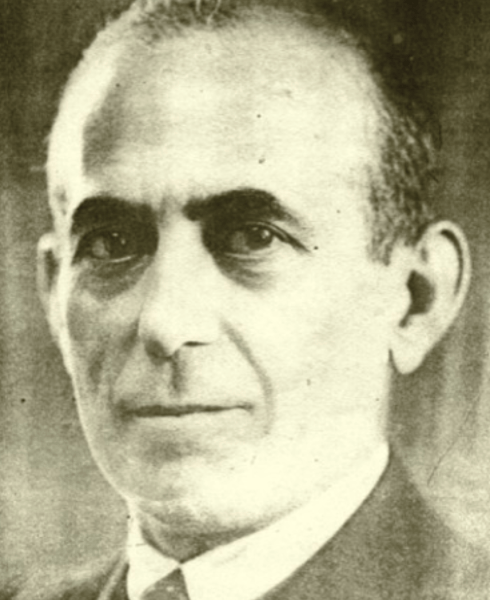
Daniel Chaverdian
In 1929, Chaverdian was appointed to work in Paris within the People’s Commissariat for Foreign Trade of the USSR. His primary, official mission was to manage economic ties and state-controlled trade operations between the Soviet Union and France. The French security services viewed Soviet Trade Delegations with immense suspicion as they functioned as umbrellas for clandestine political activity. Specifically, they were used to funnel money directly to local Communist parties, subvert labour unions and run active espionage rings.
French agents maintained constant physical surveillance on anyone entering or leaving the Commissariat offices. Phone lines were routinely tapped and couriers carrying commercial correspondence were intercepted to scan for hidden diplomatic or military blueprints. Later in 1936, Chaverdian was prominent in the Armenian community for organising the repatriation of Armenian workers back to Soviet Armenia.
The connection with Brechko Brechkowski (1873-1943)
“He is in contact with a Yugoslavian national named Brechko Brechkowski, reported to be harbouring pro-German sentiments.”
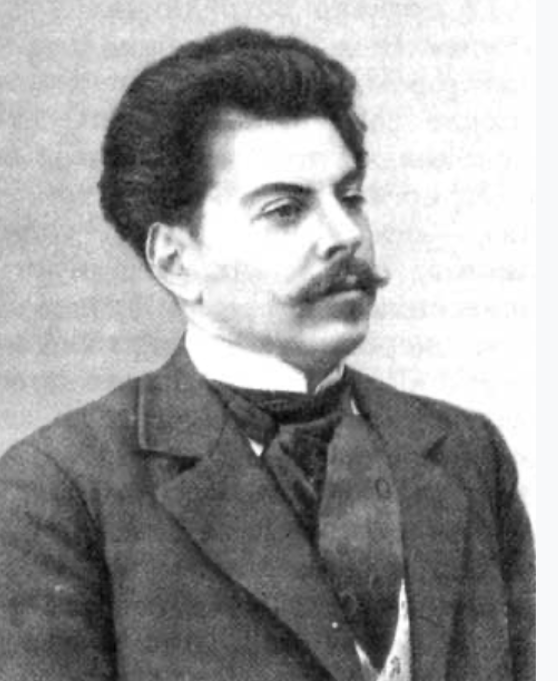
Nikolay Brechko Brechkowski
Nikolay Brechko Brechkowski was Russian, the son of Ekatarina Breshko-Breshjovskaya, a famous radical who cofounded the Socialist Revolutionary Party and was widely celebrated as the grandmother of the Russian Revolution. She had very little to do with her son, leaving him to be raised by relatives.
In the early 1910’s he was the most widely read and commercially successful writer in Russia. A pioneer of Russian Pulp Fiction he was regarded as one of the creators of the Russian political and spy detective genre. He found his niche writing fast-paced, scandalous, and action-packed thrillers.
The Soviet regime did not just ban his books; they rewrote history so that their citizens would forget he ever existed. Soviet text-books, encyclopedias and academic histories completely omitted his name.
Because of his mother, the family name had been flagged by the French Security Services long before Nikolai arrived in France in 1927. He had been deported by the Polish government as an undesirable alien and a disruptive political agitator. Because he wrote sensation seeking spy and occult thrillers that frequently exposed geopolitical secrets, life imitated art. In the paranoid environment of the Paris émigré community, rival Russian factions regularly accused each other of being Soviet spies. His constant shifts in political rhetoric led French intelligence to suspect he was either a Soviet agent-provocateur or a paid mercenary writing propaganda for foreign powers to destabilise the Russian diaspora in France. He in fact held strong anti-communist views and as the 1930’s progressed they became increasingly radical and pro-fascist. In 1941, with the German invasion of the Soviet Union, he left France for Berlin where he joined the Reich Ministry of Public Enlightenment and Propaganda.
What Gurdjieff’s actual connection to Brechko Brechkowski was, other than possibly having known him when he was living in Saint Petersburg and Moscow, is unknown
C) Insufficient Income and Financial Precariousness
As a foreigner in France Gurdjieff was not permitted to work. He was also not allowed to treat patients, as he himself acknowledged at a meeting in Paris on 18 January 1944
As “Mr Gurdjieff “I cannot help you. I could only do so as a doctor. But I am not allowed to practice medicine in France. I only treat English and American patients!
Insufficient income and financial precariousness were grounds for expulsion. This is possibly why Gurdjieff claimed he had 75,000 francs annual income (US$30,000 in today’s value) “from the sale of his books in several languages in America”. As the report states he could not provide any evidence of this, which is not surprising as none of his books, except “The Herald of the Coming Good” (subsequently withdrawn), had yet been published. It was a total fabrication.
Gurdjieff Stranded in the United States 1934
As a stateless person living in France and possessing a Nansen passport Gurdjieff was entitled to a visa de retour (return/re-entry visa). These visas were highly time sensitive with severe penalties for failing to secure an extension while abroad or returning after the re-entry visa expired. These included the prospect of imprisonment or deportation upon attempting to re-enter France.
“The following year, he applied for a visa from our Consul for a return to France. This document having been refused ”
From the US Immigration records and Gurdjieff’s stated length of stay, it appears that his French visa de retours for his visits in January 1929, February 1930, and November 1930 were for four months but for his visits in November 1931 and April 1934 they had been increased to six months.
His 26 April 1934 New York entry shows he was travelling on a USA visa issued by the American embassy in Paris on 15 February 1934. The embassy would only have issued it if he had a valid French visa de retour.
The story of what happened on this visit is partly covered in
Did Gurdjieff make a Secret Visit to Central Asia in the 1930’s?
https://gurdjieff-research.com/2025/07/10
The police report says he was refused a return visa by the French consul in the United States which suggests he was seeking an extension beyond his original visa for six months and explains why he is reported to have thrown his French Nansen passport into the Hudson River after having obtained a German Fremdenpass “Foreigner’s Passport” in New York, which he used to return to Germany.
The “Satanist Club“
This strange idea would appear to have originated from the description of the chapters of his coming book Beelzebub’s Tales to his Grandson in the 1933 French edition of The Herald of the Coming Good and rumours of group readings of the manuscript chapters in his apartment.
Withdrawal of Gurdjieff’s expulsion order
Information on the withdrawal of Gurdjieff’s expulsion order is found in his succeeding 1941-1949 Paris Police file
GURDJIEFF GEORGES 28.12.1877 ALEXANDROPOL RUSSIE, Intérieur; Secrétariat général à la police. Fichier central de police administrative: dossiers individuels de G à GZ (1941-1949) Reference Code 19800051/302/1, Archives Nationales (French National Archives, Paris)
Surprisingly there is nothing in this file for the period of the German occupation of Paris, 14 June 1940 to 25 August 1944.
The earliest entry is a letter from Gurdjieff to the Minister of the Interior on 4 February 1946 requesting the withdrawal of his deportation order.
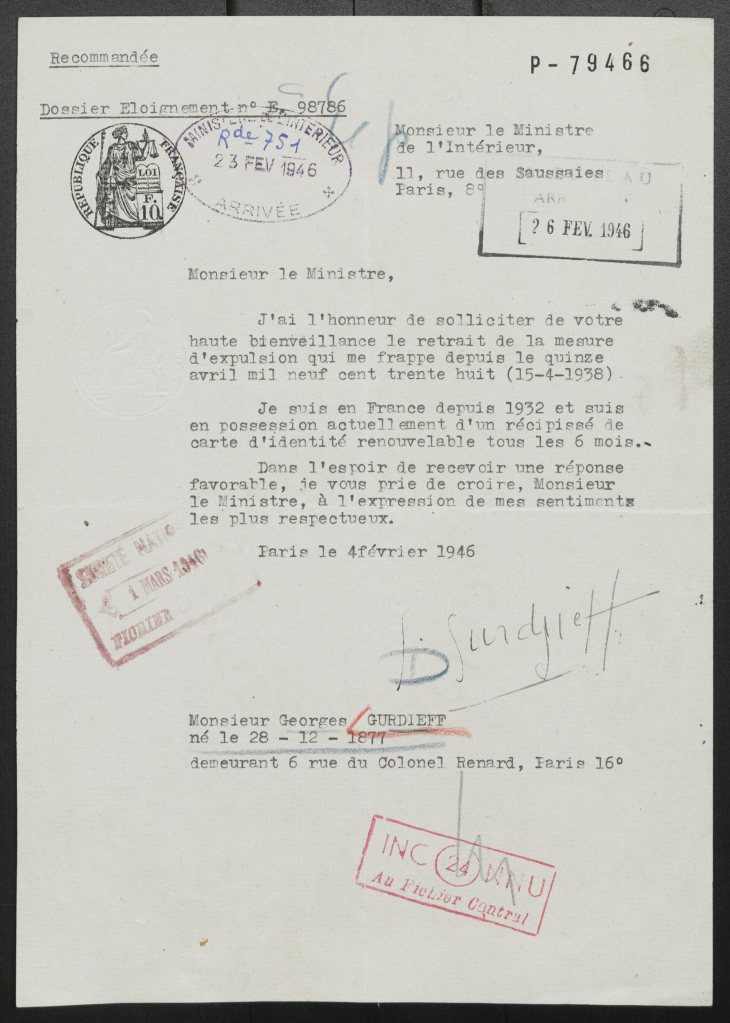
(English Translation)
Deportation File No. 98786
The Minister of the Interior, 11, rue des Saussaies, Paris, 8th
Mr. Minister,
I have the honour to request your kind consideration in withdrawing the deportation order that has been in effect from the fifteenth April nineteen hundred thirty-eight (15-4-1938)
I have been in France since 1932 (sic) and am currently in possession of a temporary identity card, renewable every 6 months.
H0ping for a favourable response, I remain, Mr. Minister, with most respectful regards.
Paris, February 4, 1946
Mr. Georges GURDIEFF (sic) born 28-12-1877 residing at 6 rue du Colonel Renard, Paris 16th,
In responding to this request two reports were prepared for both the director general of National Security and the Director of Foreigner’s and Passports 2nd bureau, one from the Prefect of the Police and the other from Director of Internal Surveillance.
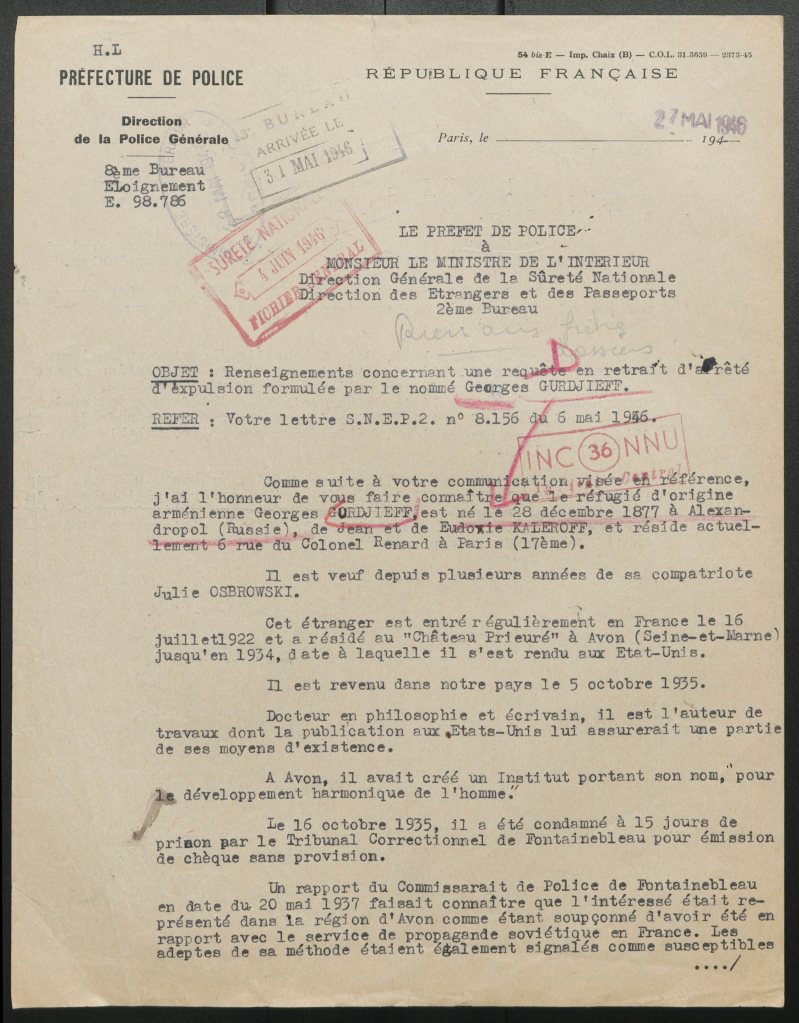
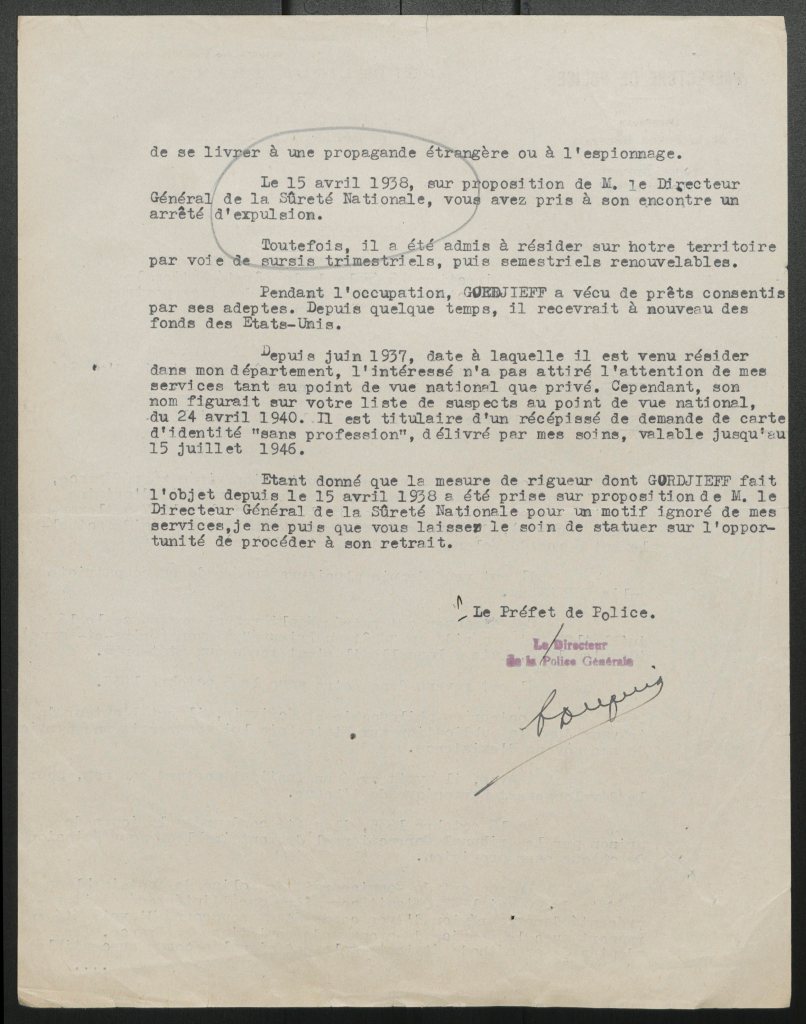
(English Translation)
Paris, the 27 MAY 1946
THE PREFECT OF POLICE to THE MINISTER OF THE INTERIOR Directorate General of National Security Directorate of Foreigners and Passports 2nd Bureau
SUBJECT: Information concerning a request for withdrawal of an expulsion order filed by Georges GURDJIEFF.
REFER: Your letter S.N.E.P.2. No. 8.156 of May 6, 1946.
Further to your communication referenced above, I have the honour to inform you that the Armenian refugee Georges GURDJIEFF was born on December 28, 1877, in Alexandropol (Russia), to Jean and Eudoxie KALEROFF, and currently resides at 6 rue du Colonel Renard in Paris (17th arrondissement).
He has been a widower for several years, his compatriot Julie OSBROWSKI having passed away.
This foreigner entered France legally on July 16, 1922, and resided at the “Château Prieuré” in Avon (Seine-et-Marne) until 1934, when he went to the United States.
He returned to our country on October 5, 1935.
A Doctor of Philosophy and writer, he is the author of works whose publication in the United States would provide him with part of his livelihood.
In Avon, he had created an Institute bearing his name, for the harmonious development of humankind.
On October 16, 1935, he was sentenced to 15 days in prison by the Fontainebleau Correctional Court for issuing a bad check
A report from the Fontainebleau Police Commissioner dated May 20, 1937, stated that the individual in question had been reported in the Avon area as being suspected of having been in contact with the Soviet propaganda service in France. Followers of his methods were also reported as being susceptible to engage in foreign propaganda or espionage.
On April 15, 1938, on the recommendation of the Director General of National Security, you issued an expulsion order against him.
However, he was allowed to reside in your territory by way of renewable quarterly, then semi-annual, stays.
During the occupation, GURDJIEFF lived on loans from his followers. For some time now, he has reportedly been receiving funds again from the United States.
Since June 1937, when he came to reside in my department, the individual in question has not attracted the attention of my services, either nationally or privately. However, his name appeared on your list of suspects from a national perspective, dated April 24, 1940. He holds a receipt for an application for an “unemployed” identity card, issued by me, valid until July 15, 1946
Given that the strict measure to which GURDJIEFF has been subjected since April 15, 1938, was taken at the suggestion of the Director General of National Security for a reason unknown to my department, I can only leave it to you to decide whether to lift it.
The Prefect of Police.
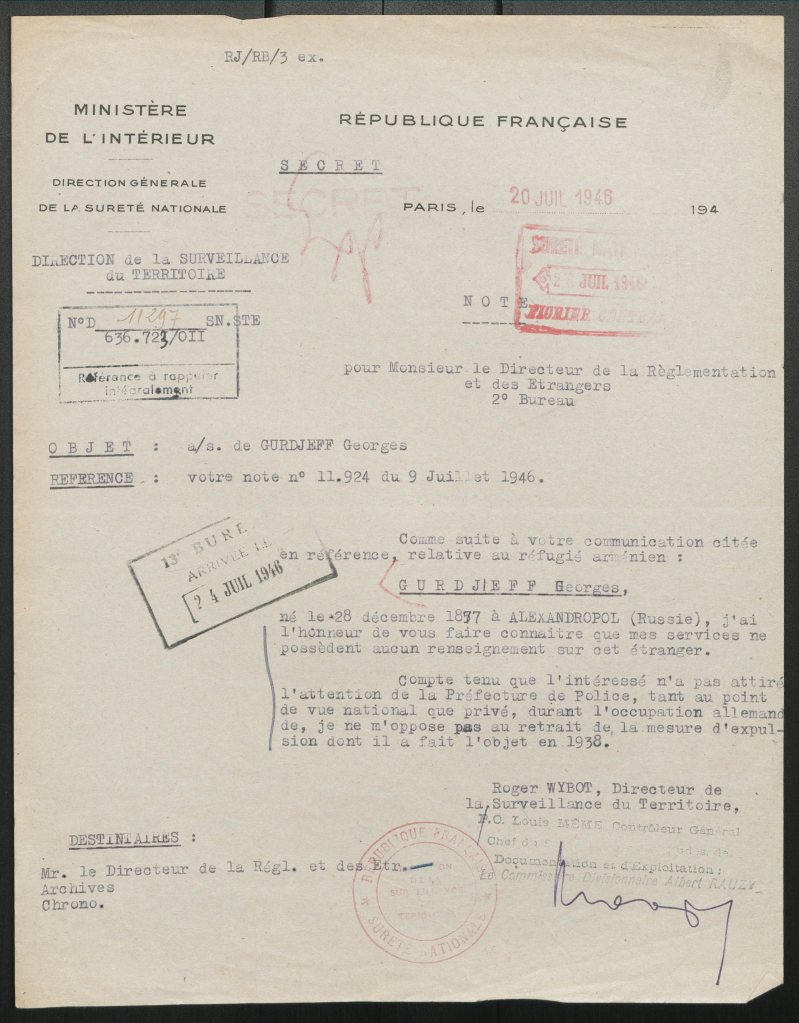
(English Translation)
SECRET
PARIS, 20 JULY 1946
NOTE
for the Director of Regulations and Foreigners, 2nd Bureau
SUBJECT: re GURDJEFF (sic) Georges
REFERENCE: your note no. 11.924 of 9 July 1946.
Further to your communication cited above, concerning the Armenian refugee:
GURDJIEFF Georges
born on December 28, 1877, in ALEXANDROPOL (Russia), I have the honour to inform you that my services possess no information on this foreigner.
Given that the individual in question did not attract the attention of the Police Prefecture, either nationally or privately, during the German occupation, I do not oppose the withdrawal of the expulsion order issued against him in 1938.
Roger WYBOT, Director of
Territorial Surveillance
RECIPIENTS:
The Director of Regulations and Foreigners Archives Chrono.
Gurdjieff’s expulsion record was officially withdrawn on 28 October 1946, and he was notified on 18 November 1946.
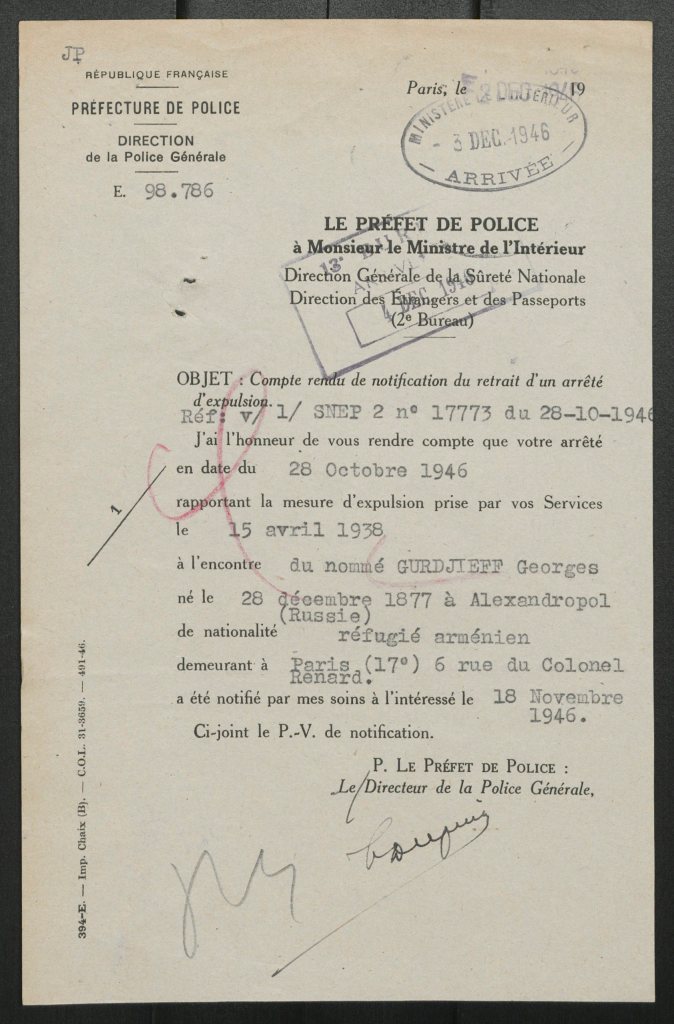
(English Translation)
Paris, The Minister of the Interior, December 3, 1946, Arrival 19
THE PREFECT OF POLICE The Minister of the Interior Directorate General of National Security, Directorate of Foreigners and Passports (2nd Bureau)
SUBJECT: Report of notification of the withdrawal of an expulsion order Ref: 1/ SNEP 2 No. 17773 of October 28, 1946
I have the honour to inform you that your order dated October 28, 1946 revoking the expulsion measure taken by your Services on 15 April 1938 against the individual named GURDJIEFF Georges born on December 28, 1877 in Alexandropol, (Russia) of Armenian refugee nationality residing in Paris (17th arrondissement), 6 rue du Colonel Renard. This was notified to the person concerned by me on November 18, 1946. Enclosed is the official report of notification.
394-E. – Imp. Chaix (B). — C.O.L. 31-3659. – 491-46.
For the Prefect of Police: The Director of the General Police,
At this point it appeared that Gurdjieff was free to apply the following year for a new visa a retour for a final trip to the United States. But complications arose when he was arrested on 2 August 1947 on charges of violating currency exchange controls.
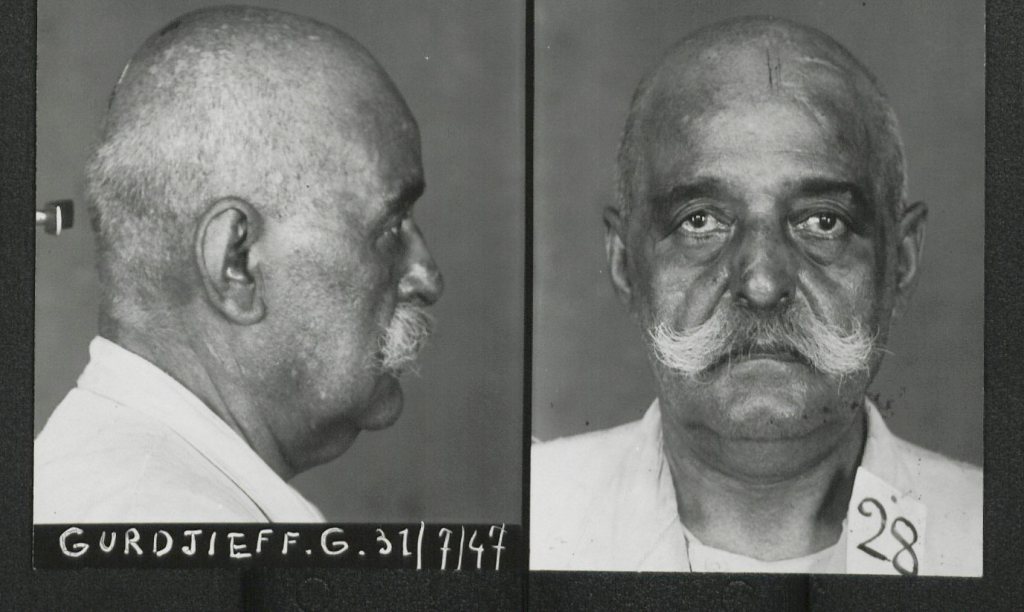
This led to a further report on Gurdjieff on 28 October 1947
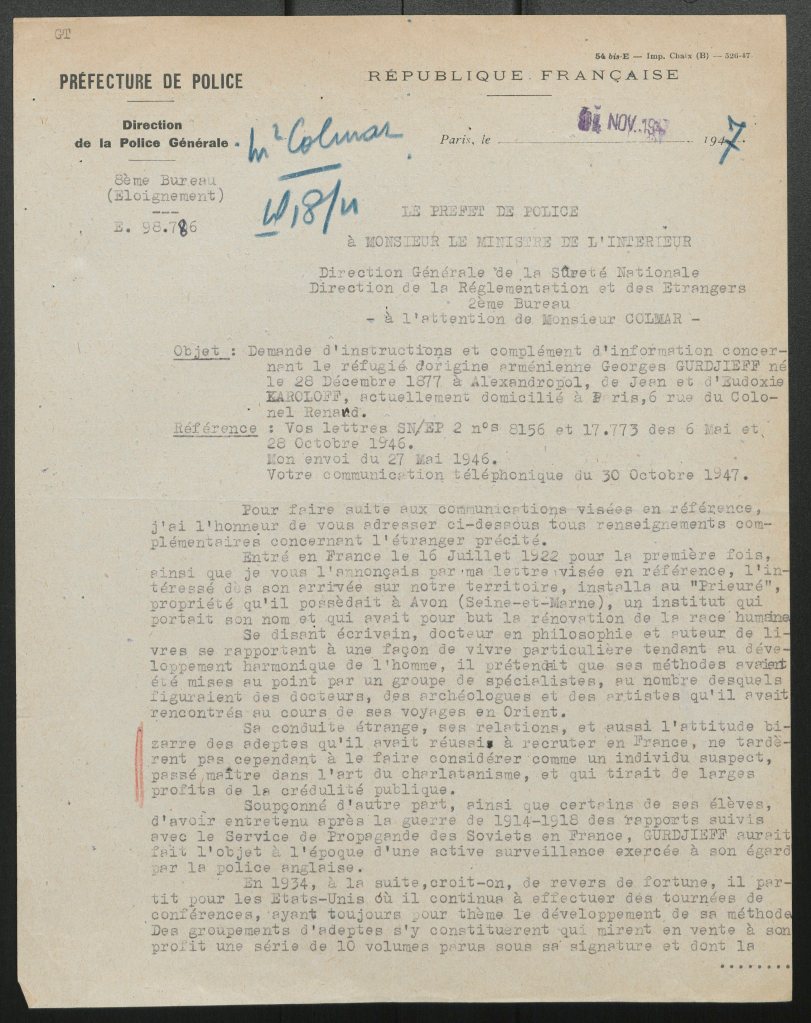
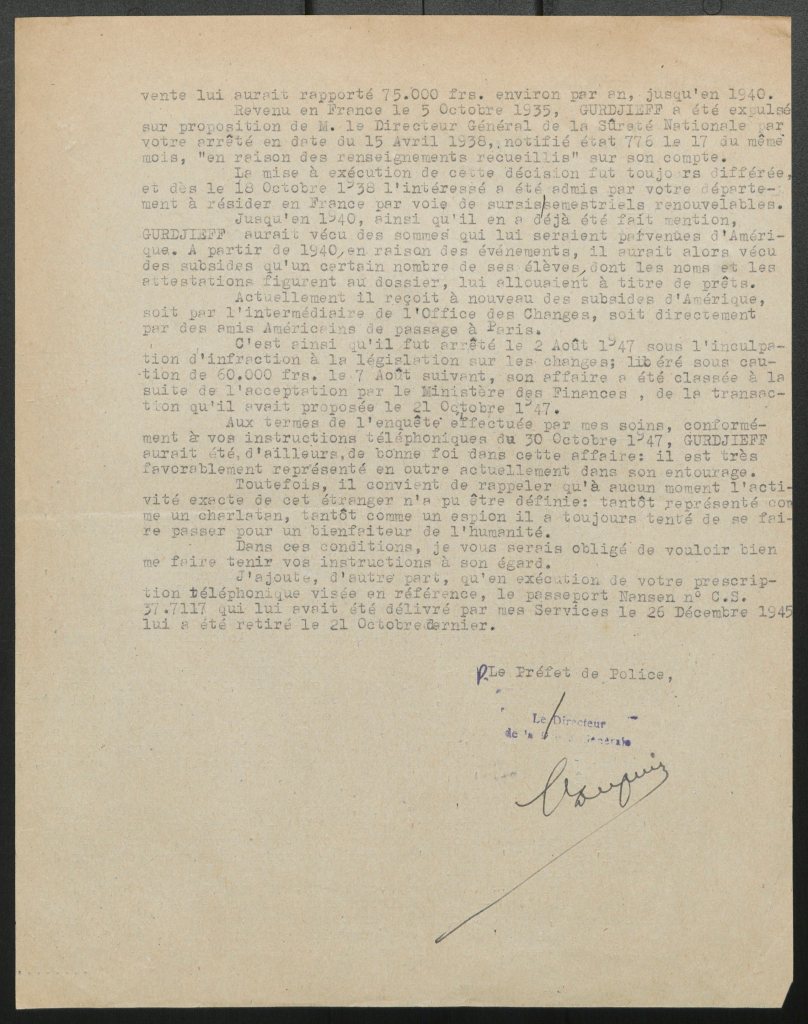
(English Translation)
THE PREFECT OF POLICE
to THE MINISTER OF THE INTERIOR, Directorate General of National Security, Directorate of Regulations and Foreigners
2nd Bureau attention Mr. COLMAR –
Subject: Request for instructions and additional information concerning the Armenian refugee Georges GURDJIEFF, born on December 28, 1877 in Alexandropol, son of Jean and Eudoxie KAROLOFF, currently residing in Paris, 6 rue du Colonel Renaud
Reference: Your letters SN/EP 2 nos. 8156 and 17,773 of May 6 and October 28, 1946.
My letter of May 27, 1946.
Your telephone conversation of October 30, 1947.
Further to the communications referenced above, I have the honour to send you below all additional information concerning the aforementioned foreigner.
Having entered France for the first time on July 16, 1922, as I informed you in my letter referenced above, the individual in question, upon his arrival on our territory, established at the “Prieuré,” a property he owned in Avon (Seine-et-Marne), an institute bearing his name, whose purpose was the renewal of the human race.
Claiming to be a writer, a doctor of philosophy, and the author of books relating to a particular way of life aimed at the harmonious development of man, he asserted that his methods had been developed by a group of specialists, including doctors, archaeologists, and artists whom he had met during his travels in the Orient.
His strange conduct, his relationships, and also the bizarre attitude of the followers he had managed to recruit in France, soon led him to be considered a suspicious individual, a past master of charlatanism, who profited greatly from public credulity.
Suspected, along with some of his students, of having maintained close ties with the Soviet Propaganda Service in France after the First World War, Gurdjieff was reportedly subjected to active surveillance by the British police at the time.
In 1934, following what is believed to have been a reversal of fortune, he left for the United States where he continued to tour and give lectures, always focusing on the development of his method. Groups of followers formed there who sold a series of 10 volumes published under his name, the sale would have earned him approximately 75,000 francs per year until 1940.
Having returned to France on October 5, 1935, GURDJIEFF was expelled on the recommendation of the Director General of National Security by your decree dated April 15, 1938, notified as status 776 on the 17th of the same month, “due to information gathered” about him.
The execution of this decision was repeatedly deferred, and as early as October 18, 1938, the individual in question was granted permission by your department to reside in France by means of renewable monthly deferments
Until 1940, as already mentioned, Gurdjieff reportedly lived on sums of money that came to him from America. From 1940 onward, due to the events, he reportedly lived on subsidies that a number of his students, whose names and attestations appear in the file, gave him as loans.
Currently, he is again receiving subsidies from America, either through the Exchange Office or directly from American friends passing through Paris.
It was in this way that he was arrested on August 2, 1947, on charges of violating exchange control laws; released on bail of 60,000 francs on August 7, his case was closed following the acceptance by the Ministry of Finance of the transaction he had proposed on October 21, 1947
According to the investigation I conducted, in accordance with your telephone instructions of October 30, 1947, GURDJIEFF appears to have acted in good faith in this matter: he is also currently very favourably represented by his entourage.
However, it should be noted that at no point could the exact activity of this foreigner be defined: sometimes portrayed as a charlatan, sometimes as a spy, he has always tried to pass himself off as a benefactor of humanity.
Under these circumstances, I would be grateful if you would convey your instructions regarding him to me.
I would add, moreover, that in execution of your telephone order referenced above, the Nansen passport no. C.S. 37.7117, which had been issued to him by my services on December 26, 1945, was withdrawn on October 21.
The Prefect of Police

