In mid-January 1919, Gurdjieff (41) accompanied by his wife, Julia (29), Thomas (34) and Olga (35) de Hartmann and Leonid (46) and Elisabeta (32) Stjernvall, arrived by train in Tiflis from the Black Sea port of Poti.
At the time the Social Democratic Worker’s Party of Georgia, also known as the Georgian Menshevik Party, governed the Democratic Republic of Georgia. On February 14, 1919, shortly after Gurdjieff arrived in Tiflis, they had won 81.5% of the vote in parliamentary elections.
A year and a half later, in June 1920, following an unsuccessful coup in May by the Bolsheviks, Gurdjieff, anticipating the eventual downfall of the Menshevik Government, travelled with a small group of followers to the Black Sea port of Batumi, where they boarded a ship and sailed to Constantinople.
By the time Gurdjieff arrived in Tiflis he had exhausted his funds. Looking for a way to replenish them he immediately set about establishing a business dealing in carpets.
Friends of Dmitri and of his father-in-law Archbishop Martinian bullishly advanced some risk capital…..he found apprentices, loyal and active; he taught them to scout for rugs, to wash them, to repair them… within three weeks ‘there was n0t only sufficient money for all to live on, but a good deal left over.‘
For the bazaar’s carpet dealers these were lucky times; even the most dubious kilims and rugs could be funnelled away to Constantinople, where the avidity of undiscriminating young officers of the Allied Occupation Force had produced a splendidly false market .
(Moore, Gurdjieff, page 126)
As for the de Hartman’s, Thomas writes
The next day, on my way to see Mr Gurdjieff, I was just approaching the bridge over the Kura River when I ran into my old friend, the composer Nikolai Nikolayevich Tcherepnin. He was as astonished as I was to meet on the streets of Tiflis. We shook hands and I asked, ‘What are you doing here ?’
‘I am the director of the Conservatory. And what are you doing here?’
‘Well as you see I am standing in the street.’
‘So? We just happen to need a professor of composition…?‘
Within two days I had a class in composition and a large class in theory for beginners.…….
Very soon the director of the State Opera suggested I join the artistic committee of the theatre, which was then planning a gala spectacle with a great singer from St Petersburg as Carmen. Tcherepnin was also the conductor of the Opera House orchestra and proposed that my wife, though she had never sung in a whole opera, take the part of Micaela, saying, ‘We will finally have a Miceala who really looks like a young girl.’
I asked who would design the scenery for this special performance and was told it would be done by a very great artist named de Salzmann. This name at once awakened memories of my days in Munich, where I had studied conducting with Felix Mottl. At that time an Alexander von Salzmann had been a very well-known painter, with whom I had struck up a warm friendship.
(DeHartmann, Our Life with Mr. Gurdjieff, pages 119, 120,121)
Alexander had been born in Tiflis. His father, Albert Teodorovich Zaltsman (1833-1897), was a celebrated local architect who lived in his own two-storey house at 115 Mikhailovskaya Street (now David Agmashenebeli Avenue), built according to his design. Many relatives and close friends lived in this spacious house. Alexander’s mother, Emilia Jurgens, was famous as a skilled needlewoman. Albert died in 1897 and Alexander eventually inherited the house, which was where he (45) and his young wife Jeanne (22) were living in 1919.

Albert Zaltsman’s house in Tbilisi
Madame de Salzmann was then expecting her first child, (Nathalie, later Nathalie de Salzman de Etievan (1919-2007)). She was teaching the Dalcroze system of dancing and held her classes in the hall of the military school, which was large and had a good piano. She was planning a demonstration, already set for June 22, at which she was to show her class in the State Opera Theatre, since the Dalcroze Institute in Tiflis was under the patronage of the Georgian Government.………
We began to see the de Salzmanns quite frequently and soon our conversations turned to the subject of Mr Gurdjieff’s teaching without any mention of his name. The question was raised of the necessity of a guide, a teacher, and we were able to say that we were fortunate enough to know such a man. When we saw the de Salzmanns sincere interest and eager desire to know who this man was, we spoke about them to Mr Gurdjieff and he permitted us to bring them to him. And so at Easter (18-20 April 1919 – my insert) time we went with them to Mr. Gurdjieff. The conversation, as I vividly remember, was very interesting and he said: ‘He is a very fine man, and she – is intelligent.’
Madame de Salzmann, having learned from us about the Sacred Gymnastics given at Essentuki, asked Mr. Gurdjieff to come see the work of her pupils. So one day we went with him to her class . The pupils, all young, pretty girls in Greek costumes, stood in a circle in the middle of a very big hall. Mr. Gurdjieff greeted them, watched with interest for five to ten minutes, and left. Some days later he came again and at once ordered them, in a military tone to straighten their lines, to dress left, to dress right. Then he put them all in a row in front of him and said; ‘Before beginning any work in Sacred Gymnastics, you must learn how to turn.’ He showed them how to turn in the military way, this turning being accompanied by my chords on the piano. I was very surprised by all this. When we had arrived that first day in Essentuki and Mr and Madame Ouspensky and others had done this military turning, I had not been surprised. Here I could imagine the reactions of these young Dalcroze dancers, who must have dreamed only about graceful Greek dances. But to my further astonishment all passed very smoothly and regular work with them started. The result was that Madame de Salzmann offered Mr Gurdjieff a part of her demonstration to show his Sacred Gymnastics and Sacred Dances.
(DeHartmann, Our Life with Mr. Gurdjieff, pages 121, 122)

Programme. Image from back cover of Constance Jones & Levan Khetaguri (eds), Gurdjieff in Tiflis, Shota Rustaveli Theatre and Film University, Tbilisi, 2008
State Theatre
Sunday, 22nd June 1919
An Evening of the School of Jeanne Matignon
The Method of Jacques-Dalcroze
The System of G.I. Gurdzhiev
1) Exercises of plastic gymnastics No 3, 9, 12, 15, 17, 21, 23
2) Exercises of ancient sacred dances No 23, 24, 25
3) Stop
4) Fragment of a round dance from Act 3 of The Struggle of the Magicians by G.I. Gurdzhiev
5) Fragments of the mystery Exiles by the same author
The performance was reviewed (by Ilya Mihailovich Zdanevich (28) (1891-1975) in the 14 -20 July 1919, one and only issue of the avant- garde magazine 41 Degrees. It reads in part:
Collaborating with Madame Matignon over the past few months has been Mr Gurdjieff – according to the composer Hartmann, one of the great lights of Eastern dance, Gurdjieff could not have come at a better time to the Dalcroze’s school. If the European achievement consists of pliancy, sinuous movement gliding on sails of inertia, then Gurdjieff gives rather than diffusion, a thrust of the will -sharp, direct movement. Gurdjieff’s method enriches the Dalcroze system twice over.
The beautifully rehearsed movements of the student troupe, by simultaneously throwing up now an arm, now a leg, along with the sheer inanity of these movements and erect positions, created an impression of stupefying relaxation on the public……
It is quite irrelevant to know that Gurdjieff learned these sacred dances in the east! This is his business! We simply need to walk on our heads and in the air! The rest will take care of itself.
(Taylor, Gurdjieff in the Public Eye, 1914-1949, page 16)
After the success of the first demonstration Gurdjieff decided to give another.
But this time he wished to give everyone a very different experience: it would be a new demonstration with none of the Dalcroze dances and nothing staged by Madame de Salzmann….With the whole force of her authority and the feeling of the rightness of Mr Gurdjieff’s Work, she was able to persuade her pupils to take part in the new ‘exercises’. and the demonstration took place after intensive work.
The theatre was less crowded. However the aim was not to have many people, but rather to create conditions for a new experience….
(DeHartmann, Our Life with Mr. Gurdjieff, page 123)
In the programme of the first demonstration, what Gurdjieff called plastic gymnastics and ancient sacred dances, (which were later to become known as the Movements), appear to have been identified by the same numbers as those used in Paris, three years later. I note that Emile Jacques-Dalcroze (1865-1959) had a “Method” whereas Gurdjieff had a “System”.
In the beginning of July, Gurdjieff sent the de Hartmann’s to Erivan (Yerevan) to give musical concerts . Armenia at the time was occupied by the British. When they returned at the end of the month, Gurdjieff and his pupils went to the cooler air of Borjomi, a resort town 165 kilometres from Tiflis, noted for its mineral waters.
Everyone returned to Tiflis in the autumn. There Mr Gurdjieff was preparing for a centre of the Work like that in Essentuki, but corresponding to conditions of life in Tiflis. It began on the terrace of the house where we lived, because the weather was still hot.There were Dr Stjernvall, the two de Salzmanns, and we two. Mr Gurdjieff briefly explained the ideas of the new Institute he wished to organise there. He told about the aim and methods of work and the day when he hoped to open the institute. Then he asked us; ‘What name would you give our new Institute?’…….He rejected every suggestion….. Finally we had the name that Mr. Gurdjieff wanted. It was: ‘Institute for the Harmonious Development of Man’.
Representations were now made to the Georgian Government to furnish us with a new building for the Institute, and they promised to find us a suitable house.
(DeHartmann, Our Life with Mr. Gurdjieff, page 138)
These representations were made in late August or early September. Georgian historian Dr. Manana Khomeriki has posed the question. Why would the Georgian Government eventually give Gurdjieff a two story building before many other well known national cultural-educational institutions ? Some in the Government apparently disapproved. Approval for the Institute was granted on 6 October 1919 , but a building wasn’t forthcoming till March of the following year.
My belief is that despite Thomas de Hartmann’s crediting Leonid Stjernvall’s negotiating skills and Alexandre de Salzmann’s cartoon in the 14 December 1919 issue of the Georgian satiric magazine “Devil’s Whip” as factors, a more likely reason was Gurdjieff’s close ties to the leaders of the Menshevik revolutionaries during the 1904-1906 unrest in Georgia.
The meticulously, hand written petition 0f Jeanne Matignon de Salzman, Doctor of Medicine Shernval, Professor de Hartman and de Salzmann – a painter of the State Theatre, together with their signatures, is still in the Georgian State Archives
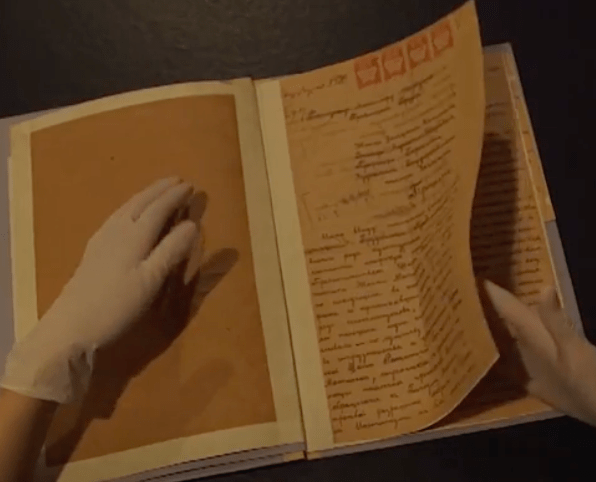
First two pages are the signed petition
GD Media – Marta Baramidze – George Gurdjieff video (in Georgian)

Right hand page reads
Institute for the Harmonious Development of Man.
The program of the Institute for the Harmonious Development of Man is based on the system of G.I. Gurdjieff, which is based on the following principles:
Due to the conditions of modern life, man has deviated from his original type, from that type which should have been created by the combined influence of heredity, environment, culture, in which he was born and grew up, which by its very nature should have outlined for this man those paths of development, that final normal type, which should have been achieved. The civilization of our time, with its unlimited possibilities of spreading its influence, has separated man from the natural conditions in which he grew up. It is true that it has opened up new paths for man in the fields of science, culture and economic life, and has thus significantly expanded his worldview; but instead of raising it comprehensively to a new stage of development, it has developed some aspects of being to the detriment of others, and has partly even destroyed in man the individual, complete, normal, united with the nature and environment surrounding him, depriving him of natural typical advantages, not giving him all that it should have given for the harmonious completion of the new type.
This is confirmed by the system of G.I. Gurdjieff, experimentally proving that the worldview of modern man and its external manifestation are not the result of the correct interaction of the mind with the spiritual forces, and are not a conscious manifestation of all that is.
Thomas de Hartmann writes
Meanwhile, Mr Gurdjieff began to work in a similar way on the text of a brochure about the Institute. …… When the brochure was finished and ready for the printer, the question arose about what should be on the cover. In the evening as we sat at the de Salzmanns, Mr Gurdjieff asked Mr de Salzmann to draw his portrait in an oval frame,
(DeHartmann, Our Life with Mr. Gurdjieff, pages 138, 139)
Dr Mañana Khomeriki says the copy of the granting of permission for the Institute, dated 6 October, 1919 is in Georgian State Archives. This was followed by an announcement in the October issue of the newspaper ‘Ertoba’ (Unity). The paper was the central organ of the Social Democratic (Menshevik) Workers’ Party of Georgia.
The Institute for Harmonious Human Development is commemorated in Tbilisi
According to the system of G. I. Gurdjieff.
Olga Street, Melik Azariantsi House #3. Classes will be held in the mornings and evenings. Subjects: Gymnastics – rhythmic, medical, plastic, ancient, jiu-jitsu. Training – development of willpower. Emotions, instincts, thinking, memory, attention, hearing, voice, etc. Means of this: practical and theoretical study of: 1) music, 2) painting, 3) sculpture, 4) dance – of the peoples of the East and Europe, 5) languages – Russian, Georgian, Armenian, Ottoman, Greek, Italian, German, French, English and others. Housekeeping – cooking, cutting, sewing, economy, washing clothes, ironing and others. 6) Crafts – carpentry, shoemaking, tailoring and others. Lectures: psychology, philosophy, religion, pedagogy, physiology, hygiene, aesthetics and others. The heads of the institute will be: Zhanna Salzman, Matinon, T. Gartman, Doctor of Medicine Chorny, Doctor of Medicine Shernaviani, P.D. Uspensky, Engineer Petrov, V.V. Zhukov and others. At the beginning of the classes, the Institute will be led by G. I. Gurdjieff, who is temporarily in Tbilisi. More detailed information can be found at the first lectures. Children and adolescents will be taken for a walk at the appointed time by the Institute’s governesses – who will take the children home after the classes. In bad weather, the Institute’s strollers will operate. Pre-registration will be held at the State Theater’s cantor from 11-1 and 7-8 pm every day until November 3, after which registration will be suspended due to the small size of the building.
https://tengizisimashvili.blogspot.com/2017/06/1919-1920.html
From this announcement it can be seen that Gurdjieff , while waiting for a building to be supplied by the Government, had rented temporary premises, but not just in any building. It was in the house of Melik-Azaryants, built between 1913 and 1915, and at the time the largest modern style, and one of the finest, buildings in the capital.
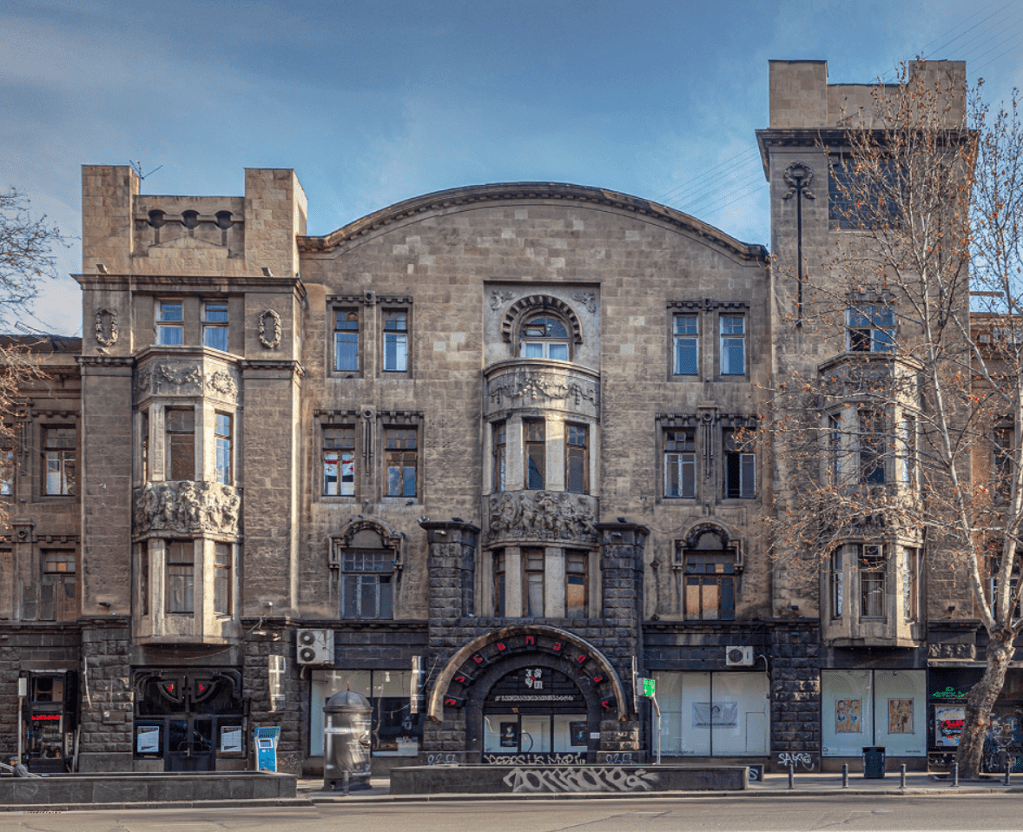
Melik-Azaryants House
It was the largest apartment house in Tbilisi, a kind of complex that was divided across 6 entrances. The building was equipped with uninterrupted electricity, a water supply, kitchen and bathroom facilities that represented a kind of luxury, its own telephone exchange, a kindergarten, a photo booth, an art gallery, a cinema, a garden that featured a fountain and plants, as well as other conveniences. In addition, the building was characterized by a special architectural and artistic look, decorated with unique bas-reliefs and decorative mouldings, entrance hall paintings and interior decorations, which all made a great impression on visitors.
https://atinati.com/news/6463652a89f23d00386f8436
……..within a week after the opening of my Institute, all the special classes which had been started in these temporary premises were filled up, and there were also waiting-lists of two or three times as many people for the classes. I expected to start as soon as we had a larger building
In these temporary premises which were very unsuitable in every respect, and under exceedingly trying conditions, ‘work on oneself’ began to come to life. Studies were carried on for several months by dividing the pupils into separate groups and by arranging working hours in the morning, afternoon and evening, and even late at night.
(G.I.Gurdjieff, Meetings with Remarkable Men, pages 280, 281)
While the lectures and other classes were held in this building, classes in Sacred Gymnastics were taught in a room in the de Salzmann’s house.
Soon the de Salzmann’s room was too small for the Gymnastics, because more people joined us. One of the pupils arranged with her father, a dentist named Weller, to loan a big hall in his house until the promised building was found. At the same time the director of the State Theatre placed at Mr Gurdjieff’s disposal an office next to his own.
Gurdjieff had contracted with the State Theatre to stage his ballet, The Struggle of the Magicians. In Moscow he had struggled to interest the theatre community but in Tiflis he had the endorsement of two luminaries -Thomas de Hartmann and Alexander de Salzmann. The first was writing the music and the second painted sketches of sets for at least three of the five acts. The Sacred Gymnastics, performed by Gurdjieff’s pupils were to be the feature of the performance. Thomas de Hartmann details the efforts made to produce props , despite the scarcity of materials and other work on the production. Eventually with the worsening political situation Gurdjieff abandoned the project and either destroyed the equipment or packed it up for shipping to Constantinople and it was lost in the chaotic conditions of the move.
At the time of the petition, Thomas de Hartmann says that they also began work on the text of a brochure about the Institute, which eventually evolved into the first Prospectus for ‘The Institute for the Harmonious Development of Man. To the de Hartmann’s consternation, Gurdjieff had Alexander de Salzmann design the now famous front cover, that Gurdjieff reused for the Constantinople and Paris Institute Prospectuses. The cover, plus it being printed on thin yellow paper gave it, in Thomas de Hartmann’s view, ‘the appearance of an advertisement in bad taste for a provincialist occultist‘.
I have not seen the prospectus. Apart from the cover, what the rest consisted of can only be guessed at from Ouspenky’s description and two newspaper announcements. One in October 1919 in ‘Ertoba’ and the other in March 1920 in ‘Slovo’.
Ouspensky had been sent a copy of the prospectus from which he quotes
With the permission of the Minister for National Education, The Institute for the Harmonious Development of Man based on G.I.Gurdjieff’s system is being opened in Tiflis. The Institute accepts children and adults of both sexes. Study will take place morning and evening. The subjects of study are: gymnastics of all kinds (rhythmical, medicinal, and other). Exercises for the development of will, memory, attention, hearing thinking, emotion, instinct, and so on.
To this was added that G.I.Gurdjieff’s system
Was already in operation in a whole series of large cities such as Bombay, Alexandria, Cabul, New York, Chicago, Christiania, Stockholm, Moscow, Essentuki, and in all departments and homes of the true international and laboring fraternities.
At the end of the prospectus in a list of “specialist teachers” of the Institute for the Harmonious Development of Man I found my own name as well as the names of “Mechanical Engineer’ P. and still another of our company J. who was living at that time in Novorossiyk and had no intention what ever of going to Tiflis.
(P.D. Ouspensky, In Search of the Miraculous, pages 380,381)
The opening statement suggests the Prospectus was printed in October after permission had been given by the Minister for National Education and thus after the hand written petition, but may have given the same explanation of Gurdjieff’s system and the aims of his Institute as the petition’s attachment. From Ouspensky’s description, it appears that Gurdjieff hadn’t yet fully outlined these to the extent that he did in the Constantinople, Berlin and Paris Prospectuses. There also doesn’t seem to be any mention of a medical section.
Five months later, when a building was supplied by the Georgian Government, Gurdjieff placed an advertisement in the newspaper ‘Slovo’ (Word) on 14 March 1920. (The paper was to be closed by the Georgian Government at the end of the month). The address of the Institute was given as 22 Nikolas (now Ivane Javakhishvili) Street

The ground floor/basement section has been turned into small shops typical of modern Tbilisi (2014)

No 22 is a large block and includes part at the end with entrance to the inner courtyard. Currently made up of old apartments some of which are being renovated (2014)
From the advertisement…. we come to know, that Gurdjieff lectured on subjects of religion, philosophy, science and art from the point of view of esotericism. the main attention was paid to the systems which were studying man, as well as the ideas of the super-man in the oriental teachings. Gurdjieff was explaining the modern exact sciences such as Medicine, Chemistry, etc, in accordance with the old oriental teachings. It was announced that those lectures had not been yet published anywhere.
(Manana Khomeriki, About the Origins of Gurdjieff and His Activities in Georgia, Constance Jones & Levan Khetaguri (eds), Gurdjieff in Tiflis, page 34)
…… the city officials …….gave us a two storey house across the river with a large ground-floor hall. The next problem was to furnish the house. First we had to prepare the hall for Gymnastics. We had a piano, but we needed something for all the people to sit on. So several of us went to a lumber yard to get wood for benches. Somewhere Mr Gurdjieff found a hammer, a rasp and saw, and the carpentry began. He worked on everything himself and proved to be an expert carpenter. Benches for fifty or sixty people were made and painted a very dark brown, washed over wildly with various colours The ensemble has a marvellous effect when they were placed around the walls or arranged in rows for visitors when there were lectures
Mr Gurdjieff moved into the house and insisted that Mr and Madame de Salzmann, with their new baby daughter, Boussik, should occupy one of the rooms. It was the same demand he made on us in Essentuki. At eight o’clock every evening, except Saturday and Sunday, Gymnastics began…… Work on the exercises began to go very extensively. A special women’s class was formed of the most talented and inwardly devoted pupils. With them Mr Gurdjieff developed those women’s dances that later were shown in the public demonstrations in Paris.
Several times the director of the State Theatre sent about fifty of his Georgian students to study our exercises. They were not from the intelligentsia, but were very nice, simple young people, dreaming of work in the theatre. Mr Gurdjieff gave them special, uncomplicated exercises, for which Lili Galumian was always the instructor.
(DeHartmann, Our Life with Mr. Gurdjieff, pages 142, 144)
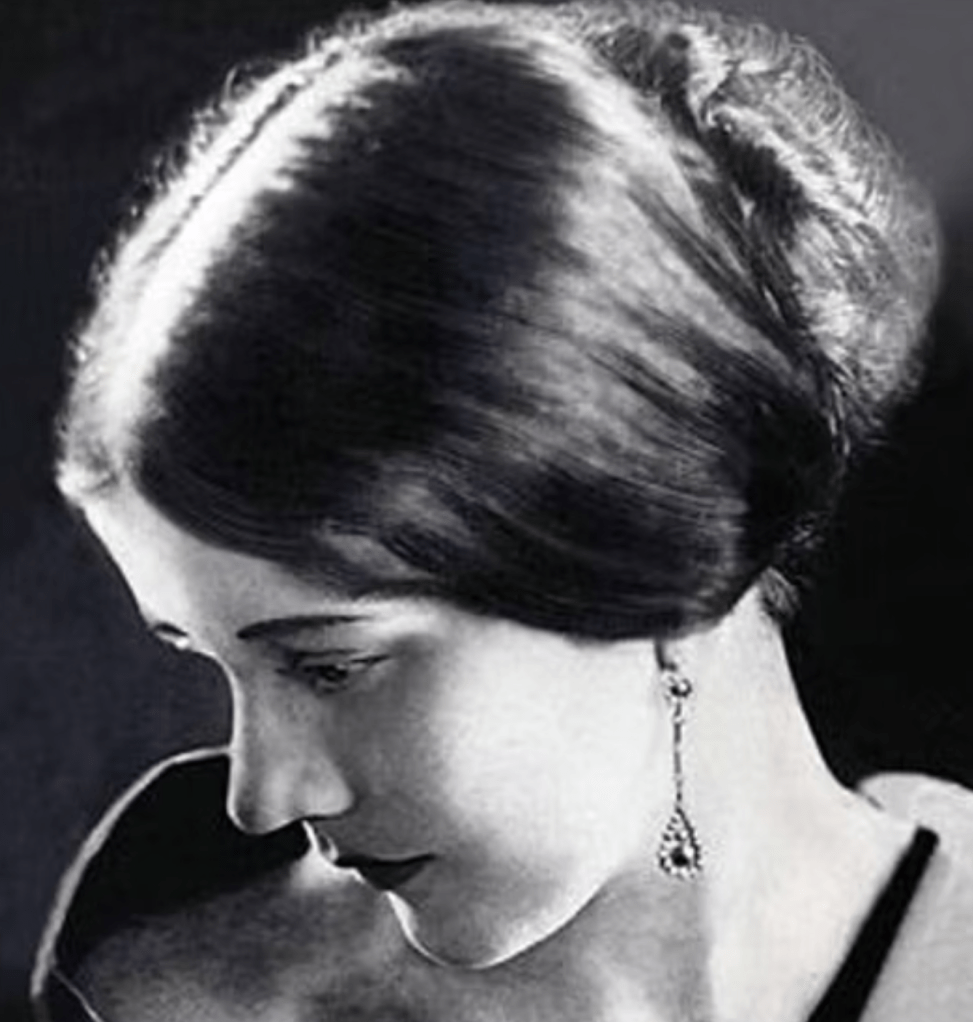
Olgivanna Ivanova Lazovich, (Hinzenberg), (Lloyd-Wright)
Another pupil, who was to play a major role in Gurdjieff’s Work, Olgivanna Hinzenberg, joined the Institute at this time. Her then husband, Vladimir Hinzenberg, who she had married when she was 19, was a partner with Alexander de Salzmann in a restaurant “The Peacock’s Tail.”
On day Valya burst into my room and in her easy way she said. “You know. I have met a wonderful man who teaches dances bases on philosophy, just along your line. His name is George Ivanovich Gurdjieff. I know you would be interested to meet him. I want you to come with me.”
“Oh no,” I said. “I am not interested in any dances.”
“But they are not common dances; they are for the development of your will, your mind. Please Olyenka, come,” she pleaded. “You have isolated yourself from life. You cannot go on like this, reading all day. It makes me unhappy to see you so unhappy, and there is your daughter Svetlana with you. Oh, Olya, please come – just for my sake ! You will see what fascinating things they are doing.”
“All right,’ I said, to appease her really, and without any interest whatsoever I walked through the narrow winding streets of Tiflis….
It was a long way to the two Storey house. We climbed the wooden stairway up to a rather barren room where a small group of people surrounded a buffet table on which were an unusual variety of foods. In the midst of this group I instantly saw the remarkable man Valya had told me about.
Gurdjieff did indeed look remarkable. He had a beautiful, closely shaven head and classic features, with a fine nose and strong jaws; his eyes were dark and luminous. It was a noble face, with the traditional oriental black moustache which seemed natural on his face. His expression was of profound strength and great compassion….
After a while, five women separated themselves from the rest and began to do the exercises which could even be called “dance”. What impressed me most was that Gurdjieff created an intricate geometric pattern with a calculated mathematical sequence. The movements were so unusual that I could not place them in any category known to me. Throughout the entire event the presence of Georgivanitch could be sensed, radiating, overpowering..…..
I was going through the motions exteriorly, all the time thinking, “When will I have the chance to speak to him ?” But the first evening I did not have the chance.
Returning with Valya on the same streets through which we had come, a change had taken place in me. For the first time I had some feeling of my presence in this world. I was no longer completely and desperately out of it.
I went home. I wanted understanding and knowledge, and I knew with all my being that Gurdjieff had them….
Shortly after this first meeting with him, he taught me the Movements, trying somehow to correlate a human machine which had been fed many varieties of things, one by my mother, another by my father, still another by my school friends.
He said, ” I want to show you the First Obligatory. Combine the arms and legs and head movements together at the same time,” and he explained the value of that concentration. The first thing with which he tripped me up was that you do not begin your arm motion on the count “one”, you start on “two”. It is precisely that that has been the greatest stumbling block for many people whom I taught later.
It is not a trick. Its purpose was simply to dislodge the mechanical process of thinking. It was a wonderful exercise which I have used many times in life. (page 37)
(Maxine Fawcett-Yeske and Bruce Brooks Pfeiffer, The Life of Olgivanna Lloyd- Wright, pages 34, 35, 37)
Anna Butkovsky, together with P.D. Ouspensky was an early member of Gurdjieff’s 1915-1918 St. Petersburg Group. Their wealthy father helped her sister Natalia, open a publishing house. Anna persuaded her to publish Russian translations of then popular books on Yoga from England and America. Natalia was also an actress and a close friend of the writer and director Nikolai Nikolaevich Evreinov (1879-1953). He attended Gurdjieff’s meetings in St. Petersburg.
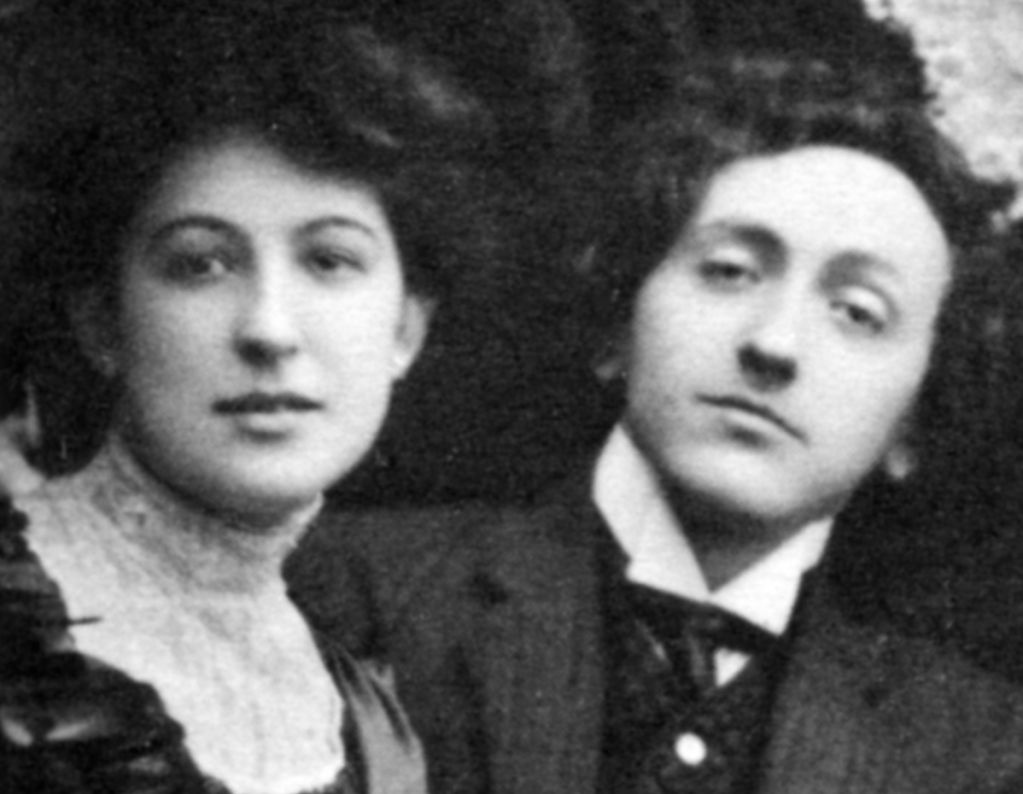
Natalia, sister of Anna Butkovsky , and Nikolai Evreinov
One person who surprised us very much by appearing without warning on our very first day in the Caucasus, (Essentuki – my insert) was my old friend Evreinoff, the well-known theatrical producer and writer. We were all stupefied when we met him in the street, and felt that there must be some special meaning to so extraordinary a meeting. Evreinoff came up to Gurdjieff, inclined his head towards him and said, ‘I am a difficult, pretentious man. I an ambitious. But here, Georgi Ivanovitch, I bow to you, and I can only say because I met you here that I don’t think our meeting like this is casual. I will stay with you for some time, and you will look at me and I will look at the group. So Evreinoff stayed for a while
(Anna Butovsky-Hewitt, With Gurdjieff in St. Petersburg and Paris, page 105)
In 1919, at the height of the Civil War, Evreinov ended up in Tiflis and accidentally ran into Gurdjieff on the street. This is how he told his wife about this meeting:
I walked ⟨…⟩ along Golovinsky Prospekt.29 This was either at the end of 1919, or at the beginning of 1920. And suddenly I heard: ‘Nikolai Nikolaevich, is that really you?’ I looked—this was Gurdjieff! ‘I just need you!’ he said. ‘How can I be of any use to you?’ I asked ⟨…⟩. ‘You are a writer,philosopher, Nikolai Nikolaevich, and I am about to give a literary form to the program of the institution that I intend to establish in Paris.’ According to Anna Evreinova, ‘it turned out that Evreinov had to create a detailed program for the “Institute for Harmonious Development” based on incoherent and illiterate sketches of Gurdjieff himself.’ Evreinov successfully fulfilled this request. ‘He really liked my version of the text,’ said my husband. Gurdjieff paid him a sum of money and finally ⟨…⟩ said: ‘And now my offer to you: come with us abroad, because we will all be leaving for Europe soon’ ‘Who are we?’—asked Evreinov in surprise. ‘I, the composer Hartmann with his wife, the artist Salzmann, also with his wife, and several other people. I have carpets in Constantinople, there will be things to start life abroad.’
(Konstantin Burmistrov, Gurdjieff in Constantinople, New Evidence and Documents. Aries – Journal For The Study of Western Esotericism (2020) page 10)
Shortly before leaving Tiflis, Gurdjieff’s pupils gave a performance of Sacred Gymnastics at the Mushtaidi Park Pavilion
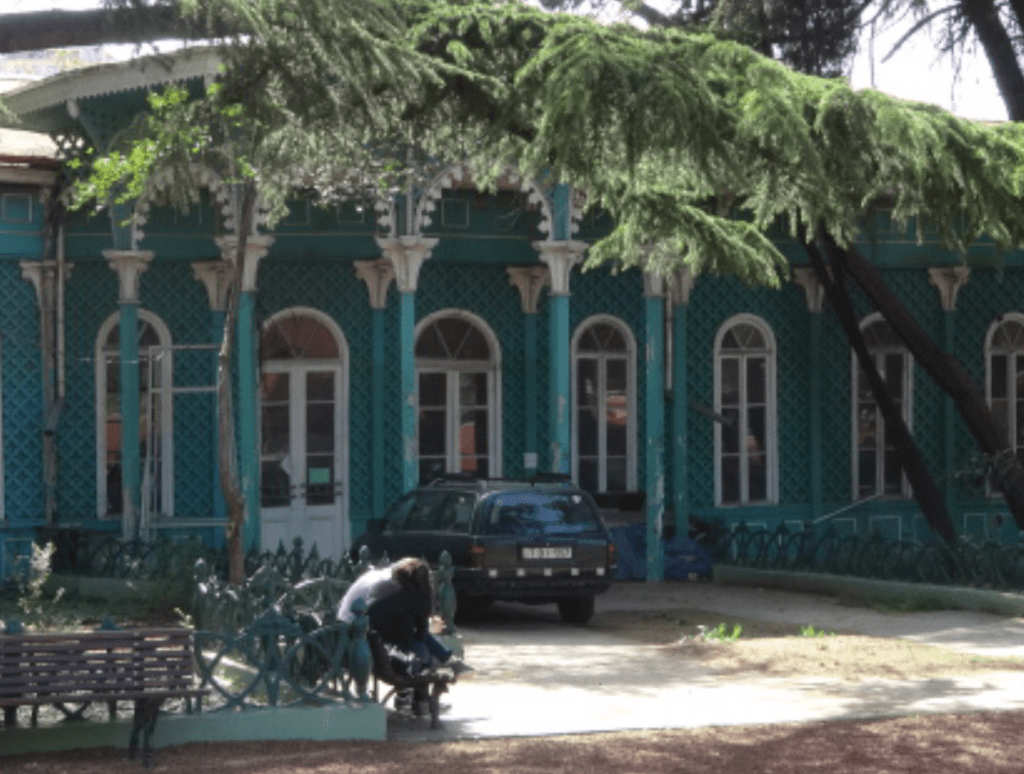
Mushtaidi Park Pavilion 2014
 Gurdjieff Research