There is little in the Gurdjieff literature about Gurdjieff’s French pupil, Bernard Ferdinand Lemaistre (1907-1953), except that he was a banker and Gurdjieff’s favoured candidate for ‘Director’ at the meals of his post War French group. This is possibly due to the fact that Lemaistre died tragically, in a storm at sea, only three and a half years after Gurdjieff’s death.
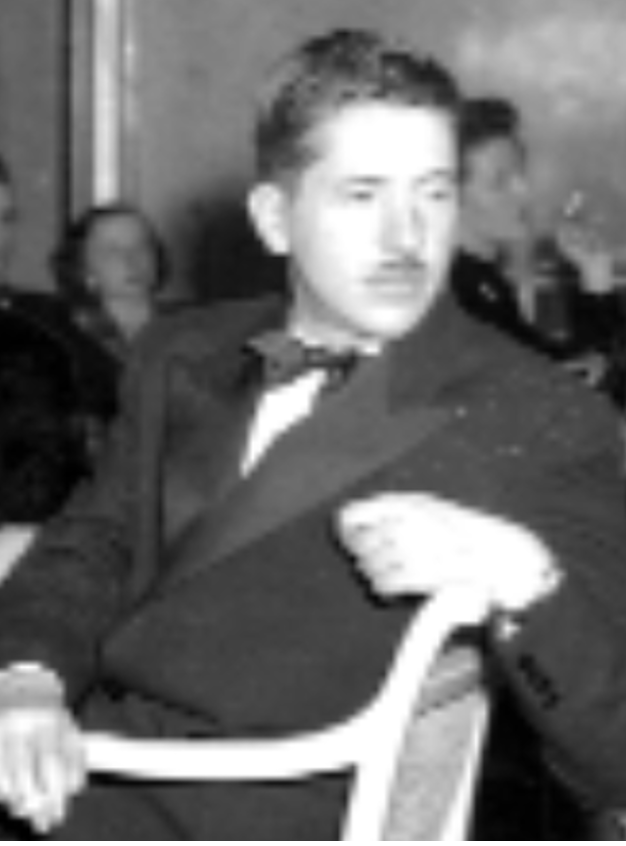
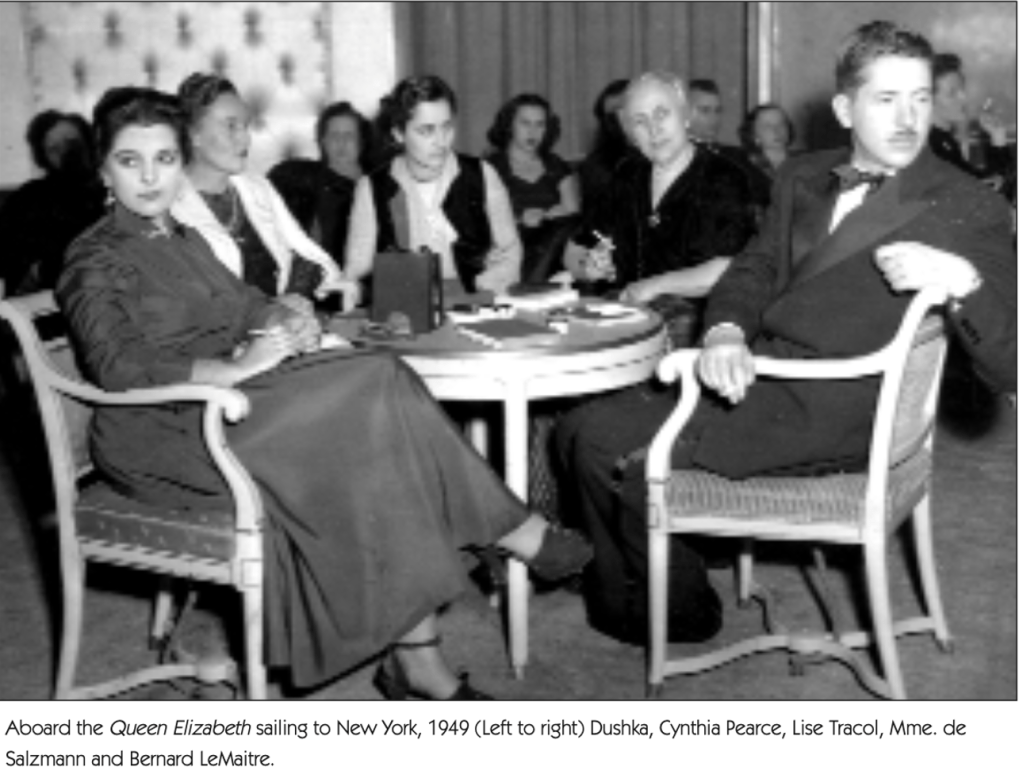
Bernard Lemaistre aboard the Queen Elizabeth sailing to New York, December 1949 Jessmin and Dushka Howarth, It’s Up to Ourselves page 295
Meals at Gurdjieff’s apartment at 6, rue des Colonels Renard were not casual dining experiences but occasions for intensive spiritual “shocks”. The ‘Director’ who sat at Gurdjieff’s left was modelled by Gurdjieff on the Tamada or master of ceremonies and toastmaster at a traditional Georgian feast who guided the feast by delivering deeply felt toasts to God, ancestors, and guests ensuring the gathering remained respectful, harmonious and emotionally engaging. In Gurdjieff’s version, the role of the ‘Director’ was tasked with officially announcing each toast according to his hierarchy of 21 “Idiots” (such as Ordinary, Round, Square, Compassionate, and Hopeless Idiot). They had to ensure every attendee fully drained their glass of Armagnac, peppered vodka or Calvados upon being toasted. The Director kept charge, allowing Gurdjieff to freely observe, encourage efforts of attention, and to provoke or puncture the egos of those present. If a student tried to dodge a toast or fake their way through a drink, the ‘Director ‘was expected to publicly call them out, creating the precise “intentional suffering” and friction Gurdjieff used to shock people awake.
THE ‘DIRECTOR’
During the War Gurdjieff had a large group of French students who would gather at his apartment several nights a week to hear readings of his unpublished writings, (principally Beelzebub’s Tales to his Grandson). He would also provide lavish dinners with ritual toasting, to get to know his students better and to open them up with the strong alcohol of the toasts. In 1948 Lemaistre said he had only known Gurdjieff for three years i.e. from 1945 so he was not part of this War time group, as some have written, and only joined it after the Liberation of Paris.
This is confirmed by his being mentioned only once in the transcripts of the Gurdjieff’s wartime meetings and then on
Monday 9 December 1946 LEMAITRE: There is no flowing in the different centres? Only the leg and the sexual organ? (page 379)
Gurdjieff, G. I. TRANSCRIPTS OF GURDJIEFF’S WARTIME MEETINGS 1941-46 Third edition Book Studio, London 2024
By 1949 groups of English pupils from J.G.Bennett’s and Jane Heap’s groups began to visit Gurdjieff in Paris. Initially those who spoke French were permitted to attend the French group meetings as described by Elizabeth and John Bennett (my emphasis where highlighted)
The French groups had been frequent and regular visitors to the flat at 6, rue Colonels Renard, but the sudden influx of English and Americans made changes necessary, as the little flat became impossibly over-crowded. At about the time of my arrival in 1949 (January), it was arranged that the French groups should come for dinner only twice a week. On the ‘French nights’, the conversation was almost entirely French, and the Director also – Monsieur Bernard Lemaitre, who died tragically, a few years later in a storm at sea. On French nights, we English kept out of the way. (page ix)
August 1: E.B. He told Marianne that Lemaitre was a real Director, whereas she was only ‘canditat’. She must watch Lemaitre if she wanted to learn, and copy everything he does. (my emphasis) (page 13)
August 8: E.B. M. Lemaitre was Director tonight, and Mr. B. Egout (page 22)
August 17 JGB. At lunch Lemaitre was there. And G. said in a pleased tone, “Ah! Real Director!” (page 34)
September 14 E.B. Lemaitre was there
September 23 E.B. Lemaitre was Director
September 29 E.B. Lemaitre was Director at dinner.
October 6 E.B. Mr. and Mrs. King took their usual places as Father and Mother, and when we reached Round Idiots – Mrs. King’s idiot – G. Pounced on Lemaitre for calling her “Madame King” So Lemaitre tried again with “Madame Mere”, but this also was not approved; he was told to simply call her “Mere” (page 83)
October 11 E.B. There were many people at dinner, and I was in and out all the time. He looked better but was very tired. He said very little. Lemaitre was the Director, and A- Verseur – repeated the toasts in English. When Hopeless Idiots, came Lemaitre and Adie both called for me. But I refused to be drawn. (page 90)
Bennett J.G. & Elizabeth IDIOTS IN PARIS Diaries of J.G. Bennett and Elizabeth Bennett, 1949 Coombe Springs Press, Daglingworth Manor, Gloucestershire, 1980
THE BANKER
Lemaistre was a member of the “Haute Société Protestante” (HSP), a highly influential and very small group of upper-class Protestant (Huguenot) families who wielded substantial economic, social and political power within predominantly Catholic France. Their business interests were concentrated in large-scale manufacturing, banking, trading, and shipping. They were closely connected socially, by combined business interests, cross-shareholdings and intermarriage. In the 1950’s they comprised around 1,500 adults concentrated in Paris.
They had achieved their extraordinary business success by blending a strict Calvinist work ethic with strategic charitable works that solidified their social capital and commercial trust. The core of their business ethic was that money was viewed as a divine trust to manage, not to be spent on luxuries. Generally, they lived relatively modest lives compared to their Catholic aristocratic peers and did not squander their earnings. Instead, they constantly reinvested their profits back into their businesses and banks, resulting in rapid, compound capital accumulation. Absolute financial integrity, rigorous accounting standards and strict adherence to contractual promises, made them uniquely trustworthy to one another and to foreign investors. It also enabled them to build highly efficient, tightly knit transnational banking networks with the ability to borrow capital at lower interest rates.
The Lemaistre family wealth had been accumulated over four generations. It started in 1793 when Jacques Lemaistre established the very first mechanised hydraulic spinning mill in Lillebonne (fifty kilometres east of the port of Le Havre) in Normandy. This single mill triggered an industrial revolution that transformed the quiet rural town into the second largest textile manufacturing hub in Normandy’s Vallée du Commerce. As the 19th century progressed, the Lemaistre family expanded their operations through multi-generational family alliances and industrial acquisitions. By the time of Bernard’s father, Gustave Marcel Lemaistre’s (1868-1911) control, they had created a highly modernised unified textile complex known as Manufacture Lemaistre Frères. The Lemaistre mills became massive operations, featuring prominently in international trade exhibitions like the 1904 St. Louis World fair, where they showcased advanced machinery for washing, boiling and printing textiles.
Bernard was the youngest of seven children. He was only four years old when his father died unexpectedly at the age of forty-three in 1911. Control of the family businesses passed to his uncles and older brothers. As far as I have been able to determine Bernard was not involved in the running of them. Instead, he embarked on a career in banking. In 1931 he married Solange Rachel Sautter (1904-1984) the daughter of Raoul Sautter (1871-1932), banker and Knight of the Legion of Honour. Raoul was a key partner in Odier, Sautter and Cie (company) an elite private Parisian bank that catered to high net-worth commercial accounts and industrial financing.
In 1872, Raoul’s father, Charles Louis Sautter (1830-1892), had become the first Director General of the newly founded Banque de Paris at des Pays-Bas (The Bank of Paris and the Netherlands (Paribas)). This bank was the first to modernise and bridge the gap between old school private wealth and the massive capital needed for industrialisation. In its current incarnation, BNP Paribas, it is the largest bank in the European Union and the seventh largest bank in the world.
In the 1936 French census, Bernard and Solange were recorded are living at 6 Rue Mazarine, Paris with two children, Chanteal, age four and Alain, age two. Bernard’s profession is given as banker and his employer as Banque de Paris at des Pays-Bas with whom he remained until his untimely death in 1953, at which point he was a director of the bank.
In 1948 Gurdjieff planned a seventh, and what was to be his final, visit to the United States, about which Bennett wrote
He had never been able to get French citizenship, and travelled on the Nansen passport issued to White Russian émigrés. The holders could not enter any country without evidence that, at the end of their stay, another country was prepared to receive them. When Gurdjieff applied to the French police, they were adamant in refusing him a re-entry permit. Without this, there was little hope of an American visa unless some other country would accept him. But he insisted that he must be assured of a return to France.
No one could see a way out. I asked to help. It happened that two of my pupils were on very friendly terms with a powerful Minister in the French Government, who on being asked, assured them that it would be the easiest thing in the world to arrange the permit. In point of fact, a former Prime Minister of France had to give his personal guarantee before the French police very reluctantly agreed to give the re-entry permit. The visa for the United States was arranged by myself and another Englishman, once again through having just the right connections.
John G. Bennett , Witness the autobiography of John Bennett, Turnstone Books, London, 1975, page 249
There is no evidence of Bennett’s claim in the official correspondence regarding the visa in Gurdjieff’s 1941-1949 Paris Police file. The decision on issuing the visa had nothing to do with Bennett’s efforts or the personal guarantee of a former Prime Minister of France but rather more mundanely more on the assurance and personal reference of Bernard Lemiastre, a substantial figure in French society.
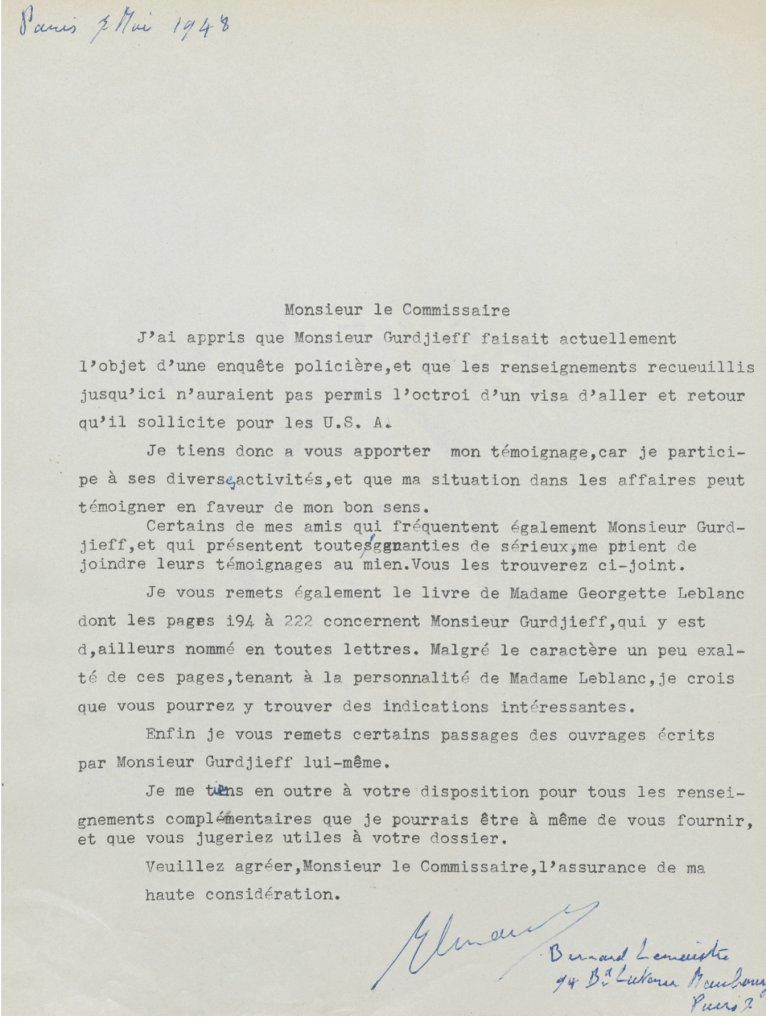
On the 9th of May, 1948, Lemaistre wrote to the Commissioner of Police in Paris
(English translation)
Paris 9 May 1948
Mister Commissioner
I have learned that Mr. Gurdjieff is currently the subject of a police investigation, and that the information gathered so far has not allowed for the granting of the round-trip visa he is requesting for the U.S.A.
I therefore wish to offer you my testimony, as I participate in his various activities, and my position in business can attest to my good judgment. (my emphasis)
Some of my friends who also associate with Mr. Gurdjieff, and who all demonstrate a high degree of seriousness, have asked me to add their testimonies to mine. You will find them enclosed.
I am also giving you the book by Mrs. Georgette Leblanc, pages 194 to 222 of which concern Mr. Gurdjieff, who is, moreover, named in full therein. Despite the somewhat excitable nature of these pages, due to Mrs. Leblanc’s personality, I believe you may find some interesting information there.
Finally, I am submitting to you certain passages from the works written by Mr. Gurdjieff himself.
I am also at your disposal for any further information I may be able to provide, and which you may deem useful to your case.
Please accept, Commissioner, the expression of my highest consideration.
Bernard Lemaistre
94 Boulevard de la Tour-Maubourg
Paris 7
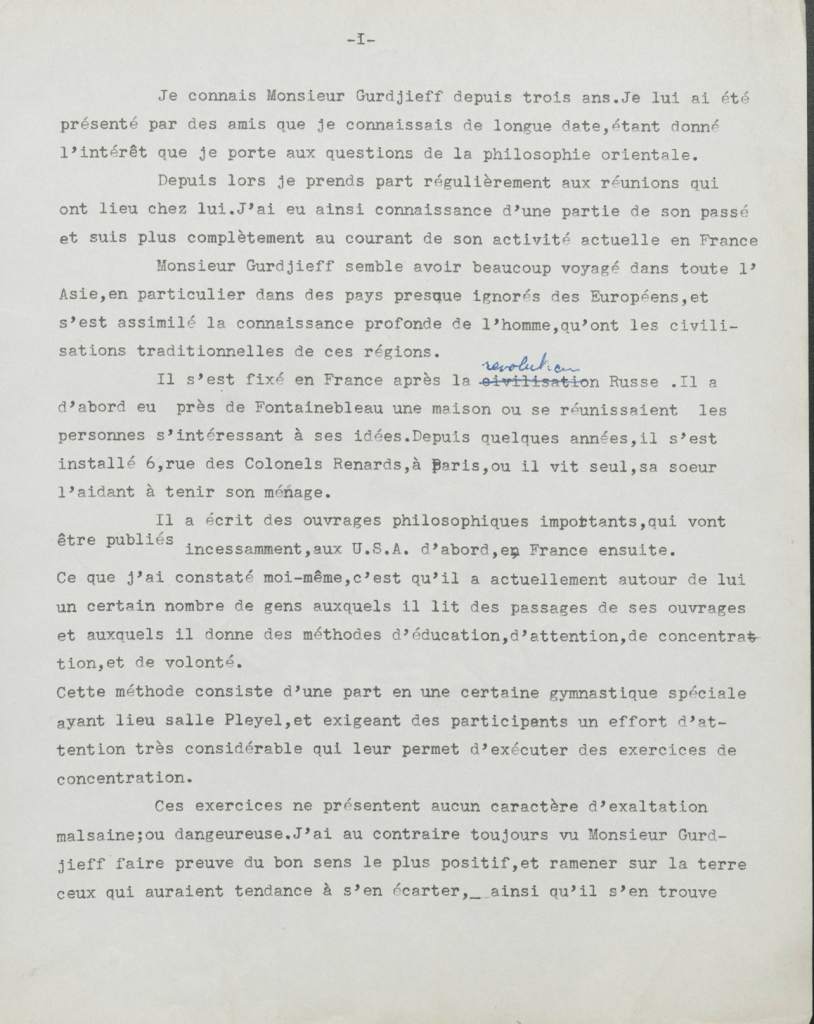
He also included a two-page personal reference.
(English Translation)
I have known Mr. Gurdjieff for three years. I was introduced to him by longtime friends, given my interest in questions of Eastern philosophy.
Since then, I have regularly attended the meetings held at his home. I have thus learned about part of his past and am more fully aware of his current activities in France.
Mr. Gurdjieff seems to have travelled extensively throughout Asia, particularly in countries almost unknown to Europeans, and to have assimilated the profound knowledge of man possessed by the traditional civilizations of these regions.
He settled in France after the Russian revolution. He initially had a house near Fontainebleau where people interested in his ideas gathered. For the past few years, he has lived at 6, rue des Colonels Renards (sic), in Paris, where he lives alone, his sister helping him with the household.
He has written important philosophical works, which will be published imminently, first in the USA, then in France.
What I have personally observed is that he currently has a number of people around him to whom he reads passages from his works and to whom he gives methods of education, attention, concentration, and willpower.
This method consists, on the one hand, of a certain special exercise taking place at the salle Pleyel, requiring a very considerable effort of attention from the participants, which allows them to perform concentration exercises.
These exercises do not present any unhealthy or dangerous characteristics. On the contrary, I have always seen Mr. Gurdjieff demonstrate the most positive common sense and bring back down to earth those who might tend to stray from it, as is sometimes unfortunately the case.
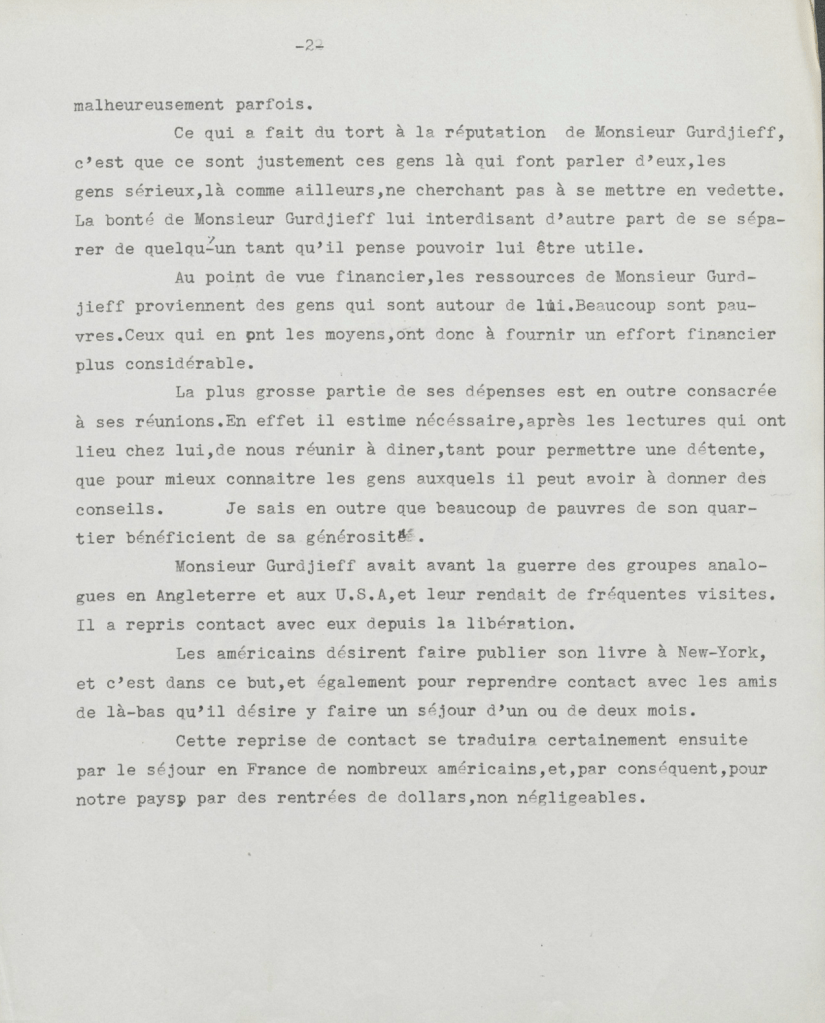
What has damaged Mr. Gurdjieff’s reputation is that it is precisely these people who attract attention; serious people, here as elsewhere, don’t seek the limelight. Mr. Gurdjieff’s kindness, moreover, prevents him from parting with someone as long as he believes he can be of service to them.
From a financial point of view, Mr. Gurdjieff’s resources come from the people around him. Many are poor. Those who can afford it therefore have to make a more considerable financial effort.
The largest part of his expenses is also devoted to his meetings. Indeed, he considers it necessary, after the readings that take place at his home, to gather us for dinner, both to allow for relaxation and to get to know better the people to whom he may have to give advice. (my emphasis) I also know that many poor people in his neighbourhood benefit from his generosity.
Before the war, Mr. Gurdjieff had similar groups in England and the USA, and he visited them frequently. He has re-established contact with them since the Liberation.
The Americans wish to publish his book in New York, and it is for this purpose, and also to reconnect with friends there, that he wishes to spend one or two months there.
This re-establishment of contact will certainly then result in many Americans visiting France, and, consequently, in a significant influx of dollars for our country.
After Gurdjieff’s death (29 October 1949) Lemaistre accompanied Jeanne de Salzmann to New York aboard the “Queen Elizabeth” arriving on the 7th of December.
Jessmin and Dushka Howarth, It’s Up to Ourselves page 295
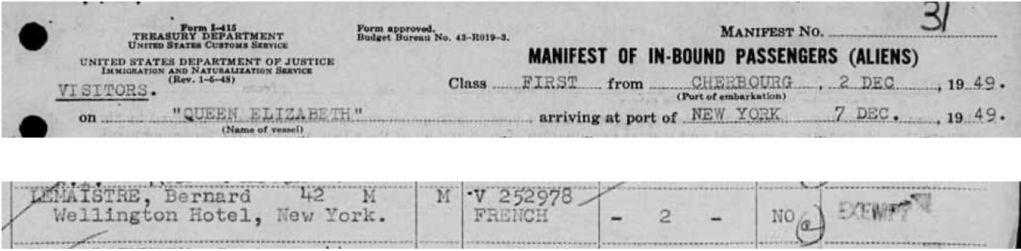
During this visit Jeanne de Salzmann’s primary focus was on organising Gurdjieff’s followers in America and securing his legacy. She brought together the various fractured groups, principally Madame Ouspensky’s people at Mendham in New Jersey and the old Orage group members in New York. Her visit laid the groundwork for what would (in 1953) officially become the Gurdjieff Foundation of New York. William Segal, an initial co-chair of the Foundation described Madame’s skill in reconciling the groups as “sheer wizardry”. One of her strategies was to send Martin Benson to live at Franklin Farms because, although he was vehemently “anti-Ouspensky”, he was a person who, as Segal (an Ouspenskyite) puts it, “we could all like”. During this time, she also co-ordinated the publication of the first series of Gurdjieff’s writings, Beelzebub’s Tales to his Grandson which appeared in February 1950. With Jessmin Howarth she also worked on the preservation of Gurdjieff’s Movements.
There is no record of de Salzmann or Lemaistre entering the United States over the next nine months and they are recorded as flying back to Paris from New York on September 11th 1950.
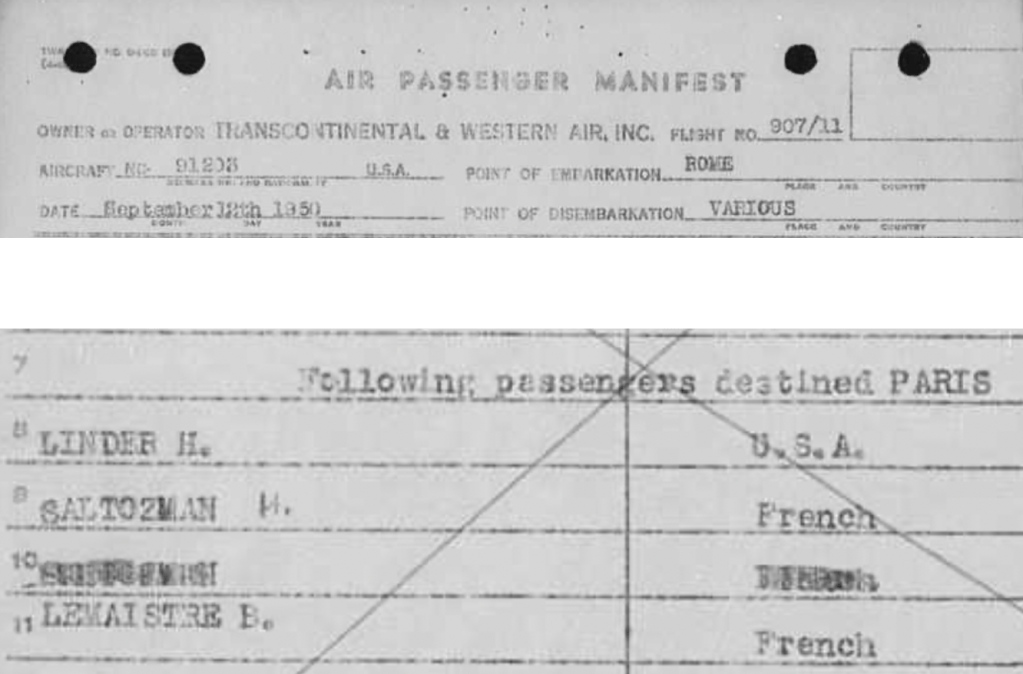
I have been unable to find any mention of Lemaistre in American Gurdjieff group members accounts of Jeanne de Salzmann’s time there in 1950. So why did she bring Lemaistre with her, if in fact that was the case? It is possible she wanted to draw on his high-level business experience and practical advice in finding ways to bring the Gurdjieff groups together, negotiate publishing contracts and establish a basis for the later Gurdjieff Foundation, but it is more likely that Lemaistre, a director of Paribas, was primarily in New York to review and reassess their American operations after the War.
At the time foreign banks were unable to establish full branches in the United States. Between World War I and the 1960’s Paribas forged major ties with the American oil industry, most notably with Standard Oil. In 1922 they had established the French-American Cie (company) Standard (51% owned by Paribas) by partnering with the Standard Oil Company of New Jersey (then the largest oil company in the world) to secure international oil concessions. Under the agreement, Standard Oil managed the operational side of the business while Paribas provided the financial backing and political leverage. A Paribas representative, Maurice Bowyer, remained in New York throughout the Second World War.
Following the invasion of France in June 1940, the US government immediately intervened to prevent Nazi Germany from seizing French assets held in American banks, which included Paribas’ capital, securities and corporate holdings. Because directives coming out of occupied Paris were assumed to be written under Nazi duress, Boyer operated with a high degree of autonomy. His primary focus was safeguarding Paribas’ joint ventures with the American energy sector. By keeping French-American Cie Standard legally insulated from the occupied parent company, he prevented the German war machine from exploiting Paribas’ lucrative American oil connections and pipelines.
During the German occupation (1940-1944) French banks operated under intense pressure. They had to navigate a dual reality of forced institutional collaboration and covert resistance. They were caught between the collaborationist Vichy regime – which used financial channels to pay massive daily occupation indemnities to Germany – and individual bankers who used their institutions to actively fund the underground movement. One of these was Andre Debray (1905-1954), a director of Paribas who used his position and the bank’s resources to secretly finance the French Resistance during World War II. He used his private office inside the historic Paribas headquarters at 3 rue d’Antin in Paris to organise clandestine meetings.
Through a number of banks, he helped raise the economic equivalent of US$400 million from wealthy donors that was funnelled to the Resistance. Within the bank it is said, only he and his personal assistant were privy to the details, but after the War it became nationally known and this action helped him prevent the nationalisation of the private Paribas when the central bank and the big four commercial banks were nationalised on 1 January 1946.
While I have no direct evidence that Lemaitre was aware of or involved in any of this it is striking that after the War, he was associated with and helped prominent Resistance figures Philippe Viannay, his wife Hélène Viannay, Jacques Richet and Jean Gandelin in running their non-profit sailing school by loaning his schooner Rollon to the school.
THE SAILOR AND HIS YACHT
After the War a small tight knit group of former French Resistance fighters who had operated the clandestine newspaper Défense de la France set up a camp/sanctuary on the Glénan Islands, in southern Brittany as a place to help young veterans from the French Resistance rehabilitate, bond, and transition back into civilian life. The original members and key leaders included Philippe Viannay, his wife Hélène Viannay, Jacques Richet and Jean Gandelin. Philippe Viannay and Jacques Richet had co-founded the CFJ journalism school in Paris. The camp operated as the non-profit CCFIJ Centre de coopération fonctionnelle de l’enfance et de la jeunesse (Functional Cooperation Centre for Children and Youth) which later became the Centre de coopération fonctionnelle de la jeunesse (Youth Functional Cooperation Centre). Jean Gandelin served as the Executive Director of the CCFIJ and handled the day-to-day operations and organizational strategy. As part of their camp’s activities, they established a non-profit sailing school. (today Europe’s largest nonprofit sailing school)
https://www.vedettes-odet.com/en/cruises/les-glenans-sailing-school/
Many in the Lemaistre family were keen sailors and yachtsmen, and Bernard and his son Alain, were no exception. Alain had been attending les Glénans sailing school during his school holidays since 1949. Shortly after returning with Madame de Salzmann from America Lemaistre acquired a small sailing yacht, the Brise Vent (Wind Breaker) from Paul Fortin a prominent yachtsman and banker from Angers. Lemaistre renamed it Rollon after the Viking leader who had founded the Duchy of Normandy in 911 AD and in February 1951 became a member of the Yacht Club de France.
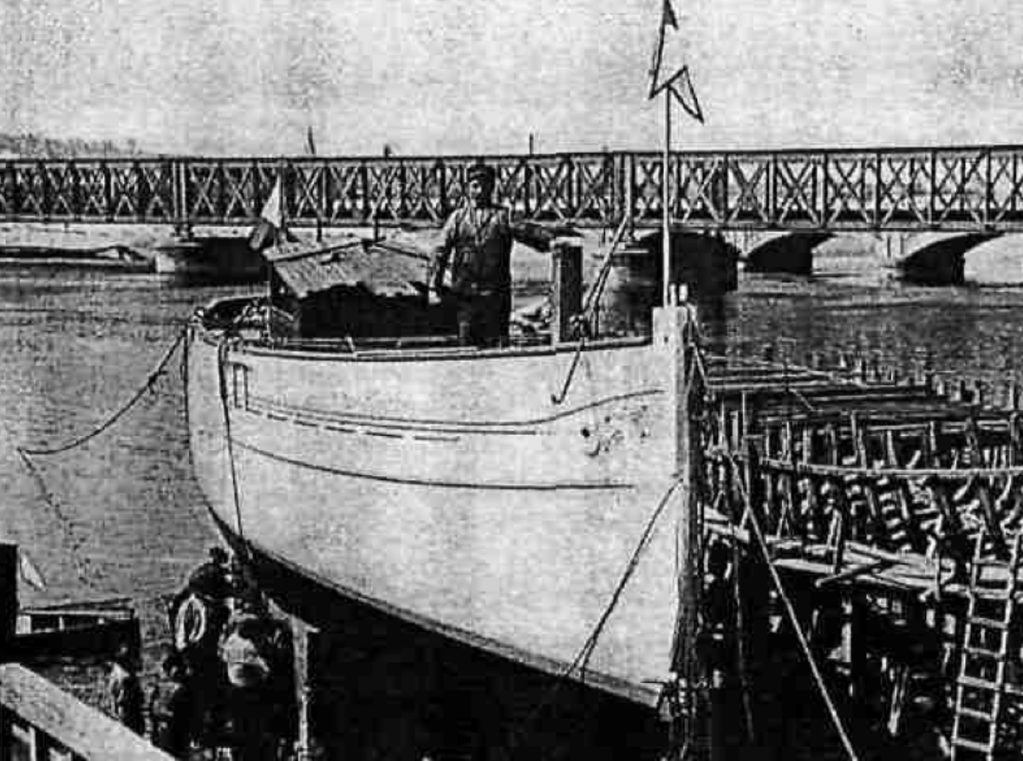
Launch of Brise-Vent in 1928 by the Lefèvre shipyard in Boulogne-sur-Mer for Mr. Paul Fortin (page 11)
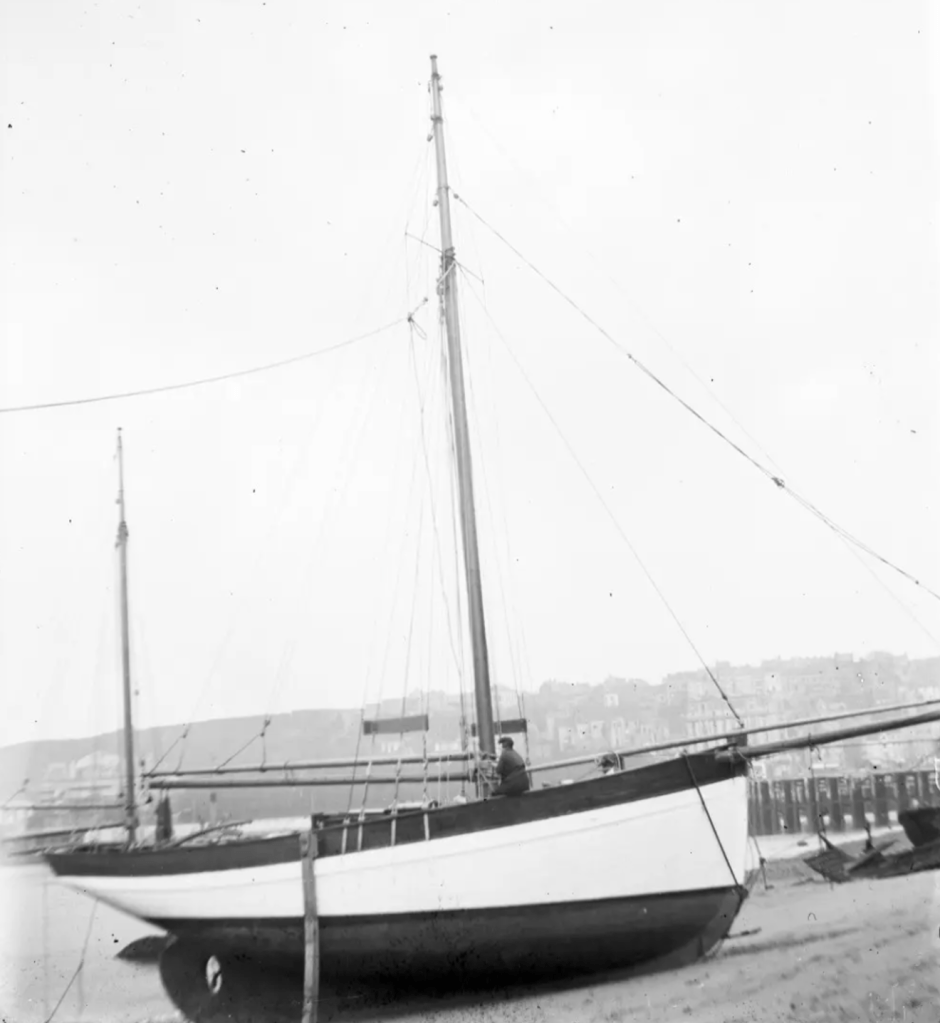
Brise- Vent at Lefèvre shipyard in Boulogne-sur-Mer 1928
https://lesartisansdelamer.com/#gallery
Le Yacht 22 Septembre 1928
Boulogne-sur-Mer.
The 15.35-meter auxiliary motor yacht, Brise-Vent, owned by Mr. Georges Fortin, recently left our port. It should be noted that it was built by the Pas-de-Calais Shipyards (Léon Lefèvre) in an exceptionally short timeframe, as the cast-iron keel (6.5 tons) arrived on site on June 19th and the boat was ready to be launched on August 10th, that is, eight weeks later. The launch was successfully completed on the tide of August 17th; the fittings were immediately completed in conjunction with the rigging, so that the Brise-Vent set sail on August 30th.
It had been designed by the naval architect Talma Bertrand who designed the Anahita, which sailed around the world in 1936 with Commander Bernicot. In 1928, Paul Fortin, who had already commissioned several designs from Talma Bertrand, asked him to design Brise-Vent, a sturdy 15-meter cutter clearly inspired by the English Tally Ho, designed by Albert Strange and winner of the Fastnet Race in 1927. This boat, with its large displacement, appeared somewhat heavy due to a lack of overhanging lines, but had very fine hull lines. It was built by the Lefèvre shipyard in Boulogne-sur-Mer. Its gross tonnage was 24.5 tons. The hull was oak, the fittings teak, the deck Nordic pine. It was equipped with a 7.1 litre, 8-cylinder Renault -Nerva Stella engine, developed for use in Renault’s answer to the Rolls Royce, the 1928 luxury Renault Reinastella.
Father and son had been sailing the Rollon for the last three years when Lemaistre offered to loan it to the Les Glénans sailing school to be used as a ship-school for navigation courses and cruise operation. By this time Alain had become a volunteer sailing instructor there.
THE FATEFUL LAST VOYAGE OF THE ROLLON
Over the winter of 1952 the Rollon had been moored in the Mediterranean between two old tuna boats converted into pleasure craft in the small port of Bandol, fifty miles east of Marseille. At the beginning of March 1953, two volunteer instructors from Les Glénans sailing school, Jean Gandelin and Jean Lepape, travelled to Bandol to prepare the boat for sailing back to Les Glénans, via the Strait of Gibraltar.
When Gandelin arrived in Bandol he told his neighbours on the quay that he was going to take it back to Brittany, but it was necessary to do some work on the boat. One of the tuna boat owners gave him an address of a shipyard in La Seyne nearby. There significant changes were made to the boat. The mast was moved back and replaced, a sternpost was installed behind the cockpit, modifications were made to the living quarters and new more responsive rigging added.
On 29th March the boat was ready in Marseille to pick up the other crew; Lemaitre and his son Alain; Jacques Richet, secretary general of the Centre de Formation des Journalistes ; Dr. André Cambessedès, of the Paris hospitals; Jean Luiset, director of a children’s home in the Tarn region and Jean Behagire, intern at the Paris hospitals. On Easter eve, 4thApril the small sailboat with auxiliary engine and no radio left Marseille. In a later interview Bernard’s son Alain recounted the circumstances leading up to the disappearance of the Rollon.
France-soir, 24 April 1953 (page 3)
At the Orléans high school, a 19-year-old anxiously awaits news of the unfortunately fruitless searches undertaken so far to find the “Rollon.” He is Alain Lemaître, son of the yacht’s owner, who left the vessel on April 12 at the Palma dock. His classmates surround him with their sympathy and respect his silence.
This tall young man, with an athletic build and a thin blond mustache, has been a boarding student at the Orléans high school since the start of the academic year in October, in special mathematics classes. But the slightly melancholic gaze of his blue eyes seems to reach far beyond the somber walls of the school. He has a passion for the sea and sailing. As soon as he speaks of it, even in the hours of anguish his eyes light up and his voice becomes stronger. Since the age of 15, he has devoted all his holidays to the sea. He took courses at the Glénans sailing school, near Concarneau, and became an instructor there. Since his father bought the Rollon, he has been part of every cruise. He was also a student of the two experienced sailors, instructors at the Glénans, who were aboard the Rollon: Jean Le Pape and Jean Gandelin, who was acting as captain.
“The Rollon,” Alain Lemaître told us, was a very well-built boat, designed to withstand storms. It measured 15.5 meters at the waterline and 20 meters over the deck. It had been built according to the plans of an English boat that won numerous competitions. In particular, it had won a difficult race in bad weather, when most of the other boats had sunk.”
–So you think it was capable of withstanding the storm it faced?
It was in perfect condition and equipped with all the necessary lifesaving equipment. Moreover, for the past three years, we’ve done numerous cruises and participated in several competitions. Last year, after a Mediterranean cruise, we left the yacht in Bandol. We wanted to take advantage of the Easter holidays to bring it back to Les Glénans, its home port. So we left Marseille on Sunday, March 29th. We planned to stop in Cartagena or Gibraltar, then Lisbon. However, right from the start, we had very bad weather, and on Monday, March 30th, the auxiliary engine broke down, forcing us to make our first stop in Port-Vendres, from where we departed again on Wednesday, April 1st
On Good Friday night, a more violent storm forced us to change course and take shelter in the harbor at Oran. Faced with the rough seas, Gandelin and Le Pape decided with my father to return to Bandol instead of heading for the Atlantic. We left Oran on Easter Tuesday; the sea was still very choppy, and we sailed towards the Balearic Islands. As my vacation was drawing to a close, the yacht stopped in Palma to disembark me. I took a steamer to Barcelona on Sunday the 12th and I went to Orléans by train.
The Rollon left Palma at the same time as me on Sunday the 12th, not the 13th as has been said. Since then, I have no further news than what you already know
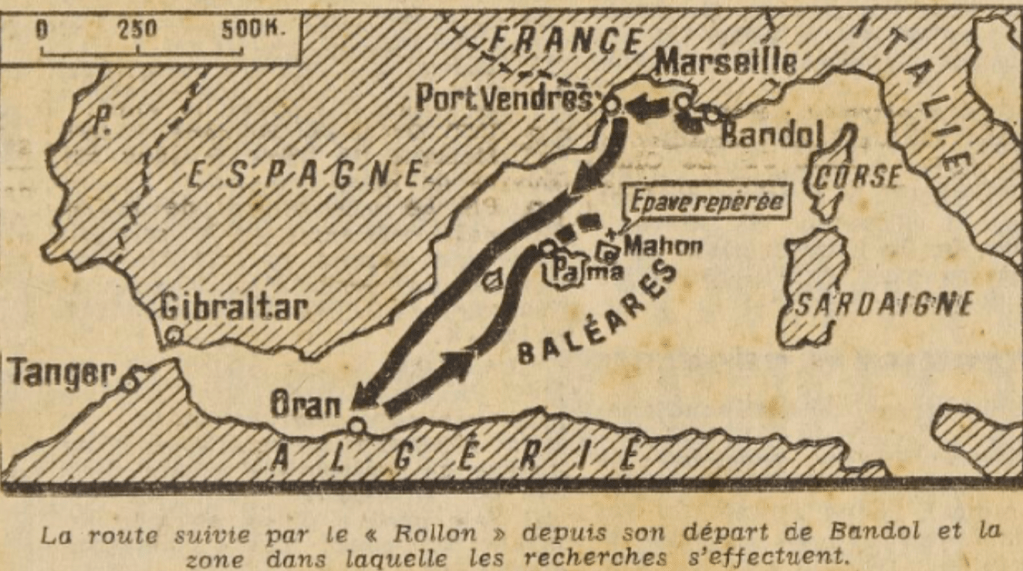
The route of the Rollon
On leaving Palma on the 12th April the Rollon had fuel for four days sailing and was expected to arrive in Bandol on the 17th but appears to have capsized and sank, sometime between the 14th and 15th April. A solo sailor in the area at the same time described the impossible conditions.
La Depeche de Constantine 2 June 1953 (page 5)
THE YACHT ROLLON, MISSING IN THE MEDITERRANEAN, WAS MAY HAVE BEEN CAUGHT IN A REAL HURRICANE
Oran. During his visit to Oran, which he has just left for Tangier, the solo sailor Peter Danieluk, a Pole who escaped from his country and who, after a brief stay in Sweden, left in 1952 for Australia aboard an old lifeboat, “La Maria,” made a revelation that seems to shed at least some light on the mystery of the disappearance in the Mediterranean in April of the French yacht “Rollon” and, above all, of its occupants
Danieluk, who had been refused passage through Suez because his boat was too slow to escape potential pirates in the Red Sea, was returning to Gibraltar when, on the evening of April 14, the probable date of the shipwreck, just after rounding Sardinia, he was caught in a veritable hurricane that arose in a matter of minutes.
Danieluk only had time to lower his mast and close the watertight cabin roof. An enormous wave, eight meters high, rolled “La Maria,” capsized her, and literally engulfed her. The special seaworthiness of this boat, designed for storms, allowed her to stay afloat. The storm lasted all night.
It was only later, during his stopover in Bougie, that the solo sailor learned of the sinking of the “Rollon.” He made a connection. The dates coincided. According to him, even with a crew experienced at sea, the “Rollon” could not have escaped shipwreck, caught off guard by such a tornado.
Danieluk also confirmed the accounts of Algerian sailors who claimed to have crossed in these waters veritable schools of sharks. The sharks, in impressive numbers, surrounded his dinghy, showing their mouths and fins and heading east. Never, in living memory, had such a gathering of sharks been reported in Mediterranean waters.
Danieluk, who is heading to Casablanca, has given up on Australia, which he cannot reach via Suez, and after a stopover in the major Moroccan port, will attempt the crossing to South America, where he wants to resume his work as a mechanic
Eight days later hopes were raised on the 22nd April when a plane reported spotting wreckage and possibly some survivors in an inflatable raft, but despite a three-day intensive sea and air search nothing was found linked to the Rollon and the search was called off at noon of the 25th April. The incident was recorded as a “disappearance”, a specific term used when a vessel vanishes without leaving any physical evidence such as oil slicks, debris or lifeboats.
A notice appeared in the 1953 third quarter issue of the official bulletin of the Yacht Club of France for a memorial service for Bernard Lemaistre on Wednesday 3rd of June, 1953 at the Oratoire du Louvre Protestant church in Paris.
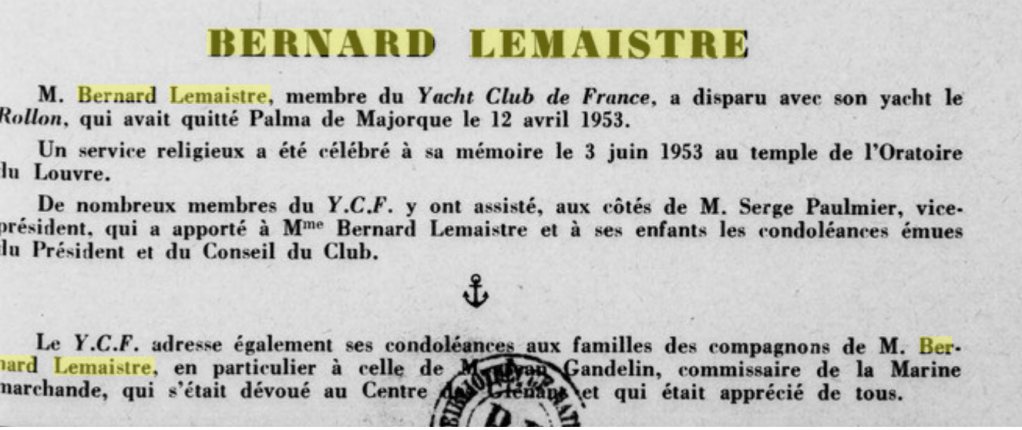
BERNARD LEMAISTRE
Mr. Bernard Lemaistre, a member of the Yacht Club de France, disappeared with his yacht, the Rollon, which had left Palma de Mallorca on April 12, 1953.
A religious service was held in his memory on June 3, 1953, at the Oratoire du Louvre church.
Many Y.C.F. members attended, along with Mr. Serge Paulmier, Vice-President, who conveyed the heartfelt condolences of the President and the Council of the Club to Mrs. Bernard Lemaistre and her children.
The Y.C.F. also extends its condolences to the families of Mr. Bernard Lemaistre’s companions, in particular to that of Mr. Jean Gandelin, who had dedicated himself to the Glénans Centre, who was appreciated by all.
UPDATE 2 September 2026
The English yatch Tally Ho that Lemaistre’s Brise-Vent/Rollon was copied from, was recently restored and sailed back to England from the United States.
A youtube video of the event, giving a good idea of the size of the Rollon and what it would have been like sailing on it can be viewed at

