Elizaveta (“Lili”) Sergeevna Galumnian Chaverdian (Shahverdyan) was from 1919 to 1932 one of Gurdjieff’s closest and most important pupils, both as a leading dancer and movements instructor at his Institute for the Harmonious Development of Man, initially in Tiflis (Tbilisi), then Constantinople (Istanbul), Berlin, Paris and finally at the Prieure in Fontainbleau, and later as a translator (from Gurdjieff’s Armenian) and typist for the Russian version of Gurdjieff’s Beelzebub’s Tales to his Grandson. Though married, in Gurdjieff’s circle, she was known as Lili Galumnian – in Russian society, married women frequently retained their maiden names after marriage for informal use.
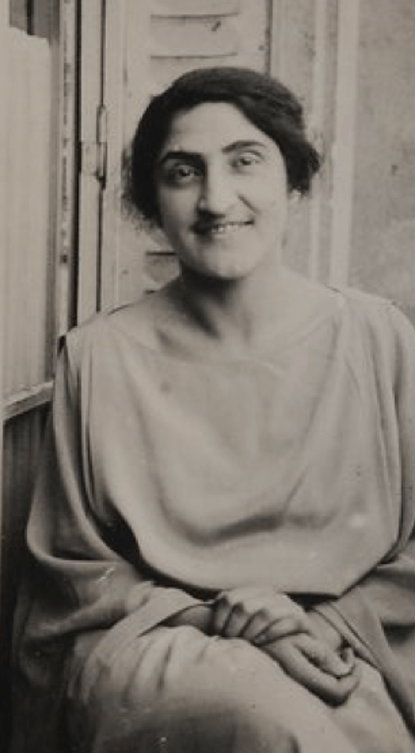
Lili Galumnian, the Prieure 1923 (Tania Negro Collection)
Lili Galumnian with Gurdjieff
Lili, a dancer, first met Gurdjieff in April 1919 in Tiflis when she was either assisting Jeanne de Salzman with her school of Dalcroze Dancing or a student at the school. Her involvement with Gurdjieff is recounted by Thomas and Olga de Hartmann in their book
Our Life with Mr. Gurdjieff, ARKANA, Penguin Books, London, Definitive Edition, 1983
In Tiflis
My activities began to widen, I wrote for newspapers. My first article concerned the Armenian composer, Komitas Vardapet, about whom I wrote a biographical sketch and a critical analysis of his choral music and compositions for solo voices. Later, I gave lectures on him as an introduction to concerts of his music. My wife took part in these concerts. She even learned some of his songs in Armenian, as we had an Armenian pupil, Lili Galumnian, who taught her how to pronounce the words. The Armenian themselves did not know what a wonderful composer they had and did not realize the place he held in their culture.
Thomas pages 133, 134
Work on the exercises began to go very intensively. A special women’s class was formed of the most talented and inwardly devoted pupils. With them Mr Girdjieff developed those women’s dances that later were shown in the public demonstrations in Paris.
Several times the director of the State Theatre sent about fifty of his Georgian students to study our exercises. They were not of the intelligentsia, but were nice, simple young people, dreaming of work in the theatre. Mr Gurdjieff gave them special, uncomplicated exercises, for which Lili Galumnian was always the instructor. In one of them, for example, to a slow rhythm of ‘one…two…’, she improvised an arm position on ‘one’, which they copied on ‘two’, and so on each succeeding ‘one’ she added legs, head, trunk or changed some elements, all of which had to be repeated by the others on ‘two’.
Thomas page 144
Another evening, when the only pupils available were Madame de Salzmann, Lili Galumnian, Nina Lavrova and a young girl of ten, Mr Gurdjieff worked on the scene where the elderly assistant of the White Magician arrives. One of the pupils asks him about the law of the movement of the stars. The young girl portrayed the pupil’s question with a convincing upward gesture to the heavens. The whole scene was mimed and their movements were quite originally conceived.
Thomas page 146
In Constantinople
Mr Gurdjieff began to plan the opening of the Institute, as Madame de Salzmann, with Lili and others of her pupils, had followed him from Tiflis.
Thomas page 154
In Berlin
Dr Stjernvall had come back from Finland, bringing a considerable sum of money for the Work. Before winter, Mr Gurdjieff worked on Gymnastics with all those who came.
Thomas page 163
After that Mr Gurdjieff devised something very difficult for me personally/ He rented a very nice little house by the sea and said that all the women had to go and live there for at least a week, maybe more. His wife, Madame de Salzmann, Madame Hinzenberg (later Mrs Frank Lloyd Wright), Madane Zhukov, Madame Lavrova, Madame Galumnian and certainly I had to go.
Olga page 164
At the Prieure
October 1922
Often, Orage found himself alone with Russians who spoke not a word of English. Luckily, the de Hartmanns, Lily Galumnian, and Elizaveta de Sternvall knew some English, and the Ouspenskys were often there.
Paul Beekman Taylor, Gurdjieff and Orage, Brothers in Elysium, Weiser Books, York Beach, Maine 2001, page 25
March 1923
He divides them into seven groups. In the first group he puts Dr. Stjoernval, Frank Pinder, Dr. James Young, and A.R.Orage. In the last group are Madame Uspenskii, her daughter Lenotchka, Boris Ferapontoff, Elisabeta Galumnian and Jeanne de Salzmann. Gurdjieff then declares that only the first group is to remain at the Prieure – all others must leave. Though he personally has nothing against some of the people in the last group, he says he is obliged to put some people there because of their connection with Uspenskii. As these are older students accustomed to Gurdjieff’s shocks, none leave.
Patterson, William Patrick. GEORGI IVANOVITCH GURDJIEFF The Man, The Teaching, His Mission, Arete Communications Publishers, Fairfax, California 2014, pages 139, 140
On the third floor the rooms all opened onto the same corridor, which was painted dark brown and black. We called it the ‘Monks’ corridor and here all the people who had come with Mr Gurdjieff had their own rooms. Over Mr Gurdjieff’s was an empty room, which was seldom used, and then came our room, Madame Ostrovsky’s and Madame Ouspensky’s together, then Miss Merton’s and Miss Gordon’s, also together. And in the furthest rooms were Lili Galumnian and the de Salzmanns. There was even an attic where additional people could stay.
Olga page 171
One day by chance I saw the following list Mr Gurdjieff had put up:
List of Responsible Members of the Institute of G.Gurdjieff.
In the Capacity of Instructors:
- Julia Ostrovsky
- Olga de Hartmann
- Dr Leonid Stjernval
- Thoma de Hartmann
- Pyotr Ouspensky
- Alexandre de Salzmann
In the Capacity of Assistant Instructors:
- Sophia Ouspensky
- Jeanne de Salzmann
- Olga Hinzenberg
- Elisaveta Galumnian
- Boris Ferapontov
- Dr Konstantin Kiselev
Olga pages 176, 177
As recorded by Orage and others, Lili spoke English. When she arrived in New York with Gurdjieff’s party on January 13, 1924, the immigration manifest of alien passengers shows Russian and English as languages that she could read, which was one of the reasons why Gurdjieff kept her with him in New York when the others returned to France.
In America
The day of our departure for France approached. Mr Gurdjieff told my wife on the last day that he needed me to stay with him in New York. As her presence was indispensable at the Prieure, she was to go back with the pupils. My wife could not agree to this and asked Mr Gurdjieff to decide which he needed more: her presence in the Prieure or mine in New York. Mr Gurdjieff was very displeased with her refusal, but in such a situation my wife could not be moved and he knew it. During supper he told her that he preferred her and that he would keep Madame Galumnian with him.
Thomas page 218
… when Gurdjieff held lectures and a class in movement at the Rosetta O’Neill Studio on upper Madison Avenue (led by Lili –my insert)
Munson, Gorham. THE AWAKENING TWENTIES A MEMOIR-HISTORY OF A LITERARY PERIOD Louisiana State University Press, Baton Rouge 1985, page 255
When Mr Gurdjieff came back, we learned that he had kept Madame Galumnian with him in order to dictate to her some recollections of his youth in the Caucasus, concerning his ‘Universal Workshop’. He scraped together enough money to rent two small, cheap rooms, where they began as energetic a work only Mr Gurdjieff knew how to create – dictation, transcription, typing, revision, again dictation… For a while they literally starved, not having the wherewithal to buy food, but the work had to go on, and it did. And when it was finished, money appeared, from lectures given by Orage and Movements classes for Americans given by Madame Galumnian. They returned at the beginning of June in first-class cabins.
Thomas page 219
Back At the Prieure
1925 after Mr Gurdjieff’s 1924 near fatal car accident
He began to come to the study house in the evenings. We were all very worried that it would make too strong an impression on him and that we would not be able to get him home. As always, he asked those who led the Movements and showed the positions, ‘Jeanne, Lili, Nina, what are the pupils working on’. The first time it happened we decided to go away at ten o’clock so that even if Mr Gurdjieff wished to stay longer, he would see that everybody had gone and so would leave too. But later we could not even do that anymore. He ordered everything himself as before.
Olga page 231
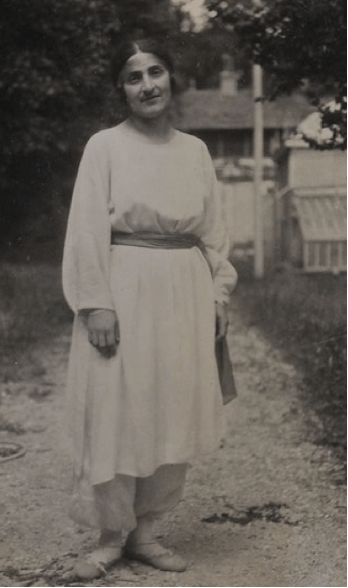
Lili Galumnian, the Prieure, in her Movements costume (Tania Negro Collection)
Remaining at the Prieure after the closure were Madame Ostrovsky, Dr and Madame Stjernval and their son Nikolai, the de Salzmanns with Boussik and Michel, Miss Merton, Miss Gordon, Lili Galumnian, Nina Lavrova, Bernard Metz, Rackhmilevich, and the two of us, along with members of Mr Gurdjieff’s family: his mother, his sister Sophia and her husband, his nephew Valya and his niece Lucie. The rest soon dispersed. There remained only those few of us, and at the same time there remained the same pile of work required to maintain a huge estate.
Thomas page 236
1926 January
Indeed Gurdjieff had Elizabeth Chaverdian write a letter to Mabel acknowledging the money, but turning down the offer of her Taos house on the grounds that it was unsuitable, and that he would be unable to liquidate the Prieure.
Paul Beekman Taylor, Gurdjieff and Orage, Brothers in Elysium, Weiser Books, York Beach, Maine 2001, page 105
1926 June 26
Gurdjieff’s wife Julia dies
1926 October
Along with Lili Galumnian, Orage has been tirelessly working on editing Beelzebub’s Tales, sometimes as many as twelve hours a day and then giving it to Miss Merton to type.
Patterson, William Patrick. GEORGI IVANOVITCH GURDJIEFF The Man, The Teaching, His Mission Arete Communications Publishers, Fairfax, California 2014,, page 212
1926 December 9
leely is pregnant, and I understand, is not at all pleased (Orage’s letter to Jesse)
Paul Beekman Taylor, Gurdjieff and Orage, Brothers in Elysium, Weiser Books, York Beach, Maine 2001, page 125
1927 May 6 Sergei born
Sergei was born May 6, 1927 in Boulogne-Billancourt, Paris, Ile-de-France (France)
He would have been conceived early August 1926, only two months after Julia’s death.
When Lili arrived in the United States on January 13, 1924 with Gurdjieff and his party she gave the name of her contact in France as Friend, Mrs Melik Noubaroff, Fontainebleau, France 7 Rue d’Erlanger, Paris Fontainebleau. This address is in Paris not Fontainbleau, a kilometre north west of Boulogne-Billancourt in the 16th Arrondissement. It is likely that Lili spent the later weeks of her pregnancy in Paris with this Armenian friend.
1929 September 5
Gurdjieff and Chaverdian are recorded as staying at Hotel De L’Amiraute, Vichy
1931
The 1931 French Census, list of the residents of Basses-Loges, Avon (the Prieure- my insert) includes Elisabeth Galumnian CHAVERDIAN born in Erevan (Yerevan) in 1896.
Last Days at the Prieure
1932 May 3
I take the train to Paris. I am collected, though both stomach and nerves feel poorly. I go straight to the Café de la Paix. It is eleven o’clock. Gurdjieff sits alone. When he sees me, a sharp electric spark passes between us. He motions me to sit down. After a few unsuccessful attempts to speak, I hear my trembling voice saying. “I have come to say goodbye to you.” What a release! I have said it. I sit very calmly.
Gurdjieff with a good and, so to say, touched look replies,
“You are very kind,”
“I very kind?”
“Yes, you musted be hated me, be angry.” Gurdjieff makes fist.
“I must?” I ask.
“Not must, but so is man. I do not wish know. I do not ask. I know now there in Prieure some hate me. Make worst man of me. I do so and so. They not know how much they cost me, even their shit. To take away their shit, 5000 francs a year. Or, as example, Lili -such political situation. I pay 200,000 francs every year to keep spies away. She does not know of course. (my emphasis) You, truth, in work almost full honor, and you also only one mouth to feed. That already better. Work and one mouth. Others, four or five mouths Yes, of course, you do not know what I did for them. You many things not know.
Annabeth McCorkle, The Gurdjieff Years 1929-1949, Recollections of Louise Goepfert March, Expanded Edition, Eureka Editions, 2012 pages 85,86
There appears to be some typical Gurdjieff exaggeration in the amount he claims he paid yearly in bribes. Based on 1925 exchange rates it was equal to US $9,500 which in 2026 would be approximately US $180,000 a year. What was the situation surrounding Lili Galumnian that would require such action?
Her husband was Danush (Daniel) Chaverdian a leading overseas representative and member of the communist government of the Armenian Soviet Socialist Republic formed as part of the Transcaucasian Socialist Federative Soviet Republic (TSFSR) on 29 November 1920. From the very onset the Armenian communists, not only banned the activity of Armenian national parties especially the Armenian Revolutionary Federation (Dashnaktsoutiun) that governed during the brief existence of the First Armenian Republic within the country, but also embarked on a campaign against them and their affiliate organizations in the Diaspora, including in France. It is possible one of these groups was endeavouring to spy on Lili.
Lili’s husband Danush Shahverdyan
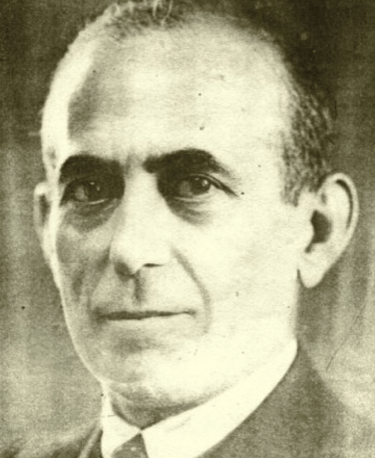
Danush Shahverdyan (Daniel Aleksandrovich Chaverdian)
Danush was born January 11, 1882 in the village of Aygehat in the Lori region of Armenia. He received his secondary education in Tiflis and graduated from the Law Faculty of St. Petersburg University in 1911.
He was an active participant in the revolutionary movement from 1902 when as a twenty-year old he participated in the creation of the short- lived Union of Armenian Social Democrats in Tiflis, which was established as a branch of the Russian Social Democratic Party (RSDLP). In 1903 he participated in the First Congress of the Caucasian Organizations of the RSDLP in Tiflis. Following the Bolshevik-Menshevik split at the Second Congress in Brussels and London he became a party member in 1904 of the Russian Social Democratic Labour Party (Bolshevik). He worked in St. Petersburg and Tiflis, participating in the publication of the Armenian language Bolshevik newspapers “Kayts” (Spark), “Khosk” (Word) and “Banvori Kriv” (Workers’ Struggle) in Tiflis. In 1914, Danoush (32) became a mentor to future USSR Politburo Member, Anastas Mikoyan (19).
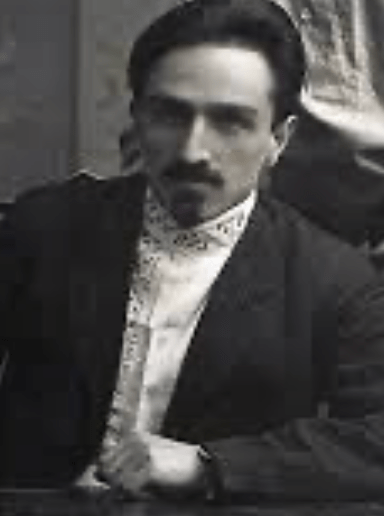
Anastas Mikoyan (1895-1978)
…That spring of 1914, I came across N. Ilyin’s book, “The Development of Capitalism in Russia.” It happened under the following circumstances. One day, I dropped by the apartment of my distant relative, Danush Shaverdyan, who worked as a lawyer in Tiflis (and, as I learned a little later, was a member of an underground Bolshevik organization).
After talking with him about my life, I told him about our studies. Danush already knew about the existence of the political circle at the seminary and approved of it. As we parted, he handed me a book and said, “Here, Anastas, read this more carefully!” He immediately explained that the real name of the book’s author—the theoretician and leader of the Social Democrats (Bolsheviks)—was Ulyanov-Lenin, who sometimes wrote under the pseudonym N. Ilyin. Thus, thanks to Shaverdyan, I first discovered Lenin…
I was pondering the events taking place and desperately needed the advice and clarification of a competent person. I felt the need to see Shaverdyan: I saw him as my senior advisor and mentor. Shaverdyan received me very warmly. He recounted Lenin’s assessment of the ongoing war in detail. Then, from a drawer, he pulled out a copy of the newspaper “Social-Democrat,” published in Geneva, printed on thin tissue paper, containing Lenin’s article “War and Russian Social Democracy.” Danush also gave me Lenin’s pamphlet “What Is to Be Done?”…
Danush was genuinely pleased with my progress, as he put it. This inspired me even more, and I decided to share my dream with him: “You know, Danush, I want to join your party.” Danush smiled and said there was no need to rush, that I needed to better prepare myself for such a decisive step. He suggested I read several of Lenin’s works, particularly “One Step Forward, Two Steps Back” and “On the Right of Nations to Self-Determination.” He also advised me to read the pamphlets of Shaumyan and Stalin on the national question, as well as Plekhanov’s “Our Differences.” I told him I was leaving for the village soon and intended, among other things, to begin studying the first volume of Marx’s “Capital.”…
One day, I reminded Shaverdyan of his promise to help me join the party. “Well!” he replied. “Now, I think you’re mature enough for that. Our activists know you well. We can think about accepting you.”
And indeed, in November 1915, I was accepted into the party. I was immediately given a party assignment: to conduct propaganda work among young students. The main topics of our discussions were the current problems of the war, the struggle to overthrow the autocracy, and the national question…
In Tiflis, I immediately went to Shaverdyan to find out all the latest party news. He said the first legal meeting of Bolsheviks was to take place tomorrow at the Zubalov People’s House.
Around 250 people attended the meeting… The main topic of discussion was the question of unification between the Bolsheviks and the Mensheviks. The rationale for unification was the fact that after the overthrow of the autocracy, a new situation had emerged: a number of tactical differences had been resolved by the people’s achievement of broad democratic freedoms and political rights. After lengthy discussion, the decision to unify was adopted by a majority vote.
The work of the Tiflis Committee was managed by the Committee Bureau. Philip Makharadze usually chaired the committee. Our primary focus was on preparing for the All-Caucasian Party Congress. It opened on October 2, 1917. I participated in the congress (it operated illegally) as a delegate from the party organizations of the Alaverdi, Manes, and Haghpat districts, where I was elected by the local Bolsheviks…
At that time, Danush Shaverdyan worked at the regional party committee—and I met with him often. Danush was universally loved and respected. Unfortunately, he was repressed in 1937 and died.
Memoirs of Anastas Mikoyan (in Russian)
https://militera.lib.ru/memo/russian/mikoyan/01.html
During World War I Danush carried out propaganda work in the Caucasian Army. In October 1917, he was elected to the Caucasian Land Committee of the RSDLP(b). In 1918-1920, he carried out underground party work in Georgia and Armenia. He was one of the organizers of the peasant uprising in the Dusheti region of Georgia. In 1919, he moved to Armenia and was elected a member of the Armenian Committee of the RSDLP(b) and the Foreign Bureau of the RSDLP(b).
Presumably, during these years he supported himself continuing working as a lawyer in Tiflis. He also found time to marry Lili, but I have been unable to find when and where this was. However, when Lili came into contact with Gurdjieff through Jeanne de Salzmann in Tiflis in early 1919, she was married. The fourteen- year age difference between her and Danush was similar to the fifteen-year difference between her friend Jeanne de Salzmann and her husband Aleander von Salzmann.
After the establishment of Communist rule in Armenia on November 29, 1920, Danush became a trade representative of the Armenian Revolutionary Federation in Constantinople (Istanbul). It also enabled him to re-establish contact with Lili who had moved there with Gurdjieff in June 1920. Lili left Constantinople for Berlin with Gurdjieff in August 1921. In 1922 Danush returned to Armenia and from 1922-1923 he held the positions of People’s Commissar of Justice of the Armenian Socialist Republic, Prosecutor of the Republic and Deputy Chairman of the People’s Commissars. He was a deputy of the 1925 XIV Congress of the Communist Party of the Soviet Union (Bolsheviks) in Moscow. From 1924-1928 he returned to Turkey as a trade representative. He was also involved with repatriation of Armenians from Greece and Bulgaria to Armenia.
In 1928–29, he was the representative of the Relief Committee for Armenia (Armenian Red Cross) in England, Germany and Belgium and from 1928 he also worked in the People’s Commissar of Foreign Trade of the USSR.
Danush’s work with repatriation as an official of the Relief Committee for Armenia and his contact with the Armenian General Benevolent Union in France, who provided the bulk of the aid to Armenia, was the basis for false charges that led to his arrest and imprisonment during Stalin’s purge of old Bolsheviks in the late 1930’s as detailed later.
From 1928 to 1936 he was primarily based in Paris, where he presumably re-established contact with Lili who was living at the Prieure with Gurdjieff and his remaining pupils. After the closure of the Prieure in 1932, Lili appears to have moved back to living with Danush. In the March 8, 1936 French Census, they are recorded as living in an apartment at 92 Rue Murat, Paris with their nine-year old son Sergei. This was only 1500 metres from where Gurdjieff was then living at that time, 11 Rue Labie.
The Armenian Red Cross / The Relief Committee for Armenia / HOK
Originally the Armenian Red Cross (Haygagan Garmir Khatch), re-named and re-stablished as the Armenian Relief Society under the new communist government.
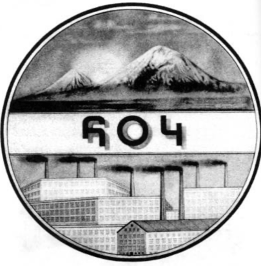
…created by a decree of the government of Soviet Armenia on September 15, 1921, the Relief Committee for Armenia, played a vital role for 16 Years… in organising aid to the country’s starving population and facilitating the resolution of general issues during the establishment of the second Republic…
The situation in Armenia in the early 1920s, following the transfer of power from the Dashnaktsakans to the communists, was catastrophic. The author cites a 1919 telegram from prominent ARF figure Avetis Aharonyan to the American press, which claimed that 2,000 people were dying of hunger in Armenia every day…. Under these circumstances, every means necessary was needed to defeat the famine and preserve the people until the next harvest.
Therefore, the Committee for Assistance to Armenia was created, aimed at mobilizing the efforts of Armenians abroad… In addition to addressing the most pressing needs (flour, seed grain, tools), funding was also sought for agricultural development, the acquisition of equipment, the construction of canals (including the Shirkanal), the drainage of swamps, assistance to homeless orphans, the establishment of workshops for children’s education, and other activities…
The committee’s work abroad was plagued by a number of problems related to, to put it mildly, party disagreements. While contacts with the Ramkavar-Azatakans and the Hunchaks were initially relatively tolerable (albeit with a negative dynamic), insurmountable tensions with the Dashnaktsakans arose from the committee’s founding. This led to clashes and even the murder of committee members. ARF members claimed that the committee’s structures abroad were solely engaged in promoting Soviet rule. There was some truth to this, but the money was spent on alleviating the social conditions of ordinary citizens… Despite the party differences, the Armenian communities assisted as best they could…
On April 26, 1936, Lavrentiy Beria proposed discussing the feasibility of the committee’s continued activities at a meeting of the Bureau of the Transcaucasian Federation. A commission was created. After some time, it became clear that not only Communist Party leaders Aghasi Khanjyan and Sahak Ter-Gabrielyan were considered “enemies of the people,” but also many of the committee’s leadership, including Arsen Yesayan, Danush Shahverdyan, Aram Manucharyan, Tigran Chugaszyan, and others, who had been executed or sentenced to long prison terms. On December 3, 1937, the committee was liquidated by decision of the Armenian government.
Alexander Tovmasyan, They shared what they could…”Voice of Armenia”, Yerramus Information Centre, February 3, 2019 (in Russian)
https://yerkramas.org/article/149804/oni-podelilis-chem-smogli—?ysclid=mh9puvojcd505953558
based on Lilit Makaryan, Activities of the Armenian Aid Committee The Armenian Genocide (1921-1937), National Archives of Armenia, Yerevan, 2018
Armenian General Benevolent Union GBU
The oldest and largest Armenian charitable organization – The Armenian General Benevolent Union (Baregortsakan in Armenian), AGBU was founded in Cairo on April 15, 1906 by leading Armenians within the Ottoman Empire; Boghos Nubar, Yacoub Artin Pasha, Yervand Aghathon, Megerdich Andranigian, Megerdich Margosoff, Garabed Sheridjian, Arakel Nubar, Nazaret Daghavarian, Grigor Yeghiayan, and Hovhannes Hagopian. The purposes of the organization were; to assist in the intellectual and moral development of the Armenian people in the homeland, to strive to improve its economic standing and to promote any initiative or publication serving the above ends.
Since the beginning of World War I, when the Ottoman authorities started the systematic implementation of the genocide and deportation of Armenians, and until the mid-1930s, the main task of the Union was to help exiles, especially orphans…
The Armenians abroad and especially those in Europe were well aware of the situation in Russia after the Bolshevik revolution of 1917… They had witnessed the red terror, the policy of extermination of the so-called “counter-revolutionary elements.”…
The new order established in Armenia was undoubtedly alien to Boghos Nubar and his colleagues but, pragmatic people as they were, they well realized that in the situation that had emerged, especially following the 1923 Lausanne Conference, the only Armenian-populated parcel that remained of the homeland was Soviet Armenia, and that its existence was secured only within the framework of the Soviet Union. However, the acceptance of this fact and the consequent disposition to deal with Soviet Armenia were not enough, and the agreement of the Armenian authorities was asked for. From the very onset the Armenian communists… not only banned the activity of Armenian national parties within the country, but also embarked on a campaign against them and their affiliate organizations in the Diaspora. From the point of view of Armenian authorities the AGBU, however, somewhat stood aside from and was less objectionable than the other well-known major organizations operating abroad… it nevertheless presented itself as an independent charity of a purely non-political nature. The fact that the AGBU was one of the most authoritative and financially sound organizations of the Diaspora was also quite important. In any case the first move in establishing relations with Soviet Armenia was left to the AGBU.
On August 30, 1921, the Board of Directors of the AGBU published a special statement entitled “The AGBU in Armenia”: “The Board of Directors of the AGBU, in response to calls addressed to it from official and other circles and in order to organize assistance also within the territory of the Armenian Republic, has agreed to expand the operations of the AGBU also into Armenia, where, as it is known, the people are subjected to starvation and misery.
“With this respect the Board of Directors has embarked on negotiations, upon the
outcome of which it shall commence its efforts and promote the noble objectives of the Union in Armenia…
In the Summer of 1923, the envoys of the Union L. Bashalian and G. Assadour discussed with the government of Armenia issues pertaining to the transportation and accommodation of orphans, and in the Fall, when the Union was invited to Yerevan to participate in the 3rd Congress of the HOK (Relief Committee for Armenia), the negotiations were carried on by the representative of the Union Yessayee Garigian…
The “provisions outlined in 22 Articles” was signed in October, 1923, by A. Mravian and the People’s Commissar for Agriculture Aramayis Yerznkian. They pertained to the activities expected from the AGBU: cultivation of land, construction and rehabilitation of canals, construction of orphanages, education and employment for orphans etc. The most important among these was Article 1:”The Council of People’s Commissars of the Armenian Soviet Socialist Republic permits charitable activities of the Armenian General Benevolent Union in the territory of Soviet Armenia for the purpose of supporting the reconstruction of the country and the economic, physical, and cultural development of the people.” By virtue of this article, the AGBU became the only organization of the Diaspora that was granted permission to operate in Soviet Armenia during the next fourteen years…
Very soon, however, the branches of the HOK abroad became the main leverage of the Communist Party of Armenia in implementing its policy in the Armenian Diaspora. Upon instructions received from Yerevan, they tried at all costs to spread communist ideas among the Diaspora and launched an uncompromising struggle against all important national organizations of the Armenian community abroad.
Mass Immigration of Working Armenians of Abroad to Armenia
On August 10, 1931, the Armenian authorities adopted a decision “On Permissionof Mass Immigration of Working Armenians of Abroad to the Territory of Armenian SSR,” where upon the repatriation received a new impetus. According to this decision, a special Commission on immigration headed by Aramayis Yerznkian was established under the auspices of the Council of People’s Commissars, which was charged with addressing all kinds of issues related to the repatriation, i.e. the number of repatriates, time-frames for repatriation, settlement areas, etc…
At the beginning of 1935, Zareh Nubar (of the GBU – my insert) applied with the same issue to the new chairman of the Council of the People’s Commissars of Armenia Abraham Gouloyan, for the purpose of arranging the repatriation of French Armenians. The Armenian authorities officially declared that they were ready to receive 1,200 unemployed Armenians from France, while the number of those interested was about 7,000. In these circumstances, Shahverdiandecided to personally make the selection which resulted in preparation, with a considerable delay, of a list of 1,800 repatriates. Like in the previous repatriation cases, the Union also financially supported the repatriates, providing 2,000 English pounds. In addition, due to its high esteem, it secured high-level official support. Specifically, upon its request the president of Nansen’s Geneva office Michael Hansson made two visits to Paris and discussed repatriation issues with Prime Minister Albert Sarraut. Thanks to the efforts of the Union, on April 17, upon the initiative of the French authorities, an agreement was signed between the Foreign Ministry of France, Nansen’s Office and the AGBU. “On this day, in response to the question of the Chairman addressed to our Union, our Director General declared that the AGBU will underwrite the charter costs of a steamboat to take the unemployed immigrants from Marseilles, transportation of all the immigrants and their belongings to the steamboat, feeding and food supplies for all the immigrants during ten days aboard (including full subsistence for the children and the sick) … We also took care of the costs of the transportation of Komitas vardapet’s coffin, having decided to send the remains of the great composer to Armenia… In view of the poverty of some of the immigrants, the Union will provide personal subsidies, primarily to the intellectuals.”
Eduard L. Melkonian THE ARMENIAN GENERAL BENEVOLENT UNION IN SOVIET ARMENIA (1923-1937) (English translation)
https://arar.sci.am/Content/9830/53-165.pdf
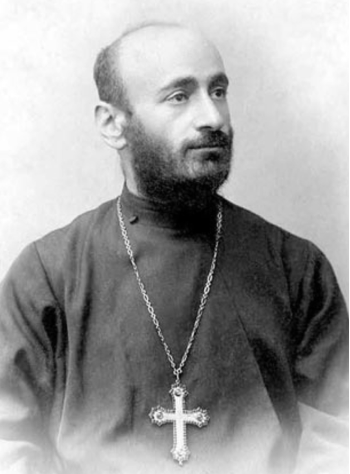
Komitas 1869-1935
Komitas died in Paris on Sunday, October 22, 1935. By this time, in Armenian communities everywhere, Komitas was being perceived as a living symbol of the sufferings endured by all victims of the Genocide.
Komitas’s funeral was held on Sunday, October 27, 1935, in the Jean-Baptist Armenian Church on Rue Jean-Goujon in Paris. He had lain in state there for three days, in an oak casket with a small glass window through which his emaciated face could be seen. The crowd of mourners that gathered for the funeral was probably more than a thousand strong and spilled out of the church’s doors. During the funeral mass, Armenag Shahmuratian sang Komitas’s “God, Bestow on Us Your Mercy.” Karekin Khachaturian, an Armenian bishop visiting from California, read the eulogy. Twelve other dignitaries also read eulogies, describing Komitas as an artist and a scholar who had introduced Armenian music to Armenians and foreigners alike. He was celebrated as a teacher whom thousands followed, a source of inspiration to Armenians everywhere. In May 1936, Komitas’s embalmed corpse was transferred to Armenia, and was put to rest at the Armenian Pantheon in Yerevan.
Until an official memorial to the Genocide was finally erected in Yerevan in 1967, his tomb served as a cenotaph around which Armenians would gather every April 24 to commemorate the one and a half million people who perished in the terrors that began with the “Red Harvest” of 1915.
Rita Suluhlan Kuyumjan, The Lost Years 1918-1935 pages 99,100
On May 9, 1936, the “Sinaya” steamboat took off from Marseilles to Armenia with 1,801 repatriates from France. The reception and accommodation of the repatriates of 1936 proceeded with the same difficulties as in the preceding years. In October the chairman of the HOK Arsen Yessayan wrote in his letter addressed to the new head of the Communist Party of Armenia Amatouni Amatouni: “Although a special government committee is set up for the employment of the 1,800 immigrants from France, the entire burden still falls on the HOK. Almost all immigrants have received jobs in various institutions. At present, some of them lost their jobs due to a variety of reasons and they appeal to the HOK again requesting, sometimes even demanding, that jobs be provided to them … In view of the prevalence of unemployment among immigrants and their unfamiliarity with our conditions, it is desirable that… some state agency or a professional organization provide its assistance for 3 to 4 months for them to find jobs.”
When organizing the transportation of the remains of composer Komitas, the leaders of the AGBU could hardly imagine that this issue may become a subject of discussion among party and state bodies of the Soviet Union. The catch was that, in order to organise this transportation, the Armenian authorities had to receive approval by the Transcaucasian Regional Committee of the Party, especially that of its First Secretary Lavrentiy Beria. The leader of the Communist Party of Armenia Aghassi Khanjian, most likely anticipating a negative reaction of Beria, appealed to him only on May 10. Informing Beria that the steamboat with the repatriates had already left Marseilles with the coffin of Komitas aboard, Khanjian wrote, in order to avert a possible negative reaction: “… on the eve of the departure of the ship, we sent him (Danoush Shahverdian – Ed. M.) through HOK a telegram asking to postpone the issue for the time being. The ship will arrive in Batum between 17-19 May. Under the circumstances, the only feasible solution is to allow the organization of Komitas’s funeral in Yerevan under the auspices of the Union of Soviet Composers of Armenia.” In these circumstances, Beria was forced to consent…
Eduard L. Melkonian THE ARMENIAN GENERAL BENEVOLENT UNION IN SOVIET ARMENIA (1923-1937) (English translation)
https://arar.sci.am/Content/9830/53-165.pdf
On May 9, 1936, the “Sinaya” steamboat took off from Marseilles to Armenia with 1,801 repatriates from France. The reception and accommodation of the repatriates of 1936 proceeded with the same difficulties as in the preceding years. In October the chairman of the HOK Arsen Yessayan wrote in his letter addressed to the new head of the Communist Party of Armenia Amatouni Amatouni: “Although a special government committee is set up for the employment of the 1,800 immigrants from France, the entire burden still falls on the HOK. Almost all immigrants have received jobs in various institutions. At present, some of them lost their jobs due to a variety of reasons and they appeal to the HOK again requesting, sometimes even demanding, that jobs be provided to them … In view of the prevalence of unemployment among immigrants and their unfamiliarity with our conditions, it is desirable that… some state agency or a professional organization provide its assistance for 3 to 4 months for them to find jobs.”
When organizing the transportation of the remains of composer Komitas, the leaders of the AGBU could hardly imagine that this issue may become a subject of discussion among party and state bodies of the Soviet Union. The catch was that, in order to organise this transportation, the Armenian authorities had to receive approval by the Transcaucasian Regional Committee of the Party, especially that of its First Secretary Lavrentiy Beria. The leader of the Communist Party of Armenia Aghassi Khanjian, most likely anticipating a negative reaction of Beria, appealed to him only on May 10. Informing Beria that the steamboat with the repatriates had already left Marseilles with the coffin of Komitas aboard, Khanjian wrote, in order to avert a possible negative reaction: “… on the eve of the departure of the ship, we sent him (Danoush Shahverdian – Ed. M.) through HOK a telegram asking to postpone the issue for the time being. The ship will arrive in Batum between 17-19 May. Under the circumstances, the only feasible solution is to allow the organization of Komitas’s funeral in Yerevan under the auspices of the Union of Soviet Composers of Armenia.” In these circumstances, Beria was forced to consent…
Eduard L. Melkonian THE ARMENIAN GENERAL BENEVOLENT UNION IN SOVIET ARMENIA (1923-1937) (English translation)
https://arar.sci.am/Content/9830/53-165.pdf
Lavrentiy Beria, the USSR’s Minister of the Interior, a staunch anti-religious figure, had forbidden Komidas’s repatriation to Armenia, claiming: “We don’t have enough money to bury a mere priest.”
But six months later, on May 9, 1936, with Stalin’s express authorization, Komidas’s body was nevertheless loaded onto the ship “Sinaïa” in Marseille, before a large crowd and his friend, Archag Tchobanian, who had come to pay him a final tribute, along with those preparing to leave for Soviet Armenia, deceived by Stalinist propaganda. A second departure for Armenia took place in 1947, to rebuild, they said, their “historical homeland.”
His coffin had been registered and cleared through customs as simple “luggage,” with the written note “Armenia, Yerevan via Batumi.” His mortal remains arrived at Yerevan station on May 27, amidst a huge crowd, while Chopin’s funeral march resounded. His body was buried in Armenia, which was then under Soviet authority, and which frowned upon the return of a “priest” to his homeland! The tomb is not located in a cemetery, but in a park in Chengavit, which has become the cemetery of the nation’s great men, the Yerevan Pantheon, where the Vartabed has rested in peace in Armenia since May 28, 1936.
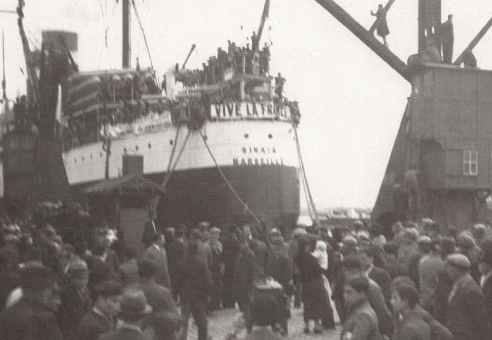
Sanaia about to sail from Marseille
Père de la Musique Arménienne Komidas Vartabed (in French)
https://www.armenweb.com/komitas/Komitas-Vartabed.pdf
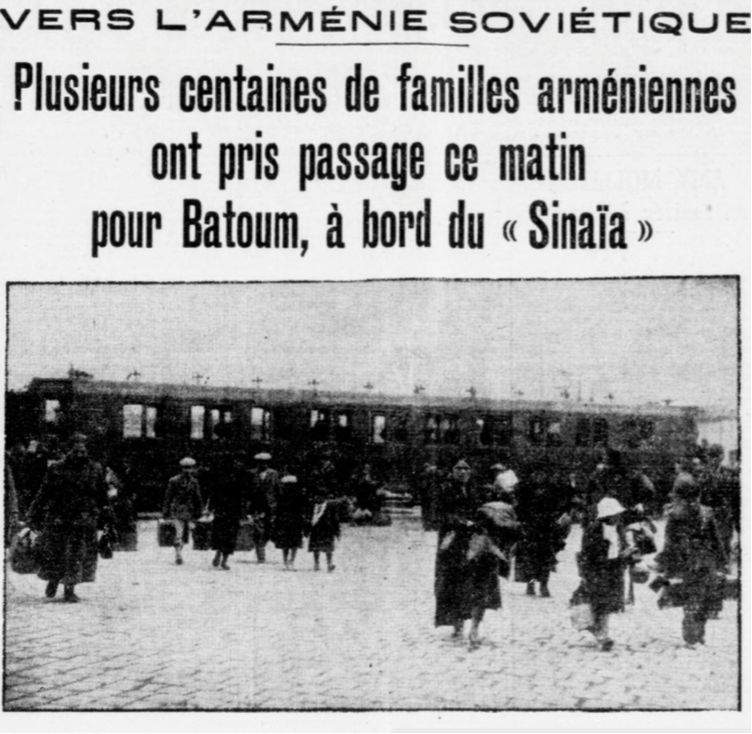
Armenian families arriving by train in Marseille to board the Sinaia
Le Radical de Marseille May 9, 1936, page 3
NEWS FROM MARSEILLE: ARMENIANS TO BE REPATRIATED HAVE BOARDED THE SINAIA (By telegram from our private correspondent) Marseille, 9 May. The Armenian repatriates who arrived in Marseille yesterday boarded the Sinaia, moored at Abattoir Pier. The liner will sail at 5 p.m. The embarkation took place in the midst of complete calm, under the supervision of Mr. Chaverdian, Minister Plenipotentairy of the Government of Erivan, in charge of emigration, and Mr. Avikian, who heads the Armenian refugee office in our city. The important security service that was operating on the quays did not have to intervene. The passengers of the Sinaia will disembark at Batum and from there, by rail, they will be directed to their new and final destination. Other expatriations will follow this one. Thousands of people will thus return to their homeland and work for its rebirth.
L’Echo d’Oran, May 10, 1936 page 2 (in French)
Danush, Lili and their son Sergei returned to Armenia with the others aboard the Sinaia. In Yerevan he worked for some time as a director of the Haypetrat Publishing House.
Danush and Lili’s Arrest, Trial, Sentence and Imprisonment
On February 23, 1937, Danush was arrested by the Armenian NKVD. Lili was arrested one month later, on March 26. Although he was accused of “‘Trotskiite-nationalist’ espionage,” the real reason for Danush’s arrest was “his refusal to endorse Beria’s falsifications on the history of the Bolsheviks in Transcaucasia. While in NKVD custody, Danush told the Armenian Bolshevik Ado Adoyan (another victim of the Purges) “do not forget that my sole ‘crime’ was my refusal to write memoirs to Beria’s taste. During the repressions, Mikoyan attempted to save Danush but to no avail. He died in Gavar prison on October 24, 1941
In the case of Danush, the most probable charges would have been a combination of:
Article 58-10 – “Anti-Soviet agitation” Used extremely widely against intellectuals and cultural administrators. Typical accusation wording: spreading nationalist ideas, maintaining “counter-revolutionary contacts abroad”, hostile statements about Soviet power.
Article 58-11 – “Participation in a counter-revolutionary organisation” This clause allowed the NKVD to construct networks of conspirators. In Armenia the NKVD frequently invented: “Dashnak nationalist organisations”, “Trotskyist-nationalist blocs”.
Article 58-6 – espionage (usually alleging contacts with foreign Armenians or French networks). For someone with diaspora links to Paris, the NKVD often inserted the claim of foreign nationalist connections.
In Lili’s case, as she had no political associations, she would have been charged under article 58-6
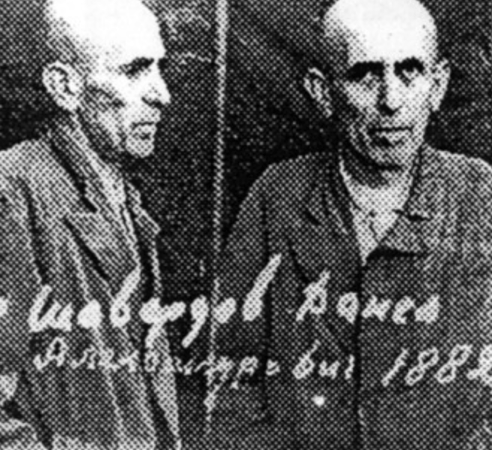
Danush arrest photograph
Both Danush and Lili were sentenced to confiscation of half their assets, 10 years imprisonment and lifetime loss of citizen’s rights. The last was particularly cruel, as if they somehow managed to survive the prison sentence, on being freed they would have been denied a job, housing and a pension, all of which were provided by the state. They would also have been presented with a list of over twenty major soviet cities where they were forbidden to reside.
At the other end of the square, a huge, gloomy building with a weed-covered roof literally looms over the center of Gavar. Judging by the map, it belongs to the Kamokaběl factory (1959) and clearly illustrates its state. But I can’t shake the feeling that it originally housed some kind of district prison:
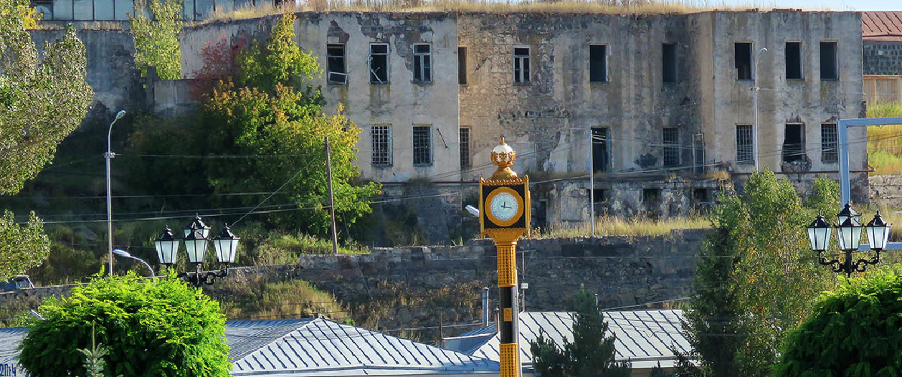
Gavar Prison
Gavar, formerly Novo-Bayazet. What’s life like in a former district town in the Armenian hinterland? October 16, 2020 (in Russian)
https://dzen.ru/a/X25j5WOyXQTN6Rt4?ysclid=mhlk2t8f1v986273435
Even as Danush was in prison, he was subjected to further charges
In Soviet Armenia, the victims of political terror were not only practically all the leaders of the Republic, but also the relations with the Armenian Diaspora themselves…
“The Immigration Committee was established three years ago in order to coordinate the activities related to the admission and accommodation of Armenian immigrants. However, the activities of the Committee had little to do with the immigrants’ problems. The Immigration Committee is just another commercial organization, headed by the Chairman of the Council of the People’s Commissars. The Committee abuses the USSR’s favourable attitude towards immigrants to receive scarce and highly critical commodities, in particular construction materials, beyond the limits imposed by the state plan, imports them to Armenia and sells to different enterprises, while the immigrants get next to nothing… They act only as a curtain for the commercial activities of the Committee… The Committee is not a part of the Soviet administrative structure. The activities of the Committee and its rather large (by the Armenian scale) transactions are not included in the national-economic plan of Armenia or its import quotas… No audit has been carried out during the 3-year activity of the Committee. The Committee does not report to anyone except its Chairman. Thanks to such profiteering, the Committee has generated significant revenues – about 3 million roubles in 1934, on an overall transactions value of 6 million roubles, and about the same amount this year – which the Council of the People’s Commissars spends over and beyond the budget and the state plan…”
Arsen Yessayan concluded his letter with the following: “The Immigration Committee is apparently a profiteering organization. The Committee ignores and violates Soviet legislation regulating the operation of Soviet enterprises. All its activities are based on the evasion of legislation, and fraud against the Soviet Government. The policy adopted by the leadership of the Committee (I am not referring to most of the staff of the Committee, who most probably are unaware of the activities within the Committee) is not the policy adopted by our party. This policy does not lead to the consolidation of the foundations of the Socialist State, it leads to bourgeois deformations.
Yessayan’s letter was a very good pretext for the Transcaucasian committee, and Beria himself, to focus their attention not only on the activities of the Immigration Committee or repatriation issues but also the Armenia-Diaspora relations.
The commission holds that the following individuals from the HOK administration have to be criminally prosecuted for the actions stated above, Grigor Vardanian, Danush Shahverdian, Arsen Yessayan, Aram Manoucharian, Vardoush Tarakhchian, Tigran Zaven, Haikaz Karageusian, Tsolak Parzian… The commission also deems necessary to hold to criminal responsibility Moughdusi,Amatouni, Shahsouvarian, Gouloyan, Kevorkov for the abuse of power, manifested in arbitrary withdrawal of imported goods from the HOK warehouses.
Eduard L. Melkonian, THE ARMENIAN GENERAL BENEVOLENT UNION IN SOVIET ARMENIA (1923-1937) Fundamental Armenology No 1 (9) 2019, pages 53-165 (English translation)
If Lili was still alive in 1938, would have been transferred with the nearly eighty Armenian wives of arrested men to the Alzhir Gulag camp for women at Akmol, 35km west of what is now Astana in Kazakhstan.
On August 15, 1937 Order No. 00486 of the USSR’s People Commission for Internal Affairs (NKVD) enabled arrests without proof of guilt of wives of men who were primarily persecuted for political reason These prisoners were arrested on the article “ChSIR” – Family Members of Traitors of the Motherland (Chlen Sem’I Izmennka Rodiny)
The Arresting Process
Earlier in 1937 the operative order of the NKVD No. 00486 “On the repression of wives and the placement of children of convicted “traitors of the Motherland” was signed by Nikolai Yezhov. It was believed that the family members could not have been unaware of the criminal activities of the head of the family, and must be punished for not reporting to the state. Each family member was recorded in the system by the NKVD, and “wives” were not only spouses, but also mothers, sisters and daughters….
Thus, wives were arrested right after their husbands, sent to “ALZHIR” without any trials, and were only notified of the decision of the Special Meeting of the NKVD about the recommended dates of imprisonment from 5 to 8 years.
Satymbekova Raikhan THE GULAG CAMP “ALZHIR”: MEMORIALIZATION PRACTICES, Budapest, Hungary, page 32
For more information see
Petr Trotsenko, Kazakhstan’s Concentration Camp for ‘Wives of Traitors To The Motherland’
https://www.rferl.org/a/kazakhstan-astana-museum-of-totalitarianism-alzhir-features/32973588.html
Memorialising Danush
The 130th anniversary of the birth of statesman, lawyer and diplomat Daniel (Danush) Shahverdyan has been reached, on which occasion events were held in Yerevan and his birthplace Aygehat from January 23 to 31.
On January 23, writers, artists, lawyers, historians, residents of Lori, and grateful residents of Aygehat gathered once again at the tomb of Komitas in the Pantheon of Armenian Greats to pay tribute to the memory of the uncompromising patriot.
For 15 years now, we have been celebrating Danush’s birthday like this, because he became a victim of the Stalin genocide not only because of his indomitable and unyielding nature and unwavering patriotism, but also because of the repatriation of the remains of the great Komitas in 1936. From February to April 1937, on Beria’s special instructions, Danush, his wife Elizaveta, and his brother Alexander (secretary of the Andrfed KG) were arrested and died in the dungeons of the KGB. In May, his younger brother Aram (rector of the Yerevan State Medical Institute) was arrested and then exiled, and his 10-year-old son Sergey (later a major Soviet and Russian diplomat-lawyer, general) bore the stigma of the son of a “traitor to the homeland (i.e., the system)” and the deprivations it “inflicted” until Stalin’s death. In 1954, they were rehabilitated…
Hovannes Davtyan, Dedication” Danush Shahverdyan – 130) Hraparak.am February 2, 2012 (in Armenian)
https://hraparak.am/post/591fc5b9e3d84d0d37fe06b4?ysclid=mgspfb7koa96146009
Lili’s son Sergei
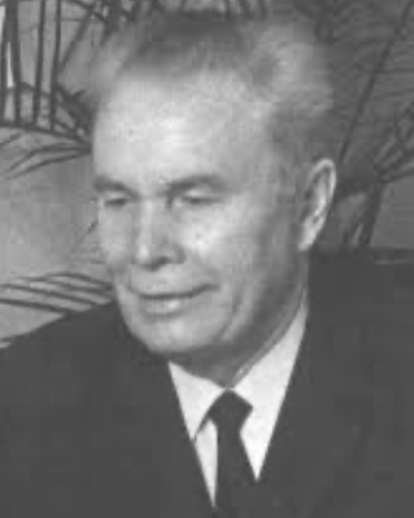
Sergei Danilovitch Chaverdian (1927-2014)
Born on May 6, 1927 in Boulogne-Billancourt, Paris. Died January 4, 2014, 13e Arrondissement, Paris
Following his parent’s imprisonment Sergei was probably cared for by relatives or his mother’s parents. Young children with no one other than their parents to support them were placed in orphanages. Despite the stigma of being the son of Traitors to the Motherland he was able to eventually attend Moscow State University where he graduated from the Faculty of Law in 1954, aged 22.
Following Mikoyan’s visit to Armenia and Yerevan speech, he appealed to Mikoyan for the rehabilitation of his parents.
One case that Mikoyan followed particularly closely was that of Danush Shahverdyan – the man who he had attempted to save during the September 1937 intervention in Armenia. On April 20, 1954, one month after the Yerevan speech, Shahverdyan’s son Sergei wrote to Mikoyan, appealing to him to have his parents’ case reviewed. He was nine years old at the time of their arrest in 1937. In response Mikoyan forwarded his request to Soviet Prosecutor General Roamn Rudenko that same day. “Please review and inform me about the results,” he wrote to Rudenko. The subsequent investigation was, as Colonel of Justice Ivan Maksimov noted on August 24, 1954,” carried out on behalf of Comrade A.I. Mikoyan. Both Danush and Elisaveta were rehabilitated on September 25, 1954. Mikoyan later played a key role in ensuring Sergei’s entry into the prestigious Moscow State University of International Relations. Sergei Shahverdyan subsequently went on to enjoy a successful career as a Soviet diplomat, becoming the consul general in Marseille, France.
Vladimir Mikoyan, interview by Pietro Shakarian, Moscow, March 11, 2020 HAA 1191/1/48/112
Pietro A Sharian, Anastas Mikoyan An Armenian Reformer in Krushchev’s Kremlin, Indiana University Press, Bloomington, Indiana, 2025, page 54
Graduating from the Moscow State University of International Relations in 1956 he entered the central office of the USSR Ministry of Foreign Affairs., where his childhood fluency in French resulted in postings to the Francophone world.
In 1962 he was sent as charges d’affairs to establish a Russian embassy in Dakar, Senegal where he stayed till 1964 before returning to Moscow.
Soviet Opening Dakar Embassy Dakar, Senegal, Oct. 13 (AP) – A Soviet charge d’affairs, Serguei Chaverdian, arrived here today to open an embassy,
New York Times October 14, 1962
In 1968 he was appointed as advisor to the Soviet Embassy in Belgium, the following year becoming Minister-Councilor. He returned to Moscow from 1972 to 1976.
From 1977 to 1981 he was the Soviet Consul General in Marseille, the returned to Moscow from 1982 to 1983.
From 1984 to 1987 he was appointed to his final diplomatic posting, Ambassador Extraordinary and Plenipotentiary of the USSR (the highest diplomatic rank) to Togo.
After retiring in 1992, Sergei worked in the Historical and Documentary Department. With his active participation, numerous reviews and publications on current issues of relations with various countries and international problems were prepared for the ministry’s operational needs.
Sergei’s work achievements were repeatedly recognized with government awards, including the Order of the Badge of Honor and the Order of Friendship of Peoples.
In the later part of his life, he returned to Paris where he died in 2014.
Who was Sergei’s Father?
The conventional wisdom as articulated by Paul Beekman Taylor below is that Gurdjieff was Sergei’s father.
Lily Galumnian Chaverdian gave birth eventually to a boy, Sergie, and when she returned to the Soviet Union in the 1930’s, she and her son were blocked there by the war. His present whereabouts are not known to any of my correspondents. All Gurdjieff’s other children to whom I talked acknowledge that Sergie is Gurdjieff’s son, and that seems to have been the unanimous opinion of residents of the Prieure at the time. Fritz Peters, Boyhood with Gurdjieff p 126 says that shortly after Mme Ostrovska’s death, the atmosphere at the Prieure seemed to change; part of it was definitely due to her death (Gurdjieff for example, was living with a woman who became pregnant a few months later);
Paul Beekman Taylor, Gurdjieff and Orage, Brothers in Elysium, Weiser Books, York Beach, Maine 2001, page 125, note 60
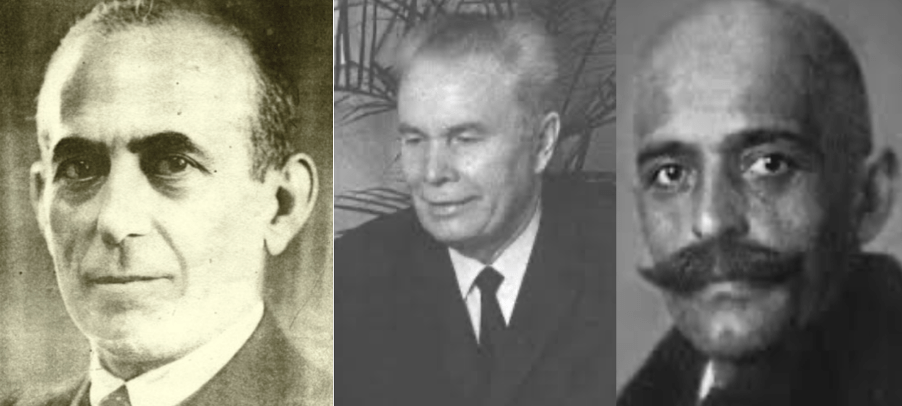
From Sergei birthdate of 6 May 1927, he was conceived in early August 1926. At the time Danush was the trade representative of Armenia in Turkey from 1924 to 1928 and apparently not in France at this time.
However, consider the following
In terms of organizing remittances for the repatriation, the role of the Union’s USA chapter was particularly important, since this is where most of the necessary funds were raised. Even before World War I, about 60,000 Armenians lived in this country, and quite a few among the best-established were supporters and members of the AGBU.
Just one action in “Support to Immigration to Armenia”, organised in New York in 1926 resulted in raising almost 12 thousand English pounds, that in the same year were transferred to the Immigration Envoy of the Council of People’s Commissars of Armenia in Paris Danoush Shahverdian and Secretary of the Plenipotentiary Mission of the Soviet Union in Paris Simonik Piroumian (Piroumov). Upon mutual agreement, this amount was to be provided to about 300 exiles resettling to Armenia from Greece, as well as Syria. However, in the same year of 1926 the Shirak earthquake struck Armenia and it not only rendered the repatriation of this group impossible, but also necessitated the organization of relief aid to the earthquake victims.
Eduard L. Melkonian THE ARMENIAN GENERAL BENEVOLENT UNION IN SOVIET ARMENIA (1923-1937) page 94 (English translation)
https://arar.sci.am/Content/9830/53-165.pdf
The fund-raising activities were typically carried out in the first three months of the year, so that the funds were available by June for the HOK to make plans for what activities it would be allocated to. As such, in this case, the funds were sent to Paris sometime between June and the October 22, 1926 Shirak earthquake. It is thus possible that Danush was in Paris in early August 1926 when Sergei was conceived.
Finally, Sergei was named after Lili’s father, Sergei Niktich Galumnian and her husband Danilovitch. Under the hundred- year rule it is not possible for non-family members to access Sergei’s birth certificate until 2027 so I have been unable to obtain a copy of his birth certificate.
If any readers can provide further information (mbenham@bigpond.net.au) I will update this post with full acknowledgement.
 Gurdjieff Research