Following the end of the First World War, the forces of the Triple Entente occupied the Ottoman capital, (December 1918). Constantinople was divided into three zones of responsibility: the French were responsible for order in the Old City (Stamboul), the British for the Galata-Pera area, (the European sides of the city) and the Italians for Kadikoy and Uskudar, (the Asian side of the city.)
In January 1920, P.D. Ouspensky, Madame Ouspensky, her daughter Lenochka and their grandson Lonya arrived from Novorossiysk on the Black Sea. He had been living and giving lectures on Gurdjieff’s ideas in Ekaterinodar (Krasnodar). When they arrived Russian refugees were not immediately allowed into Constantinople. They had to be dropped off on the Princes’ Islands, of Prinkipo (Buyukada), a holiday and resort location that had many hotels and boarding houses, and Proti (Kinaliada), where the American Red Cross had set up facilities for refugees. Ouspensky settled on Prinkipo and lived there for his entire stay in Constantinople.

Arriving at Prinkipo 1920
Gurdjieff and his group arrived five months later in July 1920. By this time vessels could dock on the Asian side at Kardikoy. Thomas de Hartmann recounts that the ship’s captain allowed them to sleep on the ship for three days while it was in port, so they had time to find accomodation. Gurdjieff moved into an apartment in a building “in Kombaradji Street a little below the former Russian consulate.“ Ouspensky, In Search of the Miraculous p 383
Unlike the majority of the impoverished Russian refugees, Gurdjieff spoke Turkish, was familiar with Islamic culture and the city, (having spent time there as a young man), and had established business relationships. He had a small capital and if we are to believe Evreinov’s account, a supply of carpets already there. He had been carrying on a profitable export trade of carpets from Tiflis with the help of Major Frank Pinder, the British agent in Batumi the previous year.
By the end of the year, according to some sources, as a result of three evacuations in 1920 (Odessa, Novorossiysk and Crimea), there were sixty-five thousand Russian civilian refugees in Constantinople alone. They settled in the European part of Constantinople, in three districts – Galata, Pera and Sisli. The Grand Rue de Père (Istiklal Street) became the centre of Russian Constantinople as the Russian embassy was located on this street. At that time, it was a mixture of an information bureau, a hospital, a warehouse and a hostel.
Russian charities (primarily the Zemstvo and City Unions) provided assistance, but it was not enough for everyone in need; many people were chronically undernourished, and sometimes people simply did not eat for several days. Not everyone had enough space in the doss house either. Foreigners helped: the British and French military missions provided small rations from military reserves, the American Red Cross helped children and women by feeding them, giving them milk, clothing and blankets. A humanitarian catastrophe was avoided, but the situation was still depressing. Impoverishment, idleness, the trauma of defeat in the war and disappointment could not help but affect the morale of the refugees. This was especially noticeable in Constantinople in 1920-1921. Intrigue, disputes and gossip, drunkenness flourished; men saved on meager rations and sold their uniforms, and some even begged for alms to get drunk on “duzik” (aniseed vodka diluted with cold water). Among women, a noticeable number of those who flirted with foreigners appeared, and even those who directly sold themselves in restaurants and other places of entertainment.
https://diletant.media/articles/45280321/?ysclid=mehnu5obxy878920243
The courtyards of three Russian Orthodox churches in the area were able to provide shelter to a few lucky refugees. The less fortunate and poor rented housing in slums. In 1921 emigrants began to leave Constantinople, as the city offered no prospects for them. Some returned to Soviet Russia while the majority began to disperse to various European countries, In 1922 the introduction of the Nansen passport enabled refuges to leave Constantinople in the thousands. By 1922, there were only twenty-eight thousand Russians there and five years later only less than three thousand remained.
The first problem for the refugees was food and the second finding a place to sleep.
A drink and a snack at the Grand Bazaar cost a few piastres. A two-course meal at the Dormitory No 8. cost 17.5 piastres. In the Zemstvo Union canteen, it cost 15 piastres, but only 350 meals a day were sold at that price. The American Red Cross fed 5,000 refugees for free, supplying three charity canteens with food and paying for fresh meat and vegetables at the rate of 5 piastres per person per day. Children and the sick received milk, cocoa, and sweet biscuits. A cup of freshly brewed coffee bought on the street from a Turkish vendor cost 5 piastres
https://www.kommersant.ru/doc/4567641?ysclid=meho7elqvv452873236
On the other side of the Golden Horn from Galata was the Grand Bazaar, which many refugees visited. Usually not to buy something, but to sell something. A fee was charged for crossing the bridge, which the compassionate Turks waived for the Russian refugees.

Galata Bridge 1920 looking towards Stamboul
Initially as Thomas de Hartmann recounts
Meanwhile Mr Gurdjieff treated psychologically ill people who were brought to him, people who, at the hospitals, had been pronounces hopeless.
Thomas and Olga de Hartmann, Our Life with Mr. Gurdjieff, page 153
Sometime later after their first concert
The following day Mr Gurdjieff advised us to use this money to go live in Prinkipo, since my wife’s health was not very good and she needed sun and rest. The pension there was the residence of a former pasha, and our room, in spite of its smallness, had a piano, a bed and kitchen facilities. Soom Mr Gurdjieff also came to live there…..
Mr Gurdjieff began to plan the opening of the Institute, as Madame de Salzmann, with Lili and others of her pupils, had followed him from Tiflis. A house was soon found. On the first floor there was a large hall with benches; on the second, living rooms for Mr Gurdjieff, and on the third, rooms for some of his pupils, including the de Salzmanns and their daughter.
Thomas and Olga de Hartmann, Our Life with Mr. Gurdjieff, pages 154, 155
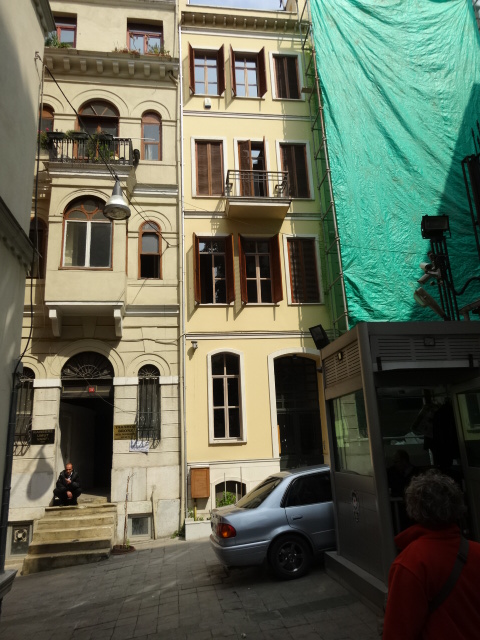
Gurdjieff’s Institute, 13 Abdullatif Yemmenici Sokak -behind car (2014)
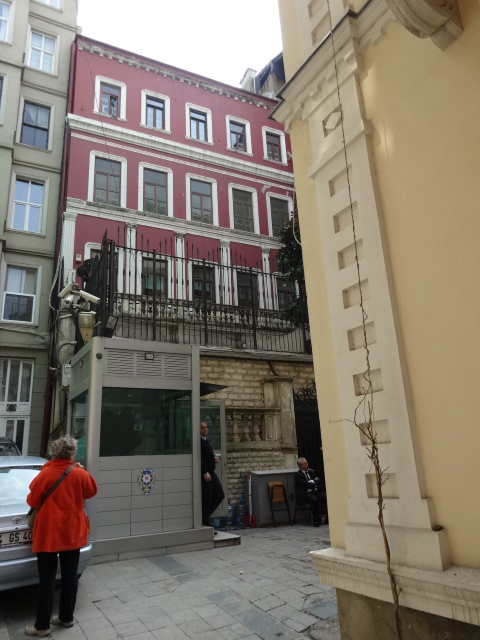
Jewish Rabbinate at top of L shaped laneway with permanent police guard box (2014)
An advertisement for the Institute appeared in October

Stamboul (French newspaper), 30 October 1920
Institute for the Harmonic Development of Man
A group of people, having learned that the founder of the Institute for the Harmonious Development of Man, Mr. Gurdjieff, happened to be in Constantinople, approached him, requesting his assistance in organizing a branch of the Institute for the Harmonic Development of Man, to which Mr. Gurdjieff gave his consent.
Since organizing a branch of the Institute according to the complete program determined by practice is impossible under current conditions, it was decided to initially open a branch according to the reduced program, subject to expanding the program as soon as possible. In the meantime, the following classes are open:
1. Harmonic and Plastic Rhythm, 2. Ancient Oriental Dances, 3. Medical Gymnastics, 4. Music.
The Institute admits adults and children from the age of 4.
The instructors are individuals who have already practiced in the Institute’s facilities. Ms. Jeanne Matignon, harmonic rhythm; Ms. Ostrovskaia, plastic arts and ancient oriental dances; Professor Th. de Hartmann, music; Dr. Sternwall, medical gymnastics.
Mr. Gurdjieff, the general director, has assumed responsibility for the organization until the arrival of the person specifically charged with managing the Institute’s branch in Constantinople.
The details of the program and organization will be explained in the lectures and in the brochures, which are available free of charge.
For a time, until specially equipped accommodation is available, the work will take place at Péra, Tunnel, 35 Yemenidji Street.
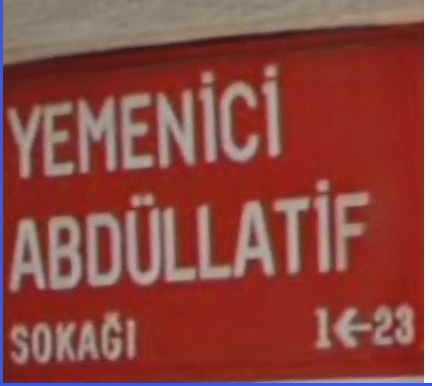
Here, and in the brochure that Gurdjieff issued for the Institute, the building number is given as 35, but as can be seen from the street sign below the buildings are numbered 1 to 23 , there is no number 35.
Though no printer’s address was shown on the brochure
The features of paper, fonts, and other printing features indicate that the Institute’s brochure was most likely printed in a printing house owned by the “Pressa” Publishing Partnership (according to the imprint of the books printed in this printing house, it was located at ‘Constantinople, Asmalı Mescit Street, 35, Péra’).
Konstantin Burmistov, Gurdjieff in Constantinople, Aries – JOURNAL FOR THE STUDY OF WESTERN ESOTERICISM (2020) page 8
This address is at number 35, which may have led to a misprint in the Institute’s address ?
We worked on movements every day. New people began to join the work, while some members of the former group arrived. We worked hard, under difficult conditions. In the plan of life Georgivanitch made for us, there was no chance pride or vanity could thrive. They were beautifully weeded out by him day by day – until nothing remained on the countenance of the people except inner attention. Silent, with weary bodies, the inner self groped for its proper place……
We spent several months working in Constantinople. Every day was filled with inner tasks and hard work of the body. I saw Georgivanitch daily, walking with him in Pera and across the bridge in Istanbul. He commanded the respect of the Turks. We would talk or walk in silence. He radiated such powerful emanations that it required no effort to remember myself. I found it easy to cut off the flow of associations of ideas and stay aware, conscious of life pulsating within, and yet feeling the flow of life on the outside of myself…..
Maxine Fawcett-Yeske and Bruce Brooks Pfeiffer, The Life of Olgivanna Lloyd Wright pages 40, 41
In early 1921, German journalist, Alfons Paquet visited the Institute.
Paquet was an avid traveler. In 1903, at the age of 22, he traveled to Vladivostok on the newly opened Trans-Siberian Railway, closely observing the colonization of Siberia. In 1904, Paquet was in America for the St. Louis World’s Fair, and in 1905, he followed the Baghdad Railway in the Ottoman Empire. In 1907, he traveled to Siberia again, waited longingly for weeks in Tomsk for the thaw, and then set off from there for Mongolia. He crossed the Altai Mountains on horseback with his guides and felt like “Odysseus in the sands of the Gobi.” In 1910, another extended journey followed, via Russia and Mongolia to China and Japan. In 1913, Paquet visited Palestine, where he was particularly interested in the Zionist settlements. In 1921, a journey through Italy and Greece, scarred by the aftermath of the European catastrophe, took him to Constantinople, which was under Allied control, where, as an undesirable German journalist, he had to sneak off his steamer.

Alfons Paquet 1908 in Mongolia
https://www.alfonspaquet.de/buecher/reisebuecher.html
I had the strangest encounter on my last day. It was on the winding street from Pera which leads up the hill. I was standing at the entrance to one of the many side streets to look at the rough handwritten sign of an Institute whose name interested me. At that moment I get a prod in my ribs, I turn around and look into the lined face of a tall, gray-haired man who, like all Russians here, is dressed in a well-worn suit, with a gray scarf and a flat cap. This man said to me in a Munich accent: “Yes, what are you doing here?” – It was Herr von Salzmann, a painter who had lived in Munich for many years before the war. I hadn’t seen him since the spring of 1914, when I last met him. Exactly seven years had passed. I had heard that von Salzmann, a Russian, had left Germany with his Swiss wife, at the beginning of the war. Then I heard from returning prisoners of war that much good had been done to them by this man in Tbilisi. The stream of refugees had also swept him into Constantinople too. Here he was stuck, and he worked together with some friends at the Institute, in front of whose sign I was standing.
We met again late in the evening and visited the Institute. It called itself the Institute for the Harmonious Development of Man. Nothing less. It was on the first floor of a labyrinthine building teeming with Russians. I met the head of the school, a Caucasian who had visited monasteries during years of wandering in the mountainous countries of Inner Asia and become acquainted with the cults, dances and sciences of the monks. This man claimed that India was not the home of miracles. He spoke of the Pamir highlands, which the West barely knows by name and whose curiosities researchers never tire of recounting. I saw the dances practiced here in the sparse hall paved with black and white stone tiles by his students-barely a few dozen men and women. At the piano sat a professor from the St. Petersburg Academy of Music, whose name is well known in Germany (Thomas de Hartmann – my insert). He played oriental melodies to accompany the dances, strange in their melodies and rhythmic sense. Among the students was a St. Petersburg doctor (Leonid Stjernvall – my insert) who was about to devote all his academic knowledge to the study of Tibetan medicine with its knowledge of humours, medicinal poisons and the effects of certain sacred physical exercises. Things of which I myself had once seen incomprehensible samples in the monasteries around Kobdo and Ulyassutai (in Western Mongolia-my insert). Here I saw dances such as those common in the esoteric schools of Chitral, among the monks of Mazar (Mazar-i-Sharif) in Afghanistan and in the Keri (Keriya) Oasis (Xinjiang, China), gymnastics exercises intended to awaken the willpower, the hearing, the memory and to strengthen the muscular body, which were nothing other than a form of yoga. What are the famous exercises of the Order of Jesus or the Prussian drill regulations other than exercises of a yoga that transforms uncouth people into the finest and most powerful instruments of great thought? The teachings of this Institute include lectures from the tradition of Asian schools on religious myths, on rhythm, on the law of the octave, on numerology and everything else related to Kabbalah and the magical arts. Here one learns an interpretation of the strange stone monuments, those dolmens that extend from the Caucasus, Southern Russia and Poland, across the North German heath to Scandinavia and England, that can be found in Brittany, the Pyrenees, and North Africa and that culminate in Egypt , mysterious symbols of forgotten people from early Bactrian and Atlantic times, far more experienced in astronomy and geography. And I saw myself here as if before the solution of a question that had occupied me since Olympia and Delphi: the thought that underlying the connection between the worship of the gods and the study of nature, between temple worship, government and banking, between gymnastics, medicine and oracles, between sculpture, painting and tragedy at the sacred sites of Greece was something unifying, a lost deeper unity that determined human life, and that this unity, this creative balance was nothing less than the origin of all measurements and laws of harmony. The people who have gathered here under this teacher are uprooted and newly rooted; each one of them struggles for existence during the day; not one of them has the means to indulge in studies that demand all their effort, as if it were a luxury; The enthusiasm and self-importance that accompany certain esoteric schools in Western are alien to them; compared to the powerful language of their dances, all mere rhythmic gymnastics is mere lamb-jumping. What these people practice is active mysticism, which feels superior to many and wishes to steel itself to one day take control of the now-empty cults, the theaters, the churches, the great soul-forming schools. Behind her, the magic flames, the witchcraft, the devilish faces of demons threaten, but also the gentle, radiant powers of the Gods shine; an Orphic chant approaches, riding on the dolphins of the sea.
Long into the night, until dawn dawned over the Asian coast beyond the Bosporus, I walked with my friend through the lonely streets of Shishli. We spoke of Germany, whose subterranean current, with its growing skepticism toward the rigid functioning of the faculties, with its search for the expression of deeper insights, which today are still dim and incoherent, accommodates these things like perhaps no other country. I had left Germany to recover from the atmosphere of pessimism and occultism that threatens to suffocate intellectual workers and draw them into unknown whirlpools. In Greece, I believed I had found traces that reconnected us to myth and pointed to the meaning of the lost mysteries, whose complete extinction threatened to tear present-day Europe apart. Here, once again, the Delphic air greeted me. A return of the East to the North seems to be taking place. It is as if the scattered things were searching for their origins. Without the ultimate inner unity of all religions and cultures, any notion of internationality would be ridiculous.
Alfons Paquet – Delphische Wanderung (1922) pages 218-222
In the spring Mr Gurdjieff made our hall into a sort of theatre so that Gymnastics could be performed on stage. He also began to work on all kinds of supernatural phenomena: hypnotism, action at a distance, thought transference, etc. But he only started this programme here; it was developed later at the Prieure in France. Now I will say only that it demanded from the pupils a maximum of attention and a quick comprehension, and had its fundamental purpose in Mr Gurdjieff’s general Work of self-development
Thomas and Olga de Hartmann, Our Life with Mr. Gurdjieff, pages 154, 155
Nearly all of Gurdjieff’s students were Russian refugees, many initially attracted by the food Gurdjieff offered everyone. But as he showed them how to fend for themselves many left. Eventually there were not enough students to justify continuing the Institute and Gurdjieff closed the Institute in Constantinople and moved it to Prinkipo Island, where a large hall was hired.
From Constantinople he moved the Institute to Prinkipo, a small beautiful island situated off the magnificent Bosporus Straight. We made the journey daily, commuting from Constantinople for an hour on a small ship. The minute we got on, Georivanitch had his French dictionary out and was writing down words, memorizing them. At first I had no fruitful reaction to it, but as our trips continued I felt uneasy doing nothing and bought myself an English dictionary and also started memorizing and spelling. For several months we worked the same way on these boat trips.
Each day as I arrived on Prinkipo it seemed I had left behind all the slush and dirt of the city, and the island became a temple in which for three months I moved my being on that high level. Although the main body of the group lived in Constantinople, They came to Prinkipo on the weekends. I spent all the days with Georgivanitch. Also living there were Mrs. Gurdjieff and Mr. and Mrs Ouspensky.
It was during those three months that Georgivanitch laid within me all the foundation of my future life. There I received true initiation He gave me interior exercises which I pledged never to disclose. At that time I partook of higher knowledge and discovered for the first time its applications in realms which could be defined as ‘miracles’. He was pleased with the results I recounted to him. “Now you understand,” he said, “what great potentialities you have. But you have to learn how to keep on developing them yourself. There will be more difficult tasks given you as we go along. More will be demanded of you. You must be prepared for bigger suffering.”
Maxine Fawcett-Teske and Bruce Brooks Pfeiffer The Life of Olgivanna Lloyd Wright (pages 40-42)
During this time Gurdjieff had his students give demonstrations of the dances to Turkish, Greek, Armenian and Jewish audiences. It is possible that he had a small number of interested people within these communities. A Turkish journalist recently wrote
He first lived on Kumbaracı Hill, two blocks behind the Galata Mevlevi Lodge, and later in houses on Yemenici Abdüllatif Street and on Asmalı Mescit Meşrutiyet Avenue. Because he spoke Turkish among the six or seven languages he spoke, he had a following of Turkish followers.
According to Cavit Orhan Tutengil, (1921 – 1979), (a Turkish sociologist, writer and columnist) one of them was Riza Nur.
Yiliray Ogur, Life will pass over us in waves 02/12/2023
https://www.karar.com/yazarlar/yildiray-ogur/hayat-dalgalar-gibi-ustumuzden-gececek-1598258
Rıza Nur (1879–1942) was a Turkish surgeon, politician and writer. He was appointed Minister of National Education in 1920. Gurdjieff was always very careful to obtain official permission for his Institute. His applications in both Tiflis and Paris can be found in Government archives. There is no reason to believe he didn’t do the same in Constantinople. All educational establishments and course material were required to be approved by The Grand Council of Education a division of the Ministry of National Education. As Minister of National Education, Riza Nur would have been in a position to help Gurdjieff with this.
In his 1922 dictated lecture read at the group house in Vaugirard (before they moved to The Prieure in Fontainebleau) Gurdjieff says,
Turkish authorities showed great interest in the Institute and urged the founders to open the Institute in Cadi-key (Kadikoy) (the Asiatic part of the town), where, at their request, several demonstrations were staged.
One of those demonstrations was on Thursday 10 February 1921 at the Apollon Theatre in the Greek part of Kadikoy. As with everything Gurdjieff did, this was not just any theatre.
My name was Apollon Theater, and I resembled my counterparts in Europe. I was the oldest known theater in Kadıköy. I was built by the Kadıköy Greek community in 1873 on land donated by the banker Stefanos Skilitçis. They spent 850 Ottoman liras on me, a considerable sum for the time. My exterior was made of masonry and my interior was made of wood. I had three-story lodges where I entertained elegant ladies and gentlemen. I was a dazzling spectacle…
The Greeks called me Teatron Halkidonas (Kadıköy Theater), and at that time, Chios Rose Street was Teatron Street; it was the Turks who called me Apollon Theater. Many wonderful performances were performed on my beautiful stage. In the Greek Theatre Archives in Athens, you can see two posters in Greek and Ottoman of two plays performed in 1889 and 1890… However, especially in the newspaper advertisements placed after the Constitutional Monarchy, you will see how many and diverse performances were given on my unique stage, which no longer exists.
http://aroundtheworldwithbengi.blogspot.com/2011/10/sinemaseverlerde-bir-kprdanma-baslar.html
The demonstration was reviewed the next day by Yakup Kadri Karaosmanoglu (1889-1974), Turkish novelist, journalist and diplomat in Ikdam, the leading Turkish newspaper with a circulation of 40,000. At this time Turkish was printed in Arabic script.
Last night in Kadıköy, an exceptional performance at the Apollon Theater. It is now late. The impression of this moment is still present in my mind as I write these lines. I wonder if everyone there were able to find the same impression at this hour? I hope they have found it. For there are moments in life, as Charles Baudelaire said, that it is not permissible to let slip away without extracting their gold. This sentence was also included in the book “From the Alps” by a poet without mentioning the name of Charles Baudelaire. The people of Istanbul have become accustomed to leaving every show, every spectacle, empty-handed, empty-hearted, empty-eyed, and empty-minded. I want, at least occasionally, to be in the audience of a genuine art night.
Let them give birth with their criticisms, let them blossom with their apologies, let them work with their cuğuş (messengers). Here last night, The Institute for the Harmonious Development of Man, the name of the Institute established by Gurdjieff in Istanbul in his own name gave their first performance in Kadıköy which was an opportunity for great enrichment for this people who are spiritually poor. What is The Institute for the Harmonious Development of Man? This is a dance academy opened by Russians in Beyoğlu. But when it comes to dance, do not let those explicit tango series, those skillful Bostons, those ugly and animalistic tropes come to mind. Each of these schools, a high art but the Russians do not even consider any of the contemporary dances that do not have the secret, spiritual, and artistic values as worthy of attention, according to the educational and artistic system taught by Mr Gurdjieff, which is a motto of great fame for some Europeans.
This Institute, opened according to the scientific and artistic system taught by Mr Gurdjieff, is said to be surrounded by the semi-spiritual, semi-doctrinal atmosphere of ancient times. This development program, which relies heavily on a psychological system, is primarily based on the following theses: Modern man has moved far away from the primitive type by living in various ambiguous conditions of present life. So, the climate and environment where he was born and raised. He has detached from the influence of his surroundings, and turned into a seemingly meaningless, nondescript, and shapeless state. However, these three conditions clearly demonstrate the easiest ways that each person is obligated to reach my decisive and natural demands. Today’s civilization has almost alienated man from himself. If you pay attention, you will notice that there are three personalities in every person.
One of them is thinking, the other is feeling, the third is living according to basic needs like eating and drinking. It can be said that there is no relationship between these three individuals residing in one body. These are the trustees and central authorities who love and govern themselves. Deprived ones are in their own element, and the influencer of the thinker who feels is very close to the influence of the eater and drinker. In this work, it is almost like a sign of energy within ourselves. The worst aspect of this situation is that, sometimes the activity of our thoughtful personality approves the activity felt by our instinctual personality, and the excessive functioning of our animalistic personality can disrupt the duties of others and take on a form.
This description in the last two paragraphs appears to have been taken from the Constantinople prospectus for the Institute. See
Konstantin Burmistov, Gurdjieff in Constantinople, Aries – JOURNAL FOR THE STUDY OF WESTERN ESOTERICISM (2020) pages 11-21
Here is the harmony of the human, the development system, the spiritual and physical activities of all our faculties working in a way that does not violate each other’s activities and, if necessary, helping each other’s activities. One understands Gurdjieff’s intentions very accurately. Filvaki (truth – in fact – actually), as it will be understood from the experiences we had last night. There is no doubt that this dance, performed within the principles of Gurdjieff, brings out the maximum skills and development in both an individual and a group. In these dances, just as our contemplative and imaginative abilities are constantly in motion, all our physical abilities are also movements towards the same goal at the same time. What is the purpose? The secret of soul and body of our entire being is the attainment of a beautiful summit.
Many hectares of movements and a little rising above our daily mundane and ugly selves with music. M. Gurdjieff’s disciples call this the attainment of a person’s true and natural essence. Isn’t the main purpose of our dervish lodges these rituals? Why is the Mevlevi turning? Why is Rıfa’i mentioning around the fire? Why does Bektaşhi start whirling in front of Cem’s table? Is our existence not destined for any purpose other than reaching the maximum sensitivity through harmony of movement and finding its unity, balance with this maximum sensitivity? The manager of The Institute for the Harmonious Development of Man‘s Istanbul Branch, Monsieur de Hartmann gave explanations to the public at the beginning about the establishment of the Institute. And the information also proves that Mr. Gurdjieff’s mysterious and sacred Dance systems have been completely taken from our religious family.
Because for years, the places where the splendour of this person has been seen are all Muslim countries from Tibet to Afghanistan. Among the dances performed last night, there were also those with Hindu, and even Egyptian and Greek origins in terms of spirit and origin. According to Monsieur de Hartmann, the current state of dances is nothing more than a continuation of the image that disregards many doubts of ancient rituals, that is, their corruption. Alone, they are contemporary dances invented by the West that have no source. There is no need to be present. These only serve to represent the most traditional virtues of human beings in terms of essence and purpose, and to contribute solely to the development of these virtues.
Adding a little interesting note. If you compare this Russian colony in Istanbul with immigrants, you can draw an interesting conclusion, with today’s immigrants and refugees. He says, related to those Russian refugees of that period: Among the foreigners who came with some moonshine, some defective fabric, and some scrap machines, it is the Russians for the first time that they are coming with their warm, deep, light, and sincere spirits; isn’t it so? In the midst of a troubled revolution where blood drips from our noses, we did not feel the weight of these unfortunate ones who suddenly appeared as guests in our starving and naked city by the thousands. We welcomed them all with a smiling face and spared no effort in seeking the well-being of the destitute. Russians, they repay this generous hospitality and even this affection we show towards them.
Since they settled here, in every endeavour from the coffeehouses they opened here and there to establishments of this kind of art, on the one hand, they aim to satisfy the tastes of a deeply emotional and highly ambitious nation, on the other hand, us. They put us in a state that will almost make us feel indebted to them by showing an astonishing sincerity in terms of influencing our tastes and emotions with the fear of intrusion into our lives. The Russians are gradually invading Istanbul. This is a truth, but from the perspective of the mind and heart.
Eksik Okumalar: “Gizemli İlişkiler” (“Mysterious Relationships”– Yakup Kadri, Ahmet Hâşim, G.I. Gurdjieff. (2022)
https://www.youtube.com/watch?v=NnEX5hc0jIk
Following these demonstrations Gurdjieff
Soon began to think about leaving Constantinople and going to Berlin, because life in Constantinople had begun to deteriorate very rapidly. We began to collect visas from the delegations of Bulgaria, Serbia, Greece, Hungary and Czechoslovakia, as well as Germany, in order to travel through these regions.
Thomas and Olga de Hartmann, Our Life with Mr. Gurdjieff, page 159
After we had given several demonstrations in various towns in Turkey, including Constantinople Georgivanitch suddenly said. “We will all move to Germany.”
Maxine Fawcett-Teske and Bruce Brooks Pfeiffer The Life of Olgivanna Lloyd Wright. page46
Mr. Gurdjieff had called us all together at Ouspensky’s house in Prinkipo. This meeting has stayed vividly in my memory, for I experienced that rare feeling of happiness. Toward evening, after a long exchange, he spoke to each of us about arrangements for our departure. “Nina (Zavroff, 18), Adele (Kopcinte, 24), Leonid (Ivanov,27)“and he mentioned several other names, “get ready to leave Turkey in a week”………..
Mr. Gurdjieff’s gaze stopped at me and then at Alexis M. (Merslioukin, 24) “Tcheslaw, (Tchekhovitch, 25), Alexis,” he murmered, “and you, Ivanov, and you Starosta (Boris Ferapontoff, 30), and you Pan (Philippovich), ” he continued. “If you want, you can join us in Berlin, but you will have to find your own means of travel. The organisations giving help to emigres will certainly help. Once you’re in Berlin, I’ll do what’s necessary.
In view of all the obvious risks involved, Mr. Gurdjieff strongly advised those of us who were leaving independently to choose a companion for the Journey.
Tcheslaw Tchekhovitch, Gurdjieff A MASTER IN LIFE, pages 57,58
Gurdjieff and the others left Constantinople for Berlin in August 1921.
 Gurdjieff Research