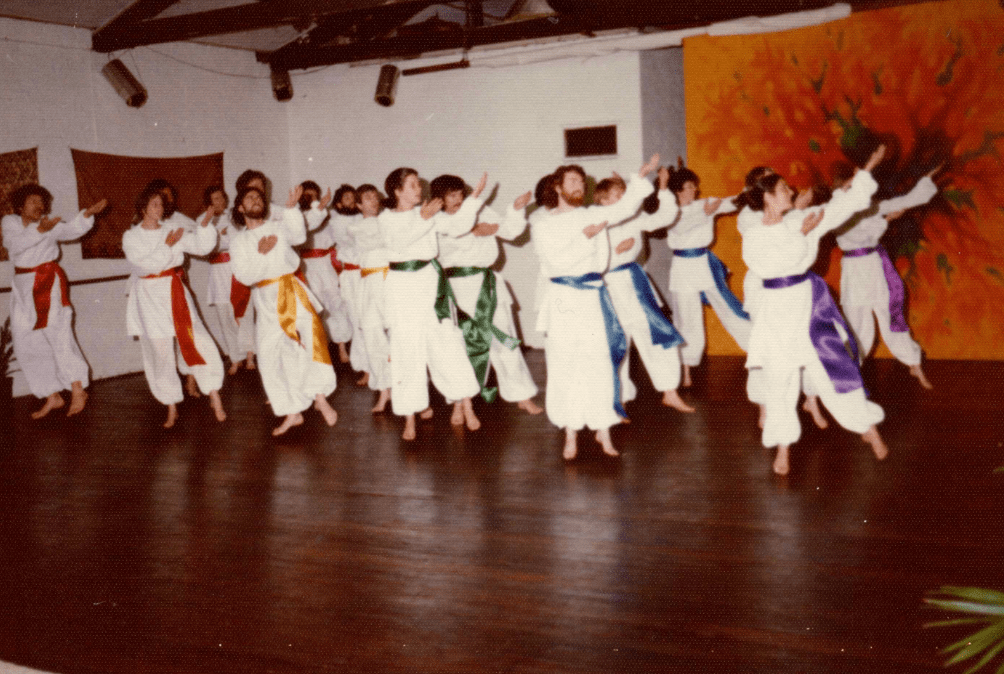
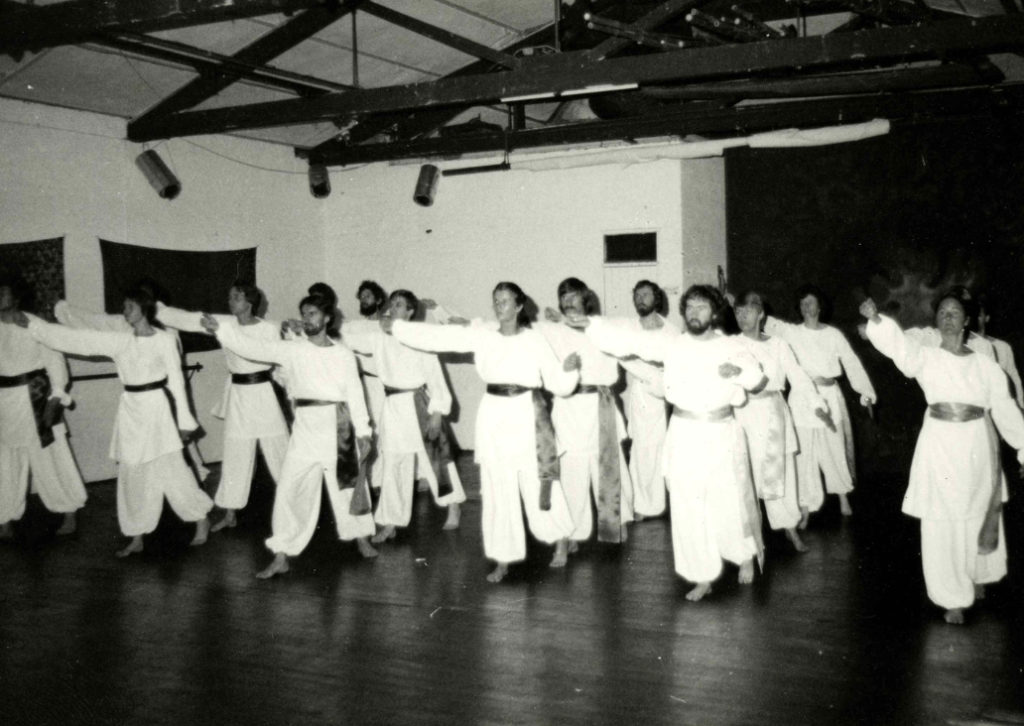
Fifty-seven years after the first public performance of Gurdjieff’s Sacred Gymnastics (Movements) at the State Theatre in Tiflis (Tbilisi), three public performances of Gurdjieff’s Movements (which included several of the same Movements as in the first performance) were given half way around the world in Melbourne, Australia.
Demonstration, Saturday December 13, 1975

A TALK AND DEMONSTRATION OF GURDJIEFF’S MOVEMENTS AND SACRED DANCES
The Movements were learned by G.I. Gurdjieff during his travels in Turkestan, Afghanistan, Kafiristan, and Chitral. At the beginning of the present century he was probably the world’s greatest authority on the sacred dances of these regions. Gurdjieff wrote “Sacred dances have always been one of the vital subjects in esoteric schools of the East. They have a double aim: they contain and express a certain form of knowledge and at the same time serve as a means to acquire a harmonious state of being.”
PROGRAMME
A talk on the work of Gurdjieff groups in Melbourne by Dr. Brian Earl.
A demonstration of Gurdjieff’s Movements or Sacred Dances
First Obligatory, Second Obligatory (First March), Fourth Obligatory (Counting), Fifth Obligatory (Note Values), Sixth Obligatory (Mazurka), Slow Second, Forming Two’s, Waltz, Shouting Dervish, Enneagram.
PLEASE DO NOT APPLAUD
NO PHOTOGRAPHS, PLEASE
In keeping with this request there are no photographs of this demonstration
Performance, Saturday July 17, 1976


THE DANCES
The dances, which are often referred to as ‘the Movements’, were brought to the West by G.I.Gurdjieff. He learned them in various dervish and esoteric communities in South West and Central Asia, at about the turn of this century. The origins of many of the Movements are probably very ancient.
The Movements have a twofold function: through their symbolism they can convey to the audience aspects of the Work and the process of inner change, and they also affect the performers but in a different manner. When we perform the Movements, they disrupt our habitual attitudes and fixed forms of thinking, which constitute a barrier to change. The results of participating in the Movements, though more profound, are analogous to the experience of visiting a new place or a different land, or else leaving forever somewhere dear to us; we notice more and feel more in contact with ourselves and the world
PROGRAMME
An introductory talk by Dr. Brian Earl
THE MOVEMENTS
First Obligatory, Second Obligatory (First March), Third Obligatory (March Forward), Fourth Obligatory (Counting), Fifth Obligatory (Note Values), Sixth Obligatory (Mazurka), Forming Two’s, Unfinished Second, Slow Second, Shouting Dervish, Waltz, Tibetan Masked Dance, Thirty Gestures, Number Nineteen, Canon of Seven, Number Thirty-Nine.
PLEASE DO NOT APPLAUD


Performance, Wednesday November 17, 1976

Introduction
Our programme tonight comprises a mixture of introductory and advanced Movements. These were learnt by G.I. Gurdjieff during his training in various Middle East monasteries, sufi groups and training schools. At the end of his training period Gurdjieff practiced as a Teacher and Healer in Tashkent and later realising the great need in the West he moved to Europe. Gurdjieff employed a variety of techniques, for helping people to acquire inner freedom, and a central feature of his methods was these Movements.
In the modern times and probably during recent centuries there have been very few people who did not suffer from chronic tensions. These are initiated in childhood by the behaviour of those around us and by our environment generally and in later life they are sustained by our environment but also by our opinions and attitudes. In fact we are trapped within ourselves by tensions, thoughts, worries, fears, etc. which reinforce each other and which are very difficult to break out of. Control of these is the beginning of the inner freedom which is the aim of this work. Performance of the Movements correctly demands an intense awareness of exactly what we are doing and a precise knowledge and control of our muscular tensions and in combination with other techniques can be a means for freeing ourselves from inner bondage.
PROGRAMME
8.00 PM MOVEMENTS CLASS
An opportunity for the audience to learn one of the Movements. (If you do not wish to participate please do not arrive before 8.30 pm)
8.40 PM THE PERFORMANCE OF EXERCISES, DANCES AND RITUALS
First Obligatory, Second Obligatory (First March), Third Obligatory (March Forward), Fourth Obligatory (Counting), Fifth Obligatory (Note Values), Sixth Obligatory (Mazurka), Enneagram, Waltz, Second Pythagoras, Shouting Dervish, Trembling Dervish, Forming Two’s, No 1: Automat, No 17, Little Tibetan, No 30, No 32, Alif Lam Min, No 5, No 39.
PLEASE DO NOT APPLAUD
NOTE: The audience will be sitting on wooden benches and on the floor so you may wish to bring a cushion or coat to sit on.
For two years we have been holding courses to provide people with the material needed for their own inner work. Many people have benefited from these, some very profoundly.
There will be a one month full-time course from 31st December to 30th January and a series of evening meetings for newcomers will begin in February. If you wish to know more about either of these, write explaining your interest briefly to Box 301. Elsternwick 3185. Please enclose a stamped self-addressed envelope for reply.

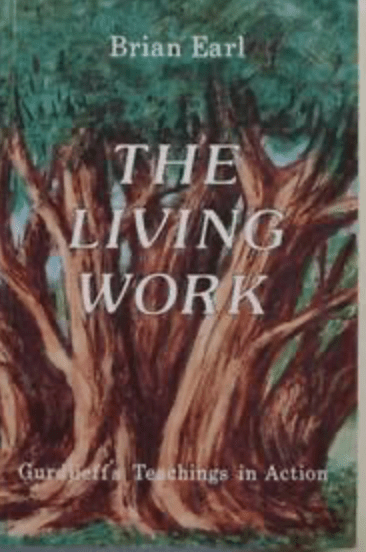
Brian Earl, THE LIVING WORK Gurdjieff’s Teachings in Action, Fourth Way Group, Melbourne, 1984
Chapter 4 The Movements
The Movements are sequences of precise gestures which are performed to special music. Some of the Movements are gymnastics, some are dances, some are marches, others are rituals or prayers. They constitute a very important part of our early training in the Fourth Way, and are complementary to the mental techniques taught by Gurdjieff.
Like any technique, they can lose their effectiveness if abused or used to excess. To avoid their abuse, the choreography of the Movements has never been published. In fact, it is probable that correct use of the Movements can only be taught by a lengthy period of instruction from someone who has undergone years of experience and study of them. There is, as in all such techniques, only a very subtle difference between right and wrong performance. The teacher, in order to be right, has always to be re-examining and refining their own understanding of them.
Some teachers advocate that Movements only be used during the first year or two of study, in order to maintain their content and a right attitude to them. After that time, they are practised only to teach others or to prepare a performance for showing outsiders. The Movements are particularly valuable in the early stages of study, because the unaccustomed gestures and sequences and the efforts of attention cause the mind to be stilled. This is otherwise a difficult thing for most people to achieve initially, but is an essential starting point in the Work.
Leanne: Can you say something about the origins of the Movements? After working on them, I have become quite fascinated by them and would like to know more about where they came from.
Brian: About the turn of this century, Gurdjieff wandered throughout much of the Middle East, south into Africa and east as far as Tibet and India. He collected the Movements during these travels. Mostly they came from Turkey, Turkestan, Afghanistan and Tibet.
His achievements were amazing for two reasons: The first is that he should obtain admission to the monasteries and training centres where they were taught. Secondly, having learnt the Movements, he was able to re-construct them years later, together with the music which he had also committed to memory.
Paul: Did Gurdjieff say whether these were connected with any particular religion?
Brian: Apparently they were not connected with any single religion. He said that the schools which preserved them, had kept alive an ancient system of knowledge about human nature and the path toward self-perfecting. This knowledge is contained in symbolic form in the Movements. As we work with the Movements we notice, from time to time, a meaning in a particular gesture or a sequence of gestures.
It is obvious from some Movements, which you will learn later, that they are of Sufi or Dervish origin, though some appear to be Muslim, some Christian and others possibly from other religions.
Janet: Is there any evidence to confirm that Gurdjieff did not just make up the Movements himself?
Brian: Not a great deal, as far as I know. Mr Bennett told us that he had come across a group of dervishes performing one of the Movements, though I cannot recall where that was.
No doubt some of the Movements were largely his own creation but it is probable that he taught others just as he had learnt them in the various monasteries or centres where he stayed.
Anne: Do you think it really matters where they came from, so long as they are effective?
Brian: That is a matter of opinion, however, they certainly are effective. When we have put on performances of Movements, many in the audience have afterward commented on their effects. As one said: ‘They strike a basic chord’. The Movements speak directly to a religious or psychological need in us. People who do not wish to have this part of themselves aroused may even find the Movements unpleasant to watch. For others there is a strong feeling that they have found something they have been searching for.
Graham: I had a strange, marvellous feeling watching the Movements in Carlton. I felt just as I did during my Confirmation, when I was fifteen. I felt elevated. Hard to describe.
Brian: Yes, there is a projection of energy towards the audience, so that some of the people briefly return to their essence. They are brought back into a deeper part of their nature than ordinarily.
Karen: I thought they were just beautiful. I could have sat all night watching them.
Walter: Whilst doing the Movements on Monday, I had a peculiar feeling, as if I was not quite myself.
Brian: This was, in reality, contact with yourself, your essence, but we are so unaccustomed to being ourselves in this deeper sense, so used to living in our personality, that it can be experienced as something strange, unusual, even alarming. Would you say this was a pleasant experience?
Walter: I am not sure. I think so. I felt a bit separate from myself, if you see what I mean.
Brian: Yes. The Movements have this effect on some people, though not all. With others the change is almost imperceptible. Everyone who sincerely works at the Movements is brought sooner or later to his real self but not everyone has this strong experience.
Maria: As much as anything, the music affects me. It is haunting.
Brian: The music is very unusual. Gurdjieff said it was composed in past times, when a great deal more was known about the effect of music on the psyche of man. He said that the music was designed to have precise effects on the sensations and feelings of the hearer and that the music corresponded to the particular Movement. When I first heard the music it had a very strong effect on me.
When we practise the Movements the music combines with the body gestures and the required efforts of attention to produce a total effect which you expressed as ‘feeling not quite myself’. This is the rare event of being in contact with a deeper part of ourselves.
Janet: Actually, my reason for coming on this course, was that I thought the Movements might improve my co-ordination, which has always been poor.
Brian: It is said that all reasons for being drawn to the Work are equal! I think you will see an improvement in bodily control. They develop our attention too. They can correct many defects, both physical and emotional and also harmonise our thoughts, feelings and sensations and bring us towards a total inner harmony.
In order to perform the Movements correctly, the body has to be in a high state of consciousness which unifies the action of the different parts of the mind. Sensations, feelings and thoughts are brought together in an integral act of expression.
Colin: Why do you insist so much on precision of the gestures?
Brian: For several reasons. Associated with each gesture is a feeling which is aroused both in the performers and in those watching. As yet, you have not developed the sensitivity to know what feeling is stimulated by most of the gestures, but in due course you will begin to notice them more. You will see that a small change, perhaps an arm at a different angle, can change entirely the feeling of the gesture. Even a displacement of two inches of an arm, or a thumb out of line can spoil the gesture.
The Movements change our way of feeling and also transmit a message to the audience through the feelings. This happens because the sequence of feelings has been carefully chosen to give the required effect. If you then change a gesture and hence the feeling, what will result? Only a random sequence of feelings. What is worse, if everyone in the performance transmits a different message the net effect on the audience will be nil. For that reason alone, it is necessary to strive to make your gestures as accurate as possible.
Another reason for insisting that they be accurate is because they are part of a program designed to help us break loose from our habits. Over the years each of us has unconsciously selected a repertoire of a relatively small number of gestures. For this reason our friends can recognise us by our gestures and posture even when we are too far away for them to see our face. In choosing these gestures each of us rejected very many others. The gestures that we did not retain represent for us a segment of life and experience which is locked away from us. The gestures which we did choose, set limits to our life to an extent much greater than we usually realise. This happens because there is some degree of association between gestures, thoughts and feelings. However, in all this the problem is that we unconsciously always seek to return to our habitual gesture pattern, so that, if we do not strive always to maintain the precision, the gestures soon deteriorate to something nearer to our habitual positions. Consequently, they lose their power to free us from our habits of thought and feeling.
Movements develop the power of attention, too. One of the ways this is done is by demanding that we make the effort always to make accurate gestures. This requires attention and it develops attention.
Finally, precise gestures are only possible when we know precisely what our body is doing – without looking, of course! If you think you already know just what your body is doing without needing any special training, you have a surprise in store! To take these gestures correctly requires an exact knowledge and adjustment of muscular tensions and relaxations. This knowledge stabilises or earths our awareness.
Leanne: Why do we have to stand still between Movements, and why is it that I often find myself moving about without realising it?
Brian: I have just been speaking about the association between postures, thoughts and feelings. If at some future time you perform the Movements before an audience, you will need to be still between Movements, otherwise what do you think will be the message that you transmit when you fidget about? Something quite different from the message in the Movement.
There is an even more important reason for keeping still. It is connected with energies. The efforts and the strange gestures generate in us quantities of higher energies that we are not accustomed to. The body seems to wish always to disperse these by scratching, moving about, adjusting clothes and a multitude of other nervous movements, including talking! If you do not resist this you will never acquire the energy needed for your work. This energy is also connected with attention. If we have the energy, we have greater attention and, therefore, only by resisting the temptation to disperse this energy will you be able to do the more difficult Movements which demand more attention.
Olaf: It must take a long time to reach the standard that you achieved in the Carlton performance. How long had those people been learning them?
Brian: All of the performers had been working on the Movements for at least four months. This sounds a very short time, I know, but at that time we were making great demands on our students. We also took measures to raise the energy level of the group so that, even with such relatively inexperienced performers, the audience could feel that these people were working on themselves and that what we were doing was real and effective, not just words and ideas.
Olaf: Even so, when I look back, it is astonishing what an impact they had on me.
Brian: This brings to mind something which happened a few years back. We had two groups separately meeting in Melbourne at the time. It was the only occasion that we ever arranged a private performance of the Movements in costume with one group performing for the other. This was an experiment which for various reasons we did that once and have never repeated.
That very day a group member, Michael, phoned me to say that John, a mutual acquaintance from Sydney, was unexpectedly in Melbourne on business and could he come to the meeting? As far as I know that was the only occasion that John came to Melbourne during the years we have been here.
John had himself been teaching the Movements for some years, so he was keen to see us in action. It was a peculiar coincidence that his work brought him here on that particular day. Naturally, we said, yes, he could come.
I took part in the performance and we did six or eight fairly difficult Movements. Afterwards, I gave a brief talk and we taught everybody a Movement called Six Positions, which was done with great gusto.
We ended the meeting with a short meditation. Afterwards, John came up to me and placing some money on the table next to me, said: ‘Please accept this; I know that your group has financial problems’.
I could tell by his tone that he had been deeply affected by the Movements. He paused and then added: ‘The Grace of God descended upon me this evening. Thank you’.
As stated in the book’s Introduction
In order to avoid possible embarrassment, the names of participants have been changed. In fact, each name represents a composite personality made up of two or more people. Otherwise the ‘cast’ would have been inordinately large.
However, in the last case the names are real, Michael was myself and the visitor was John Miqueaux , (1928-1998). John was born in Budapest of Hungarian and French parents, who later moved to France. As a young man, after World War II, he joined the French Foreign Legion, and served in Morocco and Indo-China (now Vietnam). He then studied Buddhism in Japan and Taiwan and after immigrating to Australia, eventually became an ordained Soto Zen priest. He was involved in the early days of the Gurdjieff Society of Australia, Sydney group, along with two other Europeans, the Bulgarian Peter Oulianoff and the Ukrainian Nicolas Tereshchenko. He told me he had initially joined the group to debunk Gurdjieff, (from his experience of years of studying and practicing Buddhism under noted teachers), but when he found he was unable to do so, he was driven to explore and seriously investigate Gurdjieff’s ideas and exercises. His teachers in the Work were Charles Wright , Lord Pentland and Rina Hands, amongst others. He eventually went on to lead his own Gurdjieff Society of Australia affiliated groups in Wollongong and Brisbane, before retiring to the Sunshine Coast, Queensland, where he died in 1998.
Here is his rare Buddhist perspective on the Movements.
On the Cultivation of Attention
In September, 1983, Roger Armitage and another member of Buddhist Discussion Centre (Upwey) visited Mr. John Miqueaux at the Soto Zen Buddhist Society, 33 Cairns Road, Camira, near Brisbane, Queensland.
Mr. John Miqueaux, his wife and family, have moved to Camira from Woonona in New South Wales to establish a new Centre at their home.
Discussions of various principles of Zen Meditation and the Buddhist Sacred Dances took place. According to Mr. John Miqeaux, sacred dances used to be an essential part of some religions, and are a powerful means for practice.
In his paper, Buddhist Sacred Dances Chapter 6, part B, entitled “Why the Sacred Dances are necessary”, Mr. John Miqueaux states: It is impossible to practice Right Mindfulness outside one’s body. Therefore the seeker simply has to understand what it means to be in one’s body and what it means to be outside one’s body; without mindful awareness and experiencing of our bodies we are dispossessed and dismembered.
In doing the Sacred Dances it is possible to make use of the body whilst we have to constrain ourselves to be, and to stay, mindful. During the struggle, it becomes quite obvious that there is no co-relation between the body and the mind and that we are truely like strangers in our bodies.
In part D of Chapter 6, Mr. John Miqueaux makes reference to his own training in Sacred Dances in Shaolin and other temples over thirty years ago. Since that time he has been teaching these Dances and Gurdjieff Movements. In Chapter 7 of his paper entitled Chanting the Mantras, Sutras and Dharanis, Mr. John Miqueaux quotes the Great Nagarjuna: “Remember that attention has been declared the only Path the Buddhas have ever trodden. Observe therefore constantly the body (including all the inner and outer activities of the five senses, their causes and results) in order to really know it. If you neglect to do this Supreme Practice, and fail to observe all the agglomerates which make up the you, all other spiritual exercises will have no effects whatsoever. It is only this continual Attention that is called: Freedom from “absent-mindedness”
B.D.C. (Upwey) would like to thank Mr. John Miqueaux and Mrs. Miqueaux for their kind hospitality.
 Gurdjieff Research