Gurdjieff’s dangerous driving has been described by several of his pupils. Most noted is Hulme’s account of struggling to follow Gurdjieff’s car from the Café de la Paix, Paris to the Prieure, Fontainebleau.
He started his car with a race of the motor that belched smoke from the exhaust and I swung out behind him into the boulevard traffic, galvanized by the single fixed purpose to let nothing between us for the next thirty-eight miles. I lost him a dozen times before arriving on the outskirts of Paris. He drove like a wild man, cutting in and out of traffic without hand signals or even space to accommodate his car in the lanes he suddenly switched to . . . until he was in them, safe by a hair. Black French sedans exactly like his seemed to fill the streets. I learned to watch ahead for the one being driven the most erratically, then – gripping the wheel – to try to follow it. In the breathing spaces at red lights, I sometimes saw him off to the right or left, black fur cap set at a jaunty angle, puffing tranquilly on a cigarette. He always got away first on the green light even (so it seemed) when he was one or two cars behind the starting car.
Outside Paris things were a bit easier but not much. I could keep him in sight for longer stretches on the route nationale, but the chances he took overtaking buses and trucks were terrifying. I watched with suspended breath each time he swung out around a truck and headed directly into another coming toward him on the narrow two-laned road.
Kathryn Hulme Undiscovered Country, A Spiritual Adventure, Frederick Muller, London 1967, pages 65,66
First Major Motor Accident, Tuesday 8 July 1924
On Tuesday 8th July 1924, Gurdjieff was seriously injured in a car accident 50 km south of Paris, just north of the village of Chailly, 11 km from Fontainebleau.
The most detailed account from the time is from Thomas and Olga de HartmannOur Life with Mr Gurdjieff, Definitive Edition, ARKANA, Penguin Books, London, 1992
There was no opportunity to ask my husband what had happened, but a pupil told me that quite by chance a gendarme on a bicycle had seen a car smashed against a tree, with the steering wheel broken. He found Mr. Gurdjieff lying unconscious on the ground, his head upon a double cushion that had been taken out of the automobile. Who could have taken out this cushion and laid Mr. Gurdjieff’s head on it? Nobody was around.
Shortly afterwards, an ambulance passed by, which stopped and took Mr. Gurdjieff to hospital. He was identified by a card found in his pocket.
(page 224)
Gurdjieff’s later visit to the site of the accident with Thomas and Olga de Hartmann to determine how it had occurred is also described.
It was not long before Mr. Gurdjieff insisted anew on going to the scene of the accident. That was quite an event. We rented a car with a driver, and my husband and I accompanied Mr. Gurdjieff to the fateful place, all of us for the first time. It was at a crossroads near the hamlet of Chailly, on the main road from Paris to Fontainebleau.
Mr. Gurdjieff got out and inspected everything around the area. He began to make suppositions and draw conclusions, finally settling on what seemed the only possible version: he was travelling at high speed along this stretch; for the road was in good condition and straight as an arrow, when suddenly a car came out of the side road in front of him, blocking his way. To avoid an inevitable collision, he swerved off the road to the right around a signpost at the corner and headed for a grassy space between some trees. Here a second obstruction faced him. To reach the grass the car had to get over a low stone embankment. Consequently, he had to hold the steering wheel very tightly. From the shock of hitting and lurching over this obstacle, the steering wheel itself snapped, its wooden ring falling to the floor, where it was found later. The wheel could not have broken before this point, since the tracks left by the car before mounting the embankment were perfectly straight.
From the spot where the steering-wheel broke to the tree where they found the crushed vehicle was not a great distance. All the evidence showed that during those few seconds before the automobile hit the tree, Mr. Gurdjieff was working with the brake while trying to manoeuver the car by holding on to the stump of the steering-column with the help of his hat, before opening the door to jump out of the car himself. His car was a Citroen ‘dix chevaux’ whose doors closed so tightly that he would have had to give it a very strong push to open it.
We don’t know exactly what happened after that. Seeing that he was bleeding badly, he somehow managed to get a seat cushion out of the car to lie down on, after which he lost consciousness. When they found him, he was covered with mud and blood, and by the stains on his clothing they concluded that he had been trying to reach his pocket handkerchief.
In a word, it is clear that Mr. Gurdjieff was not in the car when it struck the tree, and that the breaking of the steering-wheel made the accident much more extreme.
(pages 230,231)
Stanley Nott described the state of the car after the accident.
Later in the day I went up to the garage in Fontainebleau to get something from his car, a small Citroen, which had been towed there. The radiator was crushed, the engine was off its seating, the steering column was broken, screen and doors and windows smashed, the front axle and wings crumpled. Gurdjieff had been found lying on the grass verge of the road that runs from Paris to Fontainebleau, his head on a cushion of the car. How he had got out of the car, whether he got out himself or was carried, was not clear. The car had run into a tree.
C. S. Nott Teachings of GURDJIEFF, THE JOURNAL OF A PUPIL, Routledge & Kegan Paul, London 1961, page 80
The accident was briefly noted in several Paris newspapers on Friday 11 July 1924.
Found unconscious, on the road near Fontainebleau, Prince Gurdgieff, near his car
Prince Gurdgieff, living in the chateau du Prieure, at Fontainebleau, was returning from Paris by automobile. The prince was alone in his car, when, on arriving at the intersection of the Perthes-en-Gatinais to Ponthierry road, the car crashed into a tree. The accident had no witnesses. It was not until sometime later that the wrecked vehicle was discovered and the prince lying unconscious with a serious head injury. The victim was transported to the hospital in Fontainebleau.
Le Petit Parisien (Paris Daily) 11 July 1924, page 3
A more detailed account was also given in the Fontainebleau weekly newspaper on the same day, Friday 11 July 1924.
Automobile Accidents
Tuesday afternoon, a serious car accident occurred on the road to Paris, at the crossroads of the road to Perthes.
Around 4 p.m., a Citroen, was discovered damaged against a tree bordering the road; its driver lay motionless in the ditch. He was transported as quickly as possible to the clinic in rue Neuville.
The investigation revealed that it was doctor Gurdjieff, director of the Community of Basses-Loges.
From the observations made by Mr. Gamon, one of those who discovered the accident, it seems that Mr. Gurdjieff was crossed or overtaken by a car which, pressing him against the verge, forced him to veer to the right in order to avoid collision. The movement had been well calculated since the Citroën avoided the signpost of the road to Perthes, but Mr. Gurdjieff had not seen the angle of the embankment hidden under the grass, and the right wheel of his car stumbled against this obstacle. It is likely that the impact was such that the steering wheel broke in the driver’s hands and the car then crashed into a tree.
It seems that the accident was caused by the fault of a third party, because the victim was found lying in the ditch beside the road, a cushion under his head; he must have been carried there by someone, because if he had been able to drag himself there, he would not have taken the precaution of closing the door of his car.
In this case, we cannot overemphasize the shameful and criminal act of the individual who caused this accident, who, to avoid any embarrassing responsibility, did not hesitate to let his victim agonize, without help, on the edge of the road.
Unfortunately, the ongoing investigation is unlikely to find the culprit. However, the Ponthierry gendarmerie was informed by a motorist that an accident had just occurred on the road. It would be interesting to find this man who hastened to disappear once his deed was done.
L’Abeille de Fontainebleau : journal administratif, judicaire, industriel et littéraire (Fontainebleau weekly) 11 July 1924, page 2
The newspaper reports locate the accident at the intersection of the Paris to Fontainebleau (D607) and Perthes-en-Gatinais to Ponthierry (D372) route, 6 km north of Chailly.
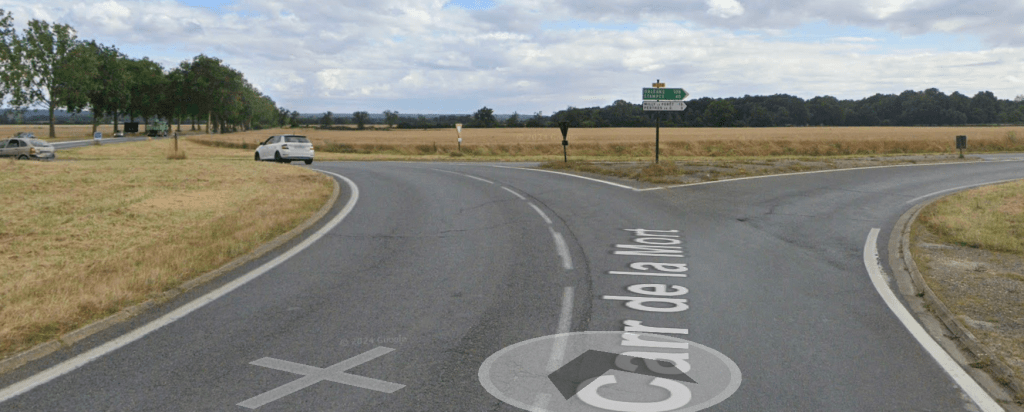
Accident site. Intersection looking south to Fontainebleau
The intersection has since been upgraded to a large roundabout and the original sign post and the tree Gurdjieff crashed into removed. The de Hartmann’s conjecture that Gurdjieff veered to his right to avoid a car coming from his right suggests he was attempting to pass behind the other car to avoid a collision and drove to the right of the signpost that would have been on the south west corner of the intersection, against a low embankment losing control when the steering wheel broke and jumped out of the car before it crashed into a tree on the right-hand side of the main road.
Second Major Car Accident, Thursday 31 July 1930
On Thursday 31 July 1930, Gurdjieff was heavily injured in a car accident just south of Montargis, 110 km south of Paris, while returning from Vichy.
The only published record of this accident is from Martin Benson.
One Saturday, Mr Gurdjieff left the Prieure with, I think, five people. I only recognized a Russian typist and Dr. Stoernwald, (sic) and here they were, off to Vichy. At about eight o’clock that evening I got a call from Vichy. They had been in a terrible automobile accident and were being treated in the hospital. Mr. Gurdjieff was driving and was in the hospital too. How the accident happened does not matter but I gathered it happened as Mr. Gurdjieff avoided hitting a chicken or some animal. At the time the Russians, Mr. Gurdjieff’s family, were living in Paradeu and all the Russian women became very hysterical.
When they came back from Vichy, Mr. Gurdjieff was like a battlefield, but he brought them all home. We quartered the women who had been on the trip in various rooms. Dr. Stoernwald had a hole in his ankle; I think he never recovered from that hole and that it finally killed him. Anyway, Mr. Gurdjieff chased all the women out and he said to me, ‘Benson, you take care of all the people around.’ He ordered a bottle of Vieux Marc for every room; that is the toughest damn liquor in the world. I went from one room to the other. I told Dr. Stoernwald, ‘You should go to the hospital’—but he was very stubborn and said, ’Oh no!’ In fact, they all should have been in the hospital. I went in and out of each room all the time.
You know these metal clips they used instead of stitches? Well, Mr. Gurdjieff sat on the bed, completely undressed. ‘Take all these clips off,’ he said to me. I said, ‘I have no experience, and I have no tools.’ ‘Make tools. Get tools, get these things out.’ I got a pair of pliers and a screw-driver and I boiled them to sterilize them. But I told him that if he started to bleed I would have to get him to the hospital right away. This was at eleven o’clock on Saturday evening!
I tore up sheets and made tourniquets. Mr. Gurdjieff looked awful, and we sat there and drank Vieux Marc. I had sense enough to know that you can only keep tourniquets on for fifty minutes and then you ease them off slowly. Mr. Gurdjieff did not say a word – he just drank. It was absolute torture. I got masses of clips out of him. The thing was that when I started slowly easing and taking the tourniquets off, he did not bleed! He just sat there and finally I got him to bed. I went outside and sat outside his door looking in now and then. He was asleep. I felt he knew what he was doing.
Carl Lehmann-Haupt (ed) Martin Benson Speaks, Codhill Press, New Paltz, New York 2011, pages 193,194
The accident was reported in the local newspaper on Tuesday 5 August 1930.
AVON
Automobile accident. – Thursday, July 31, a little before 11 a.m., Mr. Levy, a grain trader in Montargis, following the national road No. 7 by car. Arriving in Mormant (Loiret), he stopped his car, parked it on the side of the road, and got out to talk with Mr. Faisy, farmer, and left his dog in his car. However, the dog wanted all of a sudden to go and join his master. He jumped just as a car arrived heading for Montargis. The dog was caught between the wheel and the fender; the car veered to the left and the driver, wanting to straighten up, ran into a tree. The motorist, Mr. Gurdgieff, residing at Basses-Loges d’Avon, was able, after dressing, to return to his home. But the two people who accompanied him, Mrs. Chavesse and Mrs. Salzmann, were transported to the Montgaris hospital. Needless to say, the automobile is in a sorry state.
L’Informateur de Seine & Marne, 5 August 1930, page 3
Benson in an earlier section of his book, recalling Gurdjieff’s first accident, claimed that in that instance Gurdjieff was found sitting on the curb on the opposite side of the road with his shoes off, in complete contradiction to all the other reports. This puts the reliability of his recollections in question. In this case it is possible, but highly unlikely, that he is speaking of a different accident, as the day, hospital, location, direction travelling and number of people don’t match the newspaper report. Only the accident’s cause, (avoiding hitting a chicken or some animal) matches.
The newspaper report locates the accident in Mormant, 5 km south of Montargis.
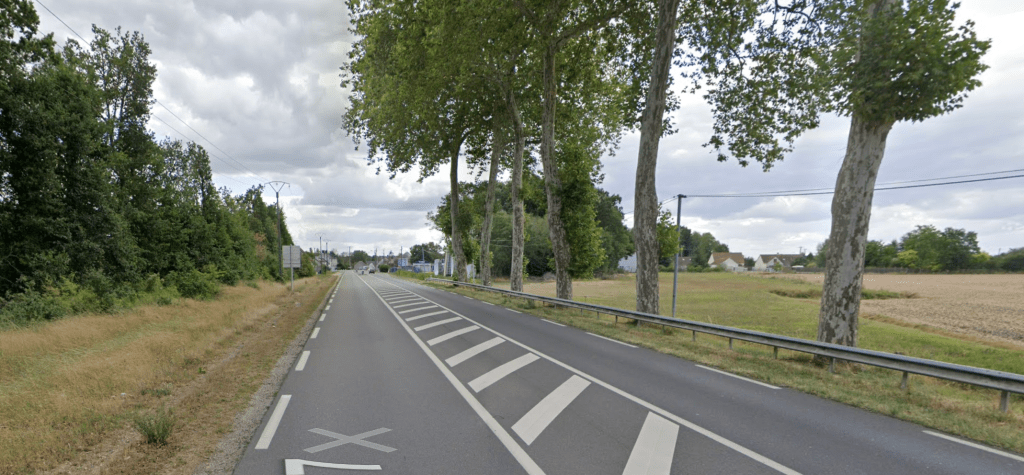
Section of road at Mormant, going north towards Montargis
This section of the road has fields on either side of the road with stretches of trees lining the road. It appears that Mr. Levy parked on the side of the road and went across the road to talk with the farmer, Mr. Faisy, leaving his dog in the car. As Gurdjieff ‘s car was approaching the dog leapt out to follow his owner and was caught between the fender and wheel of Gurdjieff’s car causing it to veer to the left. In attempting to straighten up Gurdjieff ran off the road and crashed into a tree. The newspaper report says Gurdjieff’s car was approaching Montargis, that is driving north to Paris, not south to Vichy as stated by Benson, which suggests it happened when they were returning.
Third Major Car Accident, Sunday 8 August 1948
On Sunday 8th August 1948 Gurdjieff was seriously injured in a car accident at the southern end of Montargis, 110 km south of Paris, while on the way to Cannes.
The earliest published details of the accident are from J. G. Bennett. He describes the departure of the party.
Gurdjieff went off, in a borrowed car, with the American who had been reading on the first evening, George, his Russian chauffer, and a young girl called Lise Tracol. My wife and I expected to follow the next day. Having seen Gurdjieff leave, my wife, Bernard and I spent the day quietly together.
J G Bennett, Witness: The Story of a Search, Hodder & Stoughton, London, 1962, page 248
He also describes the accident.
He had been driving through the town of Montargis, when a small lorry with a drunken driver had shot out of a side road and caught him amidships. The driver of the lorry and his passenger were killed instantly. Gurdjieff’s car had buckled up, pinning him between the wheel and seat. It had taken an hour to extricate him. He had remained perfectly conscious, and directed each move so as to avoid fatal loss of blood. The three passengers in Gurdjieff’s car had escaped with minor injuries.
(page 250)
In a talk at a meeting in Livingstone Hall, London on September 9, 1949, only thirteen months after the accident, Bennett claimed.
The car caught fire but fortunately there was a garage at the crossroads and Mr. Gurdjieff, who alone of the occupants had retained consciousness, directed the rescue work and was removed from the completely smashed car after twenty minutes.
https://www.jgbennett.org/meeting-on-september-9-1948-gurdjieff/
A further detail, that one of the passengers (the American Philip Lassell) was thrown out of Gurdjieff’s car, is related by Paul Taylor.
A more likely story was told me by my stepfather, Philip Lassell, who was in Gurdjieff’s car on August 9th (sic) 1948, when a truck crashed into it on the road south of Paris near Montargis. Gurdjieff was pinned in the wreck by the steering column. Philip was thrown clear and tried, though injured himself, to pull Gurdjieff clear. Gurdjieff told him to stop making his pain worse and sit down and listen; then, until help arrived over an hour later, he told stories.
Paul Beekman Taylor, Shadows of Heaven: Gurdjieff and Toomer” Samuel Weiser, Inc. York Beach Maine, 1998, page 53
Taylor adds that Gurdjieff was driving a Citroen
In August 1948, Gurdjieff, with Philip Lasell (sic) beside him in the front seat and Lise Tracol behind, had a near-fatal accident near Montargis when a truck crashed into the Citroen he was driving. As he lay on the roadside, waiting for help to arrive, he kept Lasell’s morale up with stories, though Lasell suffered only minor injuries compared to Gurdjieff’s.
Paul Beekman Taylor G.I. Gurdjieff: A New Life, Eureka Editions, Utrecht, The Netherlands, 2008, page 210
The accident was reported in the local newspaper on Wednesday 18 August 1948.
In Montargis, at 110 kilometres 2 cars collide. 1 dead, 8 injured
Sunday, August 8, round 7:30 p.m., on the national route no. 7, the “Blue Route”, at the southern exit of Montargis, at the place “Brise Lance”, two cars collided. One, a powerful “Buick,” driven by an Armenian subject, Mr. Georges Carjieff, (sic) 71 years old, residing in Paris, was heading towards Nevers. In this car were Mr. Lasselle, Mr. Bechenoff and Miss Tracol, also from Paris. They were going to Cannes. The other was a van, coming from Vieux Villemandeur. It was driven by Mr. Raymond Hervier, farmer in Moreau, commune of Targuées. In this vehicle were Mrs. Hervier, her daughter, a cousin, as well as the father of Mr. Hervier who all went to the Montargis fete.
The van was caught crosswise on its left by the Buick. Its engine was completely smashed, its body lifted. Mr. Hervier’s father, who was next to the driver, was thrown violently against the windshield when the van spun around. The other occupants were more or less slightly injured. They had to get out of the vehicle through the roof.
As for the Buick, its front right was completely smashed in. It crossed the road and hit the wall of the garage at the 110 km point. The steering wheel was broken completely.
The nine injured, the Hervier family and the occupants of the Buick were driven to Montargis hospital by Mr. Bajout’s ambulance, from the St-Christopher garage and by passing motorists.
Mr. Hervier’s father was soon to succumb to the consequences of his injuries. Doctor Nandroit, who was brought in to treat the wounded, has not yet commented on the gravity of the case of some of them.
The chief marechal-des-logis Mazet, of the gendarmerie brigade of Montargis, went immediately to the scene and made the first findings. The victims of this accident claiming not to know how it could have happened, it was so fast.
It is noted the “Buick” car was registered in the name of Mr. Robert Mayer residing at 45 Bde Haussmann, in Paris.
Le Libérateur de la région du Gâtinais, 18 August 1948, page 2
The ensuing court case and the damages awarded to Mr. Gurdjieff, Mr. Bechenoff, Mr. Lassell and Miss Tracol were reported in the local paper on Wednesday 9 February 1949.
MONTARGIS – After the accident at kilometer 110. — On August 8, 1948, around 6 p.m., to avoid the large crowds which were then circulating in the streets of Montargis on the occasion of the annual Fair-Exhibition, Mr. Raymond Hervier, 45 years old, farmer, living in Moreaux, commune of Trigueres, who was driving his father Eugene, 73, in a van to Chateau Renard, in Gravereaux, made a detour via Villemandeur.
When crossing the Route 7, in front of the garage at km 110, to join the Chatillon-Coligny road, it collided with a Buick 22 CV which, at about 60 km an hour, was heading towards Nevers.
In this last car were seated: Mr. Georges Gurdjieff, 71 years old, without profession, living in Paris: Mr. Georges Bechenoff, 55 years old, driver, also living in Paris: Elise Tracol, 18 years old, student, domiciled in Villeneuve-sur-Orge, and Philipp Lasselle, American subject, traveling in France. All four were going to Cannes.
Under the violence of the impact, Mr Bechenoff was thrown out of the car and found himself on the hood having gone through the windscreen. Mr. Gurdjieff who was driving was completely forced against the steering wheel of the vehicle with his chest. Mr. Lasselle had fairly deep wounds on his face and Miss Tracol a broken nose. The Buick swerved 19 meters and slammed into a low wall.
The van was severely damaged, the chassis almost separating from the body. Mr. Hervier’s father was thrown out of the vehicle onto the road. He was to die moments after the accident.
Mr. Schwob, of the Paris Bar, presented himself as a civil party on behalf of Mr Gurdjieff. He gets his client 200,000 francs in damages and interest. Mr. Lasselle, Mr. Bouchenoff (sic) and Miss Tracol had instituted civil proceedings through Mr. Dubosc. They obtain 100,000, 30,000 and 30,000 francs respectively in damages and interest.
Le Libérateur de la région du Gâtinais, 9 February 1949, page 3
The sentencing of Mr. Hervier was reported in the local newspaper on Wednesday 20 July 1949
AT THE COURT OF APPEAL THE HERVIER Accident
The consequences of a serious traffic accident! – Raymond Hervier, 45, a farmer living in Trigueres, driving his van, was coming out of the Villemandeur municipal road, on the national road No. 7, when he collided with a large American car, driven by Mr Gurdjieff, without profession, Paris, which was heading for Nevers. In the extremely violent impact that occurred, the occupants of the American car were more or less seriously injured, while Mr. Hervier’s father was killed and the driver’s wife and daughter injured.
On February 6 1949, the Court of Montargis sentenced Mr. Hervier to a fine of 20,000 francs. The Court pronounced a suspended sentence of 4 months in prison and a 50,000 franc fine.
Le Libérateur de la région du Gâtinais, 20 July 1949, page 1
The newspaper reports locate the accident at the southern end of Montargis, at the intersection of Route N7 and D93.
This is 5 kilometres before the site of Gurdjieff’s 1930 accident in Mormant.
The expansion of the N7 to dual carriageway, D93 now crosses in an excavated underpass. The Brise Lance garage has since been demolished to make way for on and off ramps to N7 so it is not possible to view the intersection as it was when the accident happened.
Another collision, between a camionnette and a tourist car, at the same intersection and location, the Brise Lance garage, ten months later, was reported in the local newspaper.
Le Libérateur de la région du Gâtinais, 7 December 1949, page 3
There are several errors and exaggerations in Bennett’s account but he was correct in saying that Gurdjieff was driving a borrowed car, not his own car, as claimed by Taylor. This was a 15CV Citroen Traction Avant shown in Jessmin & Dushka Howarth “It’s Up to Ourselves”, Gurdjieff Heritage Society, New York 1998, page 222
It was probably a 1946 Buick with a 5.2 liter I8 144hp engine and a kerb weight of approximately 2,000 kg.
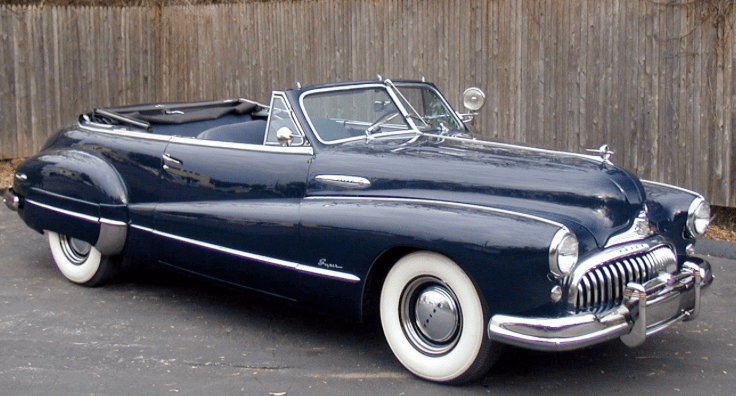
1946 Buick Convertible
The Buick was over twice the horsepower and weight of Gurdjieff’s Citroen.
In the front next to Gurdjieff was Georges Bechnoff and in the rear Philp Lassell and Lise Tracol – all recorded by Bennett as departing with Gurdjieff. Both Bechenoff and Lassell are said to have been thrown out of the car.
Bennett describes the other vehicle and the type of collision as
“when a small lorry with a drunken driver had shot out of a side road and caught him midships. The driver of the lorry and his passenger were killed instantly.”
The other vehicle was a camionnette or van (enclosed), not a British lorry, (cab with tray). There were two types of camionnette, one a high delivery van with two seats in the front and open rear cargo space,and the other a station wagon style vehicle based on a small car. It is unlikely to have been the larger style camionnette as there were five occupants. Farmer Raymond Hervier and his father in the front seats and Hervier’s wife, daughter and cousin in the back seats but a small camionnette
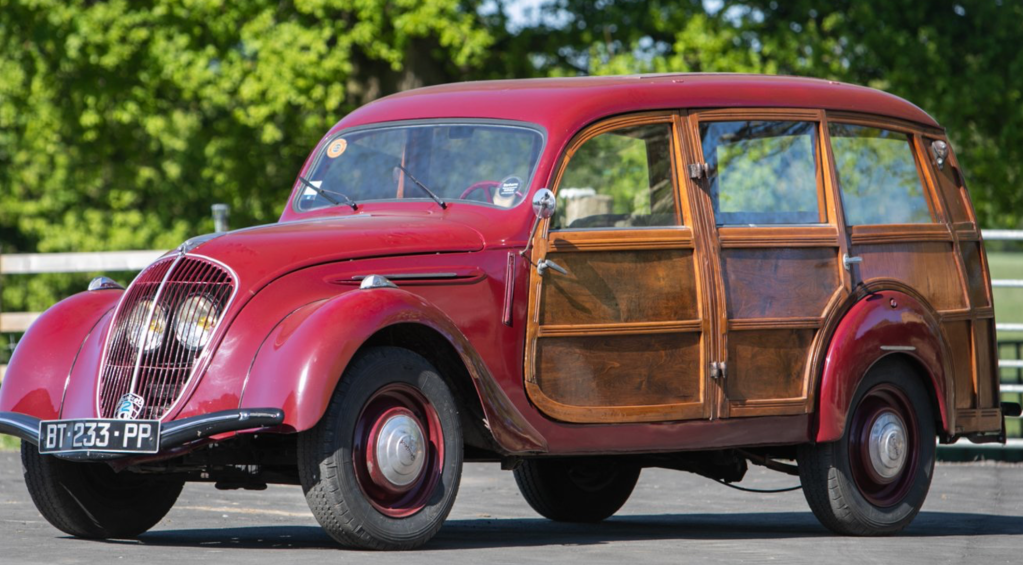
A 1948 Peugeot small camionnette
which had a kerb weight of approximately 900 kg, less than half the weight of the Buick. If as Bennett says, the other vehicle had struck Gurdjieff’s car amidships and its driver and passenger killed instantly, then the right front (Bechenoff) and rear right passenger (Lassell or Tracol) in Gurdjieff’s car could also have been killed.
As described in the first newspaper report, the camionnette came out from Gurdjieff’s right and the Buick right front struck the left front of the camionnette smashing the engine and spinning it completely around to face the other direction. For this to happen the Buick had to be travelling much faster than the camionnette. The second newspaper report adds that “The victims of this accident claimed not to know how it could have happened, it was so fast.”
The injuries to Gurdjieff and the occupants of his car occurred not at the moment of impact but seconds later when the Buick veered left 19 metres across the road and the left front slammed into the garage wall. This pushed back the steering column pinning Gurdjieff against the seat, propelled Bechenoff through the windshield onto the bonnet and threw Lassell out of the car. In the camionnette the injuries to Hervier’s father occurred immediately at impact when it spun violently to the right and he was thrown against the windshield and then out onto the road. Hervier, the driver was restrained by the steering wheel. The rear seat passengers suffered minor injuries. A video of what happens in this type of collision and where the two vehicles end up (matching the newspaper report) can be viewed on YouTube.
Bennett reports that the other driver, Hervier was drunk but this is not mentioned in the accident report or the court cases. It is not impossible, but seems strange that he would drive drunk with his father, wife, daughter and cousin in the vehicle. Another possible cause is the belief of right of way from the right in French rural areas and/or simply missing the road signage.
But in France, if a car comes out to your right, you need to give way to them! The car that is on your right will not even think twice and just drive straight out because THEY have right of way (= la priorité). Fortunately, this mostly only happens in small towns, where no priority is marked (i.e. no paint, no sign). In most intersections, there will be a road sign or a painted mark on the floor indicating who has right of way, who is facing a stop (hard thick painted line) or a give way (dotted line or “Cédez le passage” sign).
https://frenchyourway.com.au/tips-for-driving-in-france
Was Gurdjieff partially responsible by going too fast, which he was known to do? He was driving an unfamiliar car, much heavier and more powerful than his Citroen. It was dusk (sunset was at 8:14 pm that night). The sun would be setting on his right and could have partially blinded him. He had stopped earlier for some time, probably to eat and drink (alcohol?). Bennett says he had left Paris early in the day, yet by 7:30 pm at the time of the accident he had only travelled 110 km. In the court case it was claimed he was travelling at “about” 60 km/h and that the accident occurred at 6:00pm, an hour and a half earlier than stated in the newspaper. It is highly likely Gurdjieff was going faster than 60 km per hour. However, the court found in his favour and the other driver was eventually penalized for his part in the accident. Gurdjieff was awarded 200,000 francs, the equivalent of US$500 at the time.
 Gurdjieff Research