John. G. Bennett believed so, for in his major book on Gurdjieff, Gurdjieff Making A New World, (1973), (pages 181 and 182) he writes:
At times he has hinted that he went in 1932 on a visit to Central Asia in order to pick up threads of his former contacts, and returned to the U.S. determined to make one more attempt to resuscitate the Institute.
According to another version, he attributed the journey to 1933, after the publication of The Herald of Coming Good and on his return completely dropped the project, repudiated the book, and set himself to complete his writings….(my emphasis)
Gurdjieff’s passport, which I have carefully studied, shows that he went to Germany and returned to France in July (1935 -my insert). From what he said much later, I believe that he succeeded in going, during these two months, to the Caucasus and even to Central Asia. He certainly thought seriously of returning to Tashkent, but found that he would have little of the liberty of action he needed for his work. (my emphasis)
On the 8th July 1924, three weeks after returning from his first visit to America, Gurdjieff suffered a near fatal motor accident. Five months later, following a lengthy recovery, he resolved to achieve in print what he could no longer achieve in life, and became a writer. Totally focused on this aim, it wasn’t until January 1929 that he was able to return to America for the second time. Shipping passenger records show that he returned again in February 1930, November 1930, November 1931 and April 1934.
Moore and Taylor have written that Gurdjieff also visited in the autumn of 1933. Despite what they wrote there is no official record of Gurdjieff having entered America in 1933 and on his 1934 entry, he lists the last year he was in America as 1932.
In the 2006 Russian documentary film, Hitler, Stalin, and Gurdjieff , Arshak Manukyan, director of the Merkurov Museum, Gyumri claimed that when
Gregori Ivanovich was on a lecture tour around the United States, (in 1934- my insert) he was offered the chance to visit the Soviet Union and to start working on studies of longevity in the All-Union Institute of Experimental Medicine . At the last moment Gurdjieff changed his mind. The visit was cancelled. The correspondence with his cousin suddenly ended.
Seven weeks after Gurdjieff’s arrival in New York from Bremen on 26 April 1934, (on a one year visa, issued in Paris on 15 February ) advertisements appeared in the New York Times, 12 -14 June 1934, stating that he had lost a passport, though we don’t know which one, or if he recovered it. However, a year later, as his visa was about to expire, he caused a stir among his students, by saying he had been robbed of his wallet and passport on the Brighton Beach Ferry,
There’s another story, a funny one. We never understood it. Mr. Gurdjieff was on the way to Brighton Beach, on the boat, to see the Whitcomb’s. They went to pick him up, but he said his wallet was stolen and he lost his passport. I’d like to see anyone rob him, because he was aware of everything going on all the time. I said, ‘How did it happen?’ He said, ‘I don’t know, but I have to report.’ And somebody had to report to immigration. I think he threw the damn thing overboard. I never could understand how anyone could rob him. I think he threw it out, just to see what we would do.
Carl Lehmann-Haupt, Martin Benson Speaks (2011) page 181
Having overstayed his visa and needing some document to be able to leave America, Gurdjieff was eventually able to obtain a passport from the German Consulate in New York. This was confirmed by Louise Goepfert March.
When Gurdjieff was ready to go to New York, Walter and I bought Gurdjieff’s boat ticket. After he returned from his trip in 1935, stories circulated among his students about shenanigans with his passport. According to one tale, Gurdjieff threw his Nansen passport in the Hudson River. All I know is that he returned to Germany on a German passport he hadn’t had before. (my emphasis)
Annabeth W. McCorkle, The Gurdjieff Years 1929-1949 Recollections of Louise March (1990), page 92
When Gurdjieff arrived in America on his next visit in March 1939 he hid the fact that he had previously overstayed his visa by listing his previous arrival as October 1934 and his departure as January 1935.
How did Gurdjieff obtain a German passport from the German Consular office in New York? It all turns on an exact description of the document in question. Gurdjieff wasn’t given a German citizen’s passport but an aliens’ passport, also known as a foreigners’ passports (Fremdenpass in German). Such passports were issued to non-nationals who had some connection with the country, for example they have lived there for some time. These individuals did not have nationality and were unable to qualify for German citizenship.
Gurdjieff had lived in Germany from August 1921 to September 1922 so would have been eligible for a Fremdenpass, and in 1935 the Nazi Consular staff may have been keen to include as many suitable people as possible in their Third Reich.
On 3rd October 2006, Serge Troude, the inheritor of Gurdjieff’s personal documents, sent me images of all the stamps in Gurdjieff’s Fremdenpass. It was issued on 14 May 1935, at the German Consular General, New York, together with a six months German visa valid till 13 November 1935. (fee $3.20)
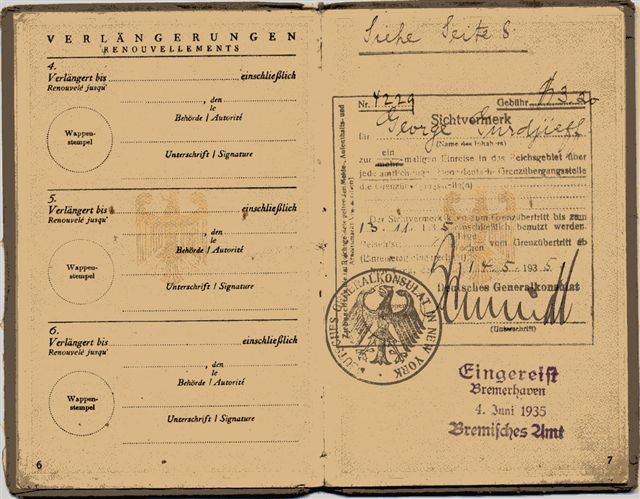
Gurdjieff arrived in Bremerhaven on 4 June 1935 and his passport was duly stamped beneath the visa.

Another page shows that a requested police report from Frankfurt had arrived by telegram at the Consular General’s on 11 May 1935. This was duly stamped by the Hamburg police when Gurdjieff was in Hamburg on 15 June 1935.
He then travelled on to Berlin where he was picked up at the Charlottenburg Bahnhoff by Louise Goepfert now married to architect Walter March. Gurdjieff stayed in a hotel, but spent time with them and ‘my dear God-given son , their new son George. Louise makes no mention of Gurdjieff in this time having made a secret trip to Central Asia.
Annabeth W. McCorkle, The Gurdjieff Years 1929-1949 Recollections of Louise March (1990), page 67

On 27 July Gurdjieff was issued with a one month Belgium visa by the Belgium Legation in Berlin. A German police stamp was issued the same day.

On 9 September in Bruxelles, Gurdjieff was given an extension of his one month Belgium visa. The extra time was possibly needed due to difficulties obtaining re-entry into France with a different passport, having left over a year earlier on a Nansen passport. Finally on 4 October the French Consul in Bruxelles issued him a French transit visa valid for a single trip with the option to stop on French territory from the date of crossing the border. A stamp at the top right shows he arrived at the Paris railway station on 5 October 1935.
If as Bennett claims he closely examined this passport he failed to mention Gurdjieff’s stay in Belgium and strangely says Gurdjieff returned to France in July when the passport shows he returned in early October.
 Gurdjieff Research