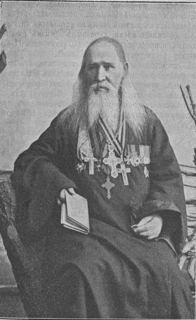
Father Damian Ambrosievich Borsh (1819 – 1899)
Photograph from Razvedchik. (Intelligence) No 317, 12 November 1896, p993
In the second chapter of his book Meetings with Remarkable Men, Gurdjieff talks about his first tutor, Dean Borsh and the extraordinary influence he had on his early life.
Damian Borsh was born in 1819 and in 1842 at the age of twenty-three became a regimental priest. The department of military clergy became a separate structure from the regular church under Czar Paul I in 1800, when regimental priests were removed from direct subordination to diocesan bishops. Before 1860 clergymen who were insufficiently prepared for pastoral service, both in education and in moral qualities joined the regiments. Bishops were always interested in keeping the best priests at home. To encourage the worthiest priests to join the ranks of the military clergy incentives were introduced. Those who had received a high-status education were entitled to free medical treatment, discounted train tickets, etc. The previous un-prestigious, position of the military clergy began to enjoy great respect in society.
As such, military priests, were of the highest standard, the most reliable, and devoted to the state, the church and the army. They were critical in maintaining the moral of the troops during war. Many of the military clergy were constantly at the front line, participating in military operations, admonishing and supporting soldiers, demonstrating heroism and courage. Their bravery is evidenced by their awards for military bravery.
In battle, the location of the regimental priest was at the forward dressing station where the wounded accumulated, needing medical care and support. Therefore, in addition to fulfilling his direct duties, the priest was required to perform the duties of medical personnel. Enormous exertion of physical and moral strength was required.
https://vestnikgum.ru/en/archive/?ELEMENT_ID=296665
At the start of the Crimean War, as a senior military priest Borsh (aged thirty-four), transferred from the 47th Ukrainian Infantry Regiment to the 45th Azov Regiment. His regiment went on the military campaign through Moldavia and Walachia to the Danube. When the Anglo-French allies landed at Crimea, he returned with his regiment to the highlands surrounding Sevastopol. There he was to experience what would have been the defining moments of his life, the siege of Sebastopol, which lasted for almost a year (1854-1855). It is estimated that 100,000 Russian soldiers were killed, wounded or died during the siege. A significant portion of the deaths were attributed to disease and the harsh conditions of the siege.
According to eyewitnesses, Father Damian, despite the mortal danger, behaved in battle with amazing composure. Now as a consoler, now as a brother of mercy, now as a spiritual father, he administered the dying, provided first aid to the wounded, and carried them out from under fire. Sometimes, when the bandages ran out, he would tear his cassock, under-cassock, shirt, so that the wounded soldier would not bleed to death. On February 4, 1855, during a battle near the Chernaya River, the shell-shocked regiment commander, Colonel Nordenstreng, fell into the water and would have drowned, but Father Damian jumped into the river after him and saved him. He himself was repeatedly wounded and shell-shocked.
https://azbyka.ru/otechnik/Istorija_Tserkvi/voennoe-duhovenstvo-rossii-georgij-poljakov/2
He fought in the Battle of Balaclava and Inkerman, in the battles near Evpatoria and on the Fedyukhiny highlands by the Chernaya. He helped repel the last storm of Sevastopol and crossed with the Sevastopol garrison to the north….
On the battlefield he gave the injured first aide notwithstanding flying bullets and artillery fire. When the regiment would return to its campsite, he would help the injured and comfort the dying. The soldiers trusted him fully when they handed him their final letters, to be sent to their families if they were to die. Such trust from the lower ranks meant that he was always inundated with requests, letters and correspondence with their families, whom he often wrote letters to himself.
The description in his service record reads:
for carrying out his duties with excellence during military action against the Turkish, English, French and Sardinian armies from 1854-55 (time and place of battle shown), where with Christian selflessness he accompanied his regiment carrying a cross in his hands and gave encouragement to his soldiers with his every deed. He never left the battlefield before battle ceased, and then he continued to bandage and administer the last sacrament to the heavily wounded and the dying.”
https://vk.com/wall-145683072_82?ysclid=m8tm7u3g9g507911200
Of the two hundred military priests who took part in the Crimean War, Damian Borsh was one of only five who were awarded the gold imperial pectoral cross on the St. George ribbon (the highest military award) from the office of His Imperial Majesty. At the recommendation of the Commander-in-Chief of the Southern Army and the land and naval forces in Crimea he was also awarded the Order of St. Anne, 3rd degree with swords. Later he was awarded skufia (1862), kamilavka (1864), the Order of St Anne of the 2nd degree (1869), Order of St. Vladimir of the 4th degree (1887) and of the 3rd degree (1891), miter (1895), and Order of St. Anne, 1st degree (1896) He was also awarded the title of Archpriest and Palitsa.
Following the Crimean War (1856) he was transferred from the Azov regiment to the position of senior priest of the Shlisselburg Jaeger Regiment and Dean of the 4th Infantry Division stationed about 30 km from St. Petersburg and then (1876) to the Vvedenskaya church at the Gunpowder factory at Shostka, in present day Ukraine. Here he was noted for creating a church choir and opening a parish school for the poor.
He then served as rector of the Sveaborg Cathedral (Helsinki) and Dean of the Finnish Military District, then rector of the St. Petersburg Admiralty Cathedral and rector of the Alexander Nevsky Church in Krasnoe Selo, (1886-1888) and Dean of the St. Petersburg and Novgorod churches of the military department.
After peace with the Ottoman Empire was concluded, following the 1877-1878 Russia Turkey War, the Commander-in-Chief of the Caucasian Army, Grand Duke Mikhail Nikolaevich, (brother of Czar Alexander II) ordered the restoration of the ancient Armenian Church of the Holy Apostles. Rather than return the building to the Armenian Apostolic Church it was transferred to the Georgian exarchate of the Russian Orthodox Church and on January 6, 1879 consecrated according to the rite of the Orthodox Church.
By the order of Czar Alexander II, the church was named the Kars Military Cathedral in the name of Archangel Michael. It was restored to its present appearance in 1886 with funds donated by the royal family and various individuals.
Dean Borsh’s appointment as Dean of the Kars Military Fortress Cathedral by order of the Supreme Sovereign Emperor is recorded in his service record. He arrived in Kars on December 6, 1888. That the emperor is mentioned may just be the protocol and style of such official announcements. However, taken with the Royal family’s funding and sponsorship of the Kars Military Cathedral’s renovation, their commissioning of a leading architect and a celebrated painter to decorate the interior suggests that Dean Borsh was personally selected by Czar Alexander III for the position. At that time, he was rector of the Alexander Nevsky Church in Krasnoe Selo, just south of Saint Petersburg, which the Emperor and his family attended when observing Military manoeuvres in the area. This would answer the question of why such a senior and highly decorated priest moved from the centre of power in Saint Petersburg to a small church at the edge of the Russian Empire.
This was the “remarkable man”, who, at age seventy, was to have such a major influence on the young Gurdjieff and his formal education.
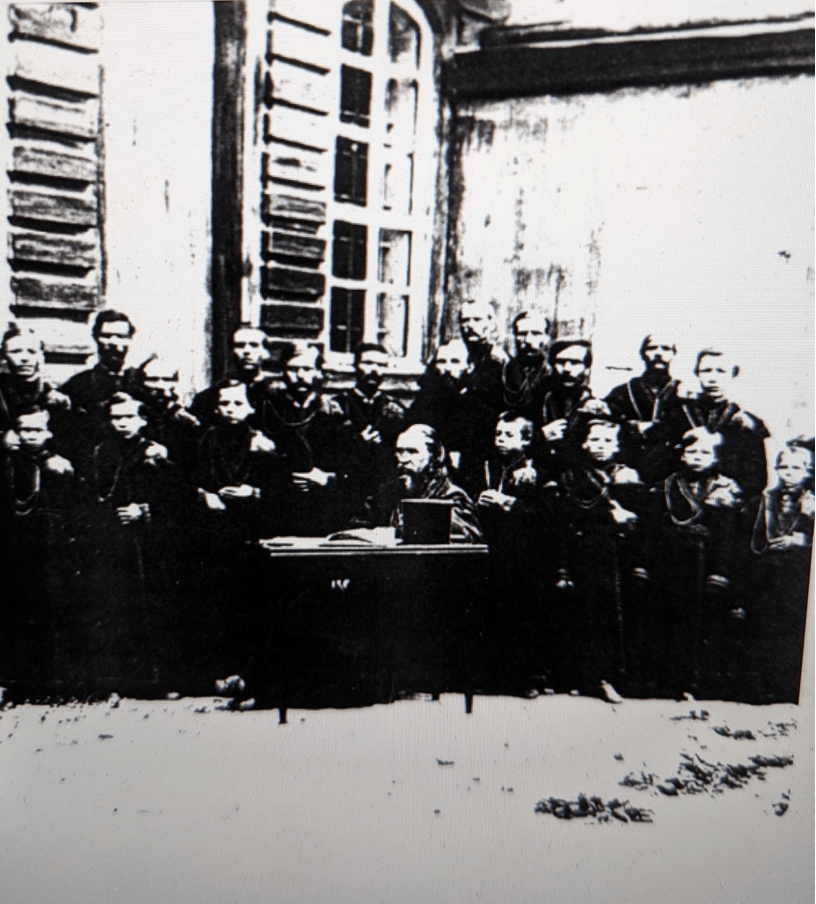
Dean Borsh, Clergy and Choristers
After his family moved to Kars in 1886, Gurdjieff’s father initially sent him to the Greek school and then to the Kars Municipal School for Boys. It was from here Gurdjieff was chosen to sing in the choir of the Kars Military Cathedral.
I did not come to the cathedral for a whole week, because of having contracted trachoma. Learning of this, the father dean himself came to our house… my father was at home when he came…. From this first meeting they took to each other, and afterwards the old dean often came to see my father in the workshop. (Meetings, page 51)
During one of the talks which took place before me in my father’s workshop, the dean began to talk about me and my studies……. Father Borsh advised my father so convincingly to take me away from school and have me taught at home, promising to give me some lessons himself. (Meetings, page 52)
After a family council this was settled. I left school and from then on Father Borsch undertook my education, teaching me some subjects himself and also providing other teachers for me.
Compared to the Kars Municipal School for Boys Gurdjieff then experienced an unrivalled, intense, full-time, three-year period of tutoring under the direction of Dean Borsh, the deacons of the Kars Military Cathedral, and a physician from the nearby military hospital. For someone of his age, social class and the educational standards of the times, he had probably the best education of any child living in Kars at that time.
Gurdjieff says of Dean Borsh
He was at that time dean of the Kars Military Cathedral and was the highest spiritual authority for the whole of that region conquered not long before by Russia. (Meetings, page 50)
The fine-looking old dean, who was interested in the new choir chiefly because the melodies of the various sacred canticles to be sung that year were of his own composition, often came to our practices; and, loving children, he was very kind to us little choristers.
Father Borsch was then seventy years old. He was tall, thin, with a fine-looking face, of delicate health but strong and firm in spirit. He was a man distinguished by the depth and breadth of his knowledge, and his life and views were quite different from those of the people round him, who in consequence considered him peculiar.
And indeed, his outer life gave grounds for such an opinion, if it were only for the fact that, although he was very well off and received a large allowance and the right to special quarters, (my emphasis) he occupied only one room and a kitchen in the guard’s house at the cathedral, whereas his assistant priests, who received much less than he, lived in quarters of from six to ten rooms with every kind of comfort.
He led a very secluded life, mixing very little with those round him and paying no visits to acquaintances. And at that time he allowed no one access to his room except myself and his orderly— who was not, however, allowed to enter it in his absence.
Conscientiously fulfilling his obligations, he gave all his spare time to science, especially to astronomy and chemistry;and sometimes, for a rest, he worked at music, playing the violin or composing sacred canticles, some of which came to be very well known in Russia. Several of these canticles, which had been composed in my presence, I happened to hear many years later on the gramophone, for example, ‘0 Thou Almighty God’, ‘Calm Light’, ‘Glory to Thee’, and others. (Meetings, pages 51,52)
Gurdjieff says that Borsh was
the founder and creator of my present individuality (Meeetings, page 34)
and highlights a crucial result of his influence
yet thanks to the circumstances that I was in my nature, since childhood, already possessed, through the deliberate inculcation of both my father and my first tutor, of certain data permitting the development in my individuality, by the time of my responsible age, among several other very original and inherent traits, of this peculiar trait of inevitable impulse and striving to understand the very essence of any object that attracted my attention out of the ordinary (Herald of the Coming Good, page 14) (my emphasis)
After leaving Kars in 1892, on the eve of his 50-year ministry, Borsh was appointed as rector of the Kiev Military Nikolaev Cathedral. Four years later he was awarded the Order of St Anne, 1st degree, the highest award for a military priest, possibly on his retirement.
It is unknown why Dean Borsh moved from his position in Kiev and came to be in Kars when he died. According to his burial record, he died of pneumonia on 26 March 1899 and was buried at the Kars Military Cathedral on the 28th March.
Gurdjieff writes
One Sunday, many years after his death, the priests and congregation of the Kars Military Cathedral were much astonished and interested when a man quite unknown in the neighbourhood requested the full funeral service to be held over a lonely and forgotten grave, the only one within the grounds of the cathedral. And they saw how this stranger with difficulty held back his tears and, having generously recompensed the priests and without looking at anyone, told the coachman to drive to the station. (Meetings, page 57)
This would have had to have been after the railway from Alexandropol to Kars was finally opened on June 21, 1899.
None of the photographs, from books and on the internet, of the site when it was the Russian Orthodox Military Cathedral show any sign of a grave or graves and since 1918 when it was turned back into a mosque by the Turks, a Christian gravestone would have been removed. I could find no sign of a grave on the site when I was there in 2014. However, I did photograph some enlarged historical photographs from Russian times mounted on the walls of a local hotel, one of which below showed a grave in the north east corner at the back. There was no date on this photograph.
The crosses mounted on plinths at the front of the Cathedral are not gravesites. Russian Orthodox style crosses mounted on plinths, primarily signify faith, religious devotion, and the victory of Christ over death. They also represent protection, with crosses traditionally erected at important locations, acting as symbols of spiritual defense against various misfortunes.
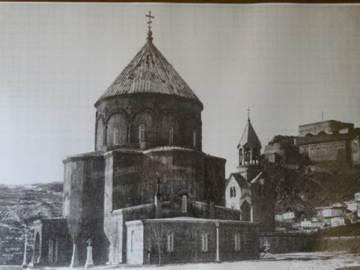
Kars Military Cathedral, Dean Borsh’s final resting place
For more details and full references see sections 3d to 3g https://www.academia.edu/129644525/G_I_GURDJIEFFS_YEAR_OF_BIRTH_1877_
 Gurdjieff Research