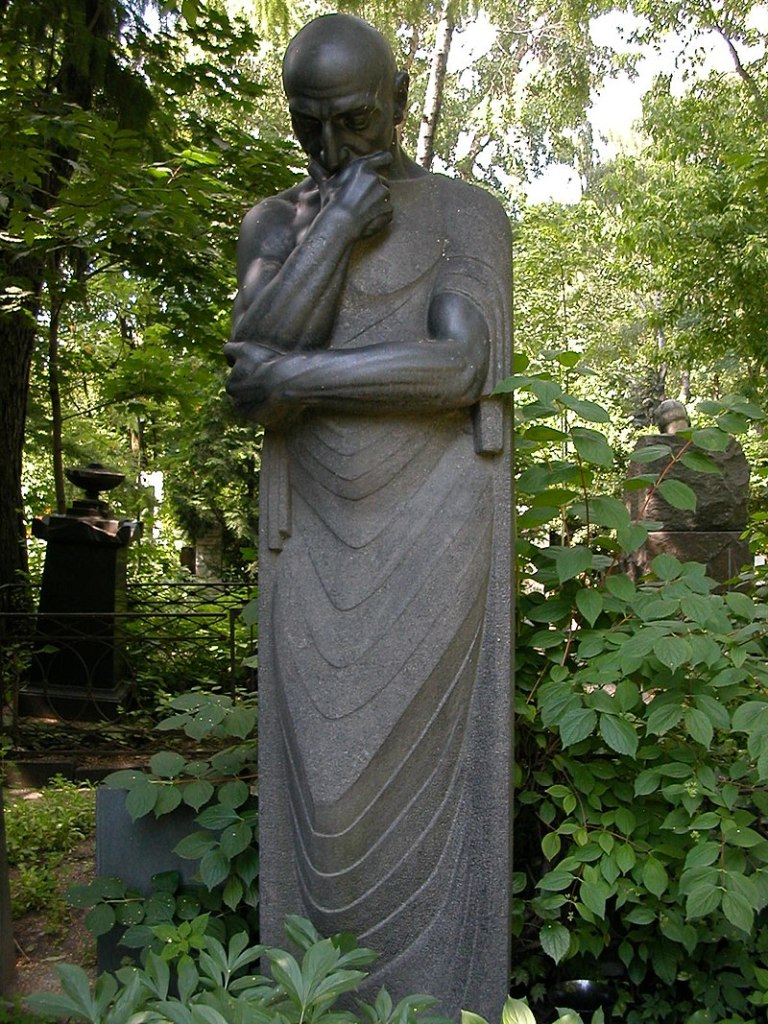
Tombstone of Sergey Merkurov, Novodevichy Cemetery, Moscow
Hiding in plain sight in Moscow for nearly a hundred years is Sergey Merkurov’s sculpture of his cousin, Gurdjieff, dressed in the robes of an eastern monk. Merkurov himself characterised his work: “I created the “Thought”. This sculpture depicts a man who tried to find his ways with his own mind to remake the world.”
Sergey Dmitrievich Merkurov (1881-1952), was one of the most famous Russian sculptors-monumentalists of the 20th century. He was born in Alexandropol (Gyumri), four years after Gurdjieff (1877-1949).
Merkurov left Alexandropol in 1896 to attend the Nakhichevan Arts and Craft College, (Gurdjieff similarly learned crafts and trades in Alexandropol) and continued on to the Tiflis (Tbilisi) real school from which he graduated in 1901. He then became a student at the Kyiv Polytechnic, and participated in political protests over workers’ strikes and demonstrations. He was caught by the Cossacks, severely beaten in police custody, and expelled from the Polytechnic .(Gurdjieff was involved in similar activities in Georgia in 1906)
In 1902 Merkurov was sent by his wealthy parents to Europe, (possibly believing he would be far away from the revolutionary influences in Russia) and continued his education at the faculty of Philosophy, University of Zurich, Switzerland. However, he still spent a lot of time in political debates, where he met Lenin and other socialists. While still studying philosophy, he became a student of the Swiss sculptor Adolf Meyer (1867-1940). Meyer was a strict teacher and insisted on a thorough understanding of all the basics. For this hard work, perseverance and patience were required, which Merkurov displayed. On Meyer’s advice he transferred to the Munich Academy of Arts, where he studied until 1905 under Professor Wilhelm von Ruhmann (1850-1905), a prominent German sculptor.
There he would study for 14-16 hours a day, (as did Gurdjieff in Kars under his first tutor Dean Borsh) attending lectures on topics such as sculpture, drawing, anatomy, and art history. He was particularly inspired by Italian artists like Donatello and Michelangelo. To see the originals, he spent many months travelling on foot to Italy, visiting Venice, Padua, Florence, Rome and other cities. (Gurdjieff also began his early travels on foot, and similarly sought to see things for himself rather than accept what he had been told or had read.)
After Ruhmann died, Merkurov moved to Paris and worked there until 1907, becoming acquainted with the sculptural works of Auguste Rodin (1840-1917) and Constantin Meunier (1831-1915). Meunier devoted most of his sculptural works to the depiction of the hard physical labour of ordinary people.
In 1906, when Rodin revealed his famous sculpture “The Thinker” Sergey Merkurov was said to be among the other participants in the ceremony.
Merkurov also achieved fame as a sculptor of Death Masks.
Kristen Anais Bayrakdarian, The Sculptor of Death Masks, EVN Report Jun 27, 2018 https://evnreport.com/arts-and-culture/the-sculptor-of-death-masks/
His first death mask was that of the Armenian Catholicos, Mkrtich Khrimian (1820-1907) when he was called in 1907 to Etchmiadzin (Vagharshapat), Armenia by the Armenian Apostolic Church for its creation. Three years later he asked permission to create the death mask of Leo Tolstoy (1828-1910). (Like Gurdjieff, he had a gift for self-promotion and an understanding of business in the real world). Tolstoy had died at Astapovo railway station after a day’s train journey south of Moscow (400km). After taking the death mask Merkurov began to work on a bust and a statue. His monumental statue of Leo Tolstoy, shows the writer tucking his hands into his belt like a peasant.
Merkurov is said to have come to Moscow in the autumn of 1910, but does not appear in the Moscow Address Books (Vsya Moskva) until 1913, where he (Merkulov) is recorded as living at his studio/workshop at 9 Tsvetnoy Boulevard. The books only give details of permanent residents. (Information supplied by Dr. Konstantin Burmistrov, Moscow, 5 June 2025). The data for the Address Books was collected in September-December of the previous year so we know he was also at this address in 1912 when Gurdjieff came to Moscow and most likely, initially stayed with him. Merkurov may have been at this address as early as 1910, before gaining permanent resident status in Moscow. The six storey house is still perfectly preserved and can be viewed at
https://maps.app.goo.gl/Qp2GVh3YeVWUK3CKA
Like Gurdjieff, Merkurov was quick to spot a commercial opportunity. In later years when he was asked how he was paid for his monumental works, some of which were the biggest in Russia and took up to twenty years to complete, he said he was paid a monthly salary by the State for as long as it took to complete the work. As he had several works in progress at the same time and each work paid a salary he was one of the highest paid artists.
November 7, 1918 – the first anniversary of the October Revolution – two new monuments created by sculptor Sergey Merkurov appeared on Tsvetnoy Boulevard: a monument to Fedor Mikhailovich Dostoevsky and the allegorical figure “Thought”.
It so happened that Sergei Merkurov finished the work on both sculptures long before their installation: the granite figure “Thought” was completed in 1913, and Dostoevsky in 1914 …….
On April 12, 1918 the famous decree of the Council of People’s Commissars “On Monuments of the Republic” appeared, which instructed to urgently eliminate “old -regime” monuments, replacing them with monuments in honour of revolutionaries and famous cultural figures. As part of its implementation in Moscow alone, it was planned to erect 67 monuments.
The commission led by Anatoly Lunacharsky, who visited the sculptor’s workshop, in addition to the statue of Dostoevsky, considered it possible to purchase two more works from the author. One of the members of the commission, Nikolai Vinogradov, later recalled these events as follows: “Since the monument to Dostoevsky was in the list of new monuments, Merkurov invited the Moscow City Council to acquire a ready -made statue from him….. During the examination of Dostoevsky’s figure, recognized as acceptable, two more figures were outlined for the acquisition: Leo Tolstoy (which is now in the Novodevichy Square) made of red granite and the figure of a thoughtful person (from black granite), which the author called the “Thought”.
They decided to install “Thought” and “Dostoevsky” in the neighbourhood of Merkurov’s studio workshop, on Tsvetnoy Boulevard: “Thought” – at the entrance to Tsvetnoy Boulevard from Trubnoye Square, and “Dostoevsky” – a little further away by the fountain. From the workshop, the three -meter high granite monuments were moved manually….. they were laid on two logs in the form of a sleigh under which rollers were placed. According to them, the “sled” with weighty logs rolled with the help of a gate. All this operation was done by three workers along with Merkurov himself. The movement of the statues attracted large crowds of spectators.
With the construction of tram tracks in the centre of the boulevard, both monuments were removed: first “Thought” in 1934, and then, in 1936-“Dostoevsky”.
The sculpture “Thought” was installed in the courtyard of the house of the Union of Soviet Writers -52 Vorovsky (now Povarskaya), Street . However, it did not stay there for long. It is said that once the writer Fedor Panferov ((1896-1960), known for his novels focused on peasant life) one of the leaders of the Writers’ Union-asked what kind of sculpture this is ? When they said to him “Thought.” he, without thinking twice, exclaimed: “What does thought have to do with it, what does it have to do with writers? Take it away!”
Sergey Ishkov, 07/07/2017, Sculptor Sergey Merkurov. Russian Rodin and his “Thought” in the Novodevichy cemetery in Moscow
https://dzen.ru/a/Xn5K2Et6uQlRbfQu?ysclid=mbkq2idqvp839227221
Even in effigy, Gurdjieff was able to offend those he labelled “contemporary writers of the bon-ton literary language“.
The sculpture returned to the workshop of Merkurov, which in 1920 had moved to a dacha at Izmailov on the outskirts of Moscow that Lenin had given him the use of as a studio. All houses, including Merkurov’s had been seized by the State after The Central Executive Committee, Abolition of Private Real Estate, Decree of August 20, 1918
Following Rodin’s example, whose will stipulated that a copy of his sculpture “The Thinker” be installed on his grave, Merkurov, in his will, asked for his sculpture “Thought” to be placed on his grave, where it has been since his death in 1956.
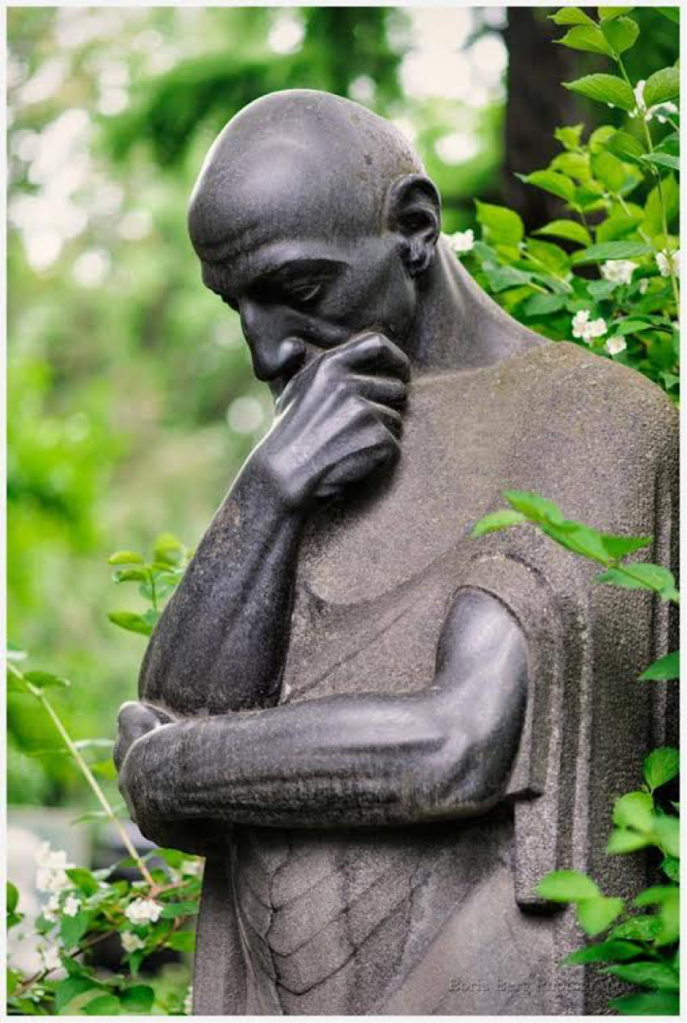
Tombstone of Sergey Merkurov, Novodevichy Cemetery, Moscow
 Gurdjieff Research